The Thinking Trail: Following Curiosity Until It Becomes Knowledge
Curiosity rarely arrives as a complete lesson. Most of the time, it begins as a small question: Why did that happen? What does this mean? How is this connected to something I already know?
That small question may not look important at first. It might appear during a quiz, while reading a paragraph, watching a short video, solving a math problem, or hearing someone explain an idea. But when learners follow that question instead of ignoring it, something powerful happens.
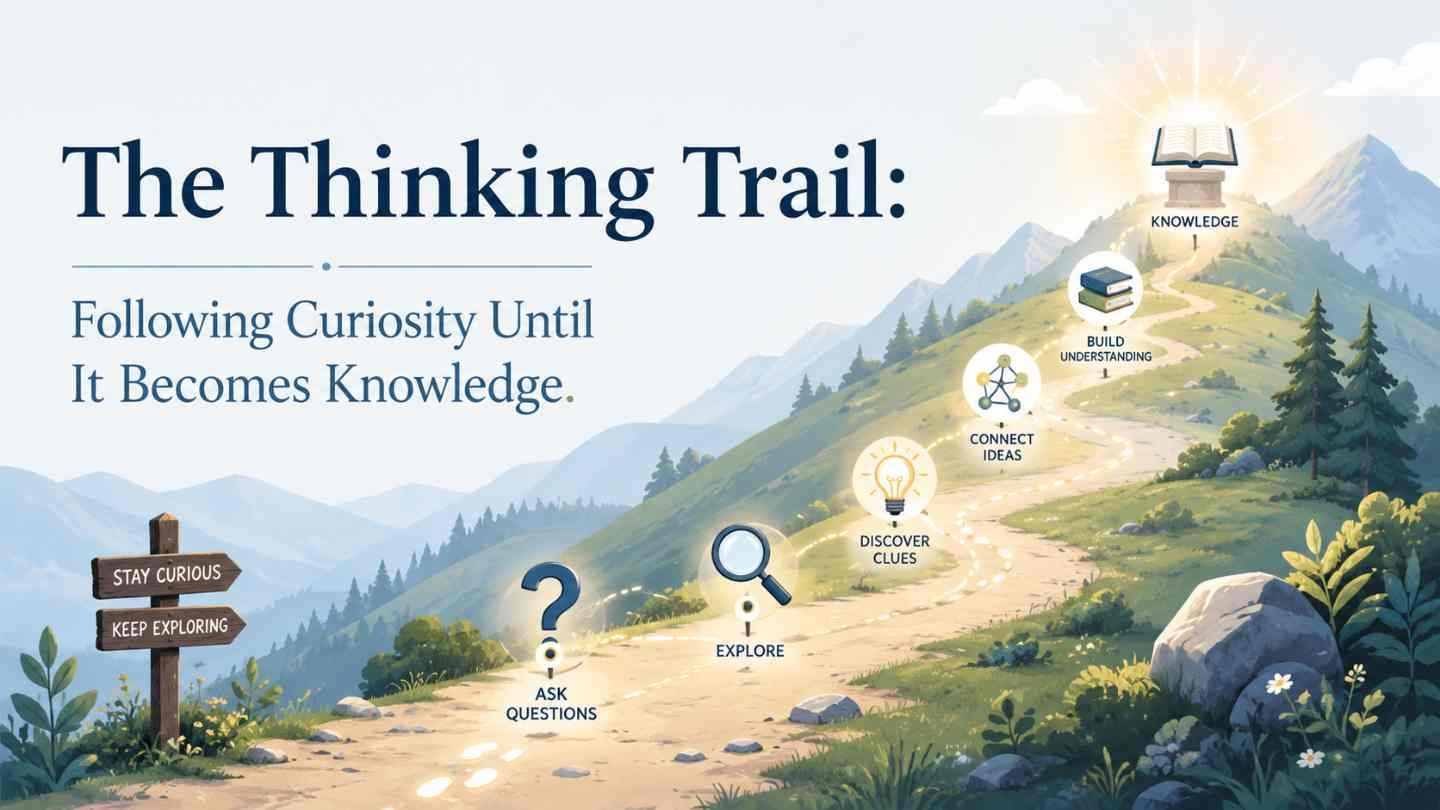
A scattered thought becomes a clue. A clue becomes a path. And step by step, that path becomes knowledge. That is the idea behind The Thinking Trail: learning by following curiosity carefully until it leads to clearer understanding.
What Is the Thinking Trail?
The Thinking Trail is a simple way to describe how curiosity moves learners from confusion to understanding. Instead of trying to memorize facts in isolation, learners follow a trail of questions, observations, tests, and connections. Each step helps them see the topic more clearly.
✨ The Thinking Trail usually looks like this:
- A learner notices something.
- Then they ask a question.
- Then they look for clues.
- Then they test an idea.
- Then they connect what they found to something bigger.
The process feels natural because it is how the mind often learns best. We do not always understand a subject all at once. We understand it by walking through it.
Why Curiosity Is a Strong Learning Guide
Curiosity gives learning direction. Without curiosity, information can feel random. A learner may read a fact, remember it for a moment, and forget it later. But when that fact answers a real question, it becomes easier to understand and recall.
For example, a student studying history might memorize that a war began in a certain year. That is useful, but it may feel dry. Curiosity asks, “What caused people to reach that point?” Now the learner is not just holding a date. They are looking for reasons, pressure points, decisions, and consequences.
💡 Curiosity changes the task
It turns information into a search for meaning. A fact becomes more than something to memorize; it becomes a doorway into a larger idea.
Step 1: Start With a Simple Question
Every thinking trail begins with a question. It does not have to be brilliant. In fact, the best learning questions are often plain and direct.
Good starting questions include:
- Why is this important?
- What changed?
- What caused this?
- How does this work?
- What is the pattern?
- What else is connected to this?
A learner taking a quiz might miss a question about a famous movie, musician, or award show. Instead of simply checking the correct answer and moving on, they could ask, “Why was that person or event so well known?” That question opens a trail into culture, media, history, and public memory.
Even a fun activity like a quiz can become a learning moment. For example, learners who enjoy pop culture topics can test your knowledge on entertainment and use missed answers as starting points for deeper discovery.
The question is the first footprint on the trail.
Step 2: Observe What Is Already There
After asking a question, the next step is to observe. Observation means paying attention before rushing to answer. Learners can look at details, examples, repeated patterns, keywords, dates, images, or clues in the material.
🔬 In Science
Observation might mean noticing how plants lean toward light or how ice melts faster on one surface than another.
➗ In Math
Observation might mean seeing that two different problems use the same structure or pattern.
📖 In Reading
Observation might mean noticing a repeated phrase, symbol, mood, or character choice.
📰 In Current Events
Observation might mean asking why several headlines seem connected across politics, weather, technology, culture, or international affairs.
A learner following current events might use a world news quiz to notice patterns and turn headlines into learning prompts.
Observation slows the mind down just enough to see what is really happening.
Step 3: Test an Idea
Curiosity is not just wondering. It also involves testing. A learner may form a small idea and then check whether it makes sense.
A learner might think:
- Maybe this math formula works because the numbers are changing at the same rate.
- Maybe this character acts that way because of something that happened earlier in the story.
- Maybe this historical event happened because several smaller problems built up over time.
- Maybe this word has a root that appears in other words I already know.
Testing an idea does not mean the learner must be right immediately. In fact, being almost right can be useful. A wrong guess can reveal what the learner misunderstood. A better explanation can then replace the weaker one.
This is how scattered thinking becomes organized thinking.
Step 4: Connect the Clues
Knowledge grows when learners connect clues. A clue by itself may seem small. But several clues together can reveal a bigger idea.
Think of a student learning about weather. At first, they may study clouds, wind, temperature, and humidity as separate facts. But once they connect those clues, they begin to understand how storms form.
Connections appear in every subject:
- In history, dates connect to causes and consequences.
- In language learning, vocabulary connects to grammar and meaning.
- In reading, character choices connect to theme.
- In science, observations connect to systems.
- In everyday life, small decisions connect to habits and results.
The Thinking Trail helps learners move from “I know a few pieces” to “I understand how the pieces fit.”
Step 5: Turn the Trail Into Knowledge
A thinking trail becomes knowledge when the learner can explain the idea clearly. That does not mean using fancy words. It means being able to say what they wondered, what they noticed, what they tested, what they learned, and how it connects to something bigger.
A strong explanation sounds like this:
- Here is what I wondered.
- Here is what I noticed.
- Here is what I tested.
- Here is what I learned.
- Here is how it connects to something bigger.
This kind of explanation proves that the learner is not only repeating information. They are making sense of it.
For example, instead of saying, “Photosynthesis is how plants make food,” a learner might explain, “Plants use sunlight, water, and carbon dioxide to make sugar, which gives them energy. That helps explain why light is so important for plant growth.”
That is knowledge with structure.
Practical Examples of the Thinking Trail
🎯 In Quizzes
A quiz question asks which country hosted a major event. The learner gets it wrong and asks, “Why was that country chosen?” That can lead to geography, politics, economics, or culture.
➗ In Math
A learner asks, “Why do I need a common denominator?” With visual models, they begin to see that fractions must refer to equal-sized parts before they can be added.
🔬 In Science
A student notices that ice melts faster on metal than on wood. That question leads to heat transfer, materials, temperature, and conductivity.
🏛️ In History
A learner reads about a revolution and asks, “What made people angry enough to act?” That opens a trail toward economics, leadership, inequality, ideas, and public pressure.
📖 In Reading
A student notices repeated images of darkness and light and asks whether they mean something. That can lead to theme, mood, symbolism, and character development.
🌅 In Everyday Life
Someone notices they focus better in the morning than at night. That simple question can lead to better study habits, time management, sleep awareness, and productivity.
How to Use the Thinking Trail in Five Minutes
You do not need a long study session to use this method. A few careful minutes can train the mind to follow curiosity instead of letting it disappear.
Try this quick exercise:
- Choose one question from something you learned today.
- Write down three clues related to it.
- Make one guess about what those clues mean.
- Check your guess using a book, lesson, video, quiz answer, or trusted explanation.
- Write one sentence explaining what you now understand better.
That is enough to begin turning curiosity into a habit.
Common Mistakes to Avoid
Asking Too Many Questions
Curiosity is helpful, but too many open tabs in the mind can create confusion. Start with one clear question.
Jumping to an Answer
The fastest answer is not always the best one. Give yourself time to observe, test, and connect clues.
Treating Mistakes as Dead Ends
A mistake can be part of the trail. It shows where understanding needs more support.
Collecting Facts Without Connections
A pile of facts is not the same as knowledge. The goal is to see how ideas work together.
Why This Method Builds Deeper Understanding
The Thinking Trail works because it keeps the learner active. Instead of passively receiving information, the learner is searching, noticing, testing, and connecting. That kind of mental effort makes learning more meaningful.
Curiosity also gives the brain a reason to care. When learners care about the question, they are more likely to remember the answer. Over time, this habit changes how a person learns. They stop seeing lessons as isolated tasks and begin seeing them as trails worth following.
🌱 The deeper shift
Learners begin to move from “What is the answer?” to “How does this idea work?” That small change can make study sessions, quizzes, reading, and everyday learning feel more connected.
FAQ About the Thinking Trail
What is the Thinking Trail?
The Thinking Trail is a learning method where curiosity guides a learner from a simple question to deeper understanding through observation, testing, and connecting ideas.
How does curiosity help learning?
Curiosity gives the learner a reason to pay attention. It makes information feel meaningful because the learner is trying to answer a real question.
Can this method work for any subject?
Yes. It can be used in math, science, history, reading, language learning, quizzes, online study, and everyday problem-solving.
What should I do if my first idea is wrong?
Use it as part of the process. A wrong idea can show what needs to be corrected, clarified, or explored more carefully.
How can I practice the Thinking Trail daily?
Start with one small question from something you read, watched, studied, or experienced. Follow it through a few clues, test your idea, and explain what you learned in one clear sentence.
Final Thoughts
Knowledge does not always begin with a big idea. Sometimes it begins with a tiny question that refuses to go away.
The Thinking Trail reminds learners to follow that question: ask, observe, test, connect, and explain. This simple process can turn scattered thoughts into useful understanding. It can make quizzes more meaningful, reading more active, school subjects more connected, and everyday life more teachable.
Curiosity is not a distraction from learning. Used well, it is the path into learning.