
What Is the Bing Science Quiz?
The Bing Science Quiz is a short science and astronomy challenge on Bing Quizzes. Each day brings a new topic from a library of 100, so one day you might be exploring the human body, the next the periodic table, and the next the planets and stars.
It is written for curious people, not specialists. You can answer most questions with what you learned at school, picked up from documentaries, or noticed in everyday life. Each question asks one clear thing, and the clock keeps the round quick.
10questions per round
4choices per question
150stime limit
5/10score to pass
Please note
Bing Quizzes is an independent website. The Bing Science Quiz is our own quiz and is not made, run or endorsed by Microsoft.
How to Play
No account, no download and no setup. Here is a round from start to finish.
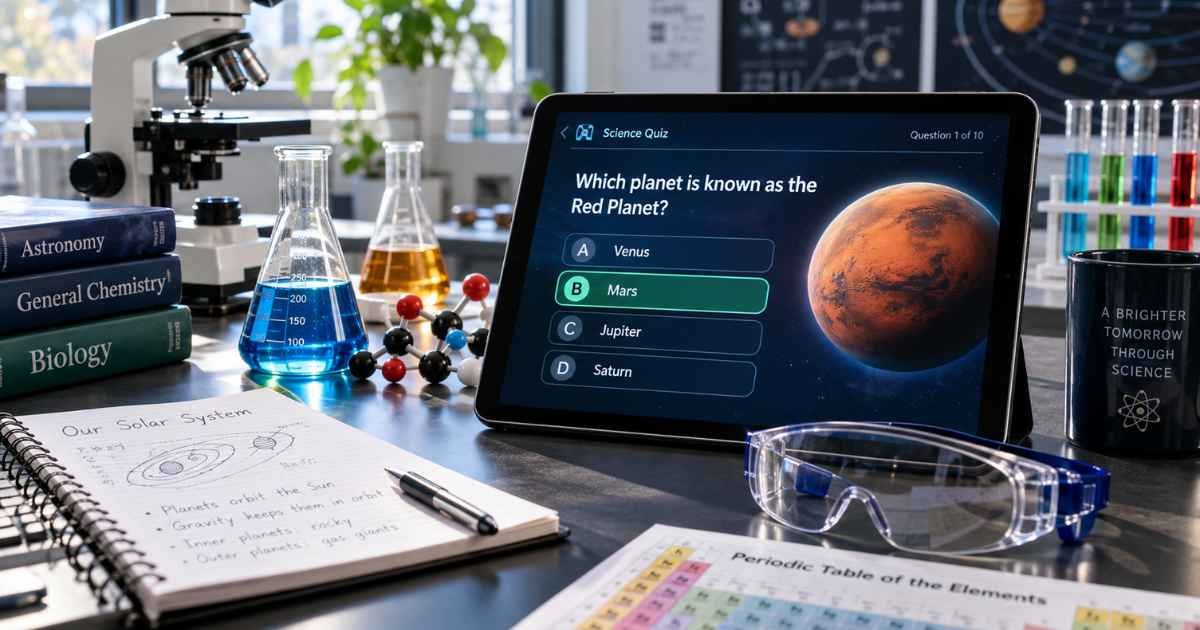
- Find the quiz. It sits at the top of this page.
- Meet today's topic. The top of the quiz shows the day's science topic with a short introduction.
- Pick your first answer. There's no Start button: the 150-second countdown begins the moment you choose your first answer.
- Pick one answer per question. Read all four choices before you decide. The 10 questions are shown on two pages of five.
- Beat the clock. If time runs out, the round ends and the answers you already gave are scored.
- See your score. Your result, rank and a full answer review appear as soon as you finish.
- Replay. Choose “Retry Today’s Science Quiz” to try again and improve your score.
How much time is that?
150 seconds for 10 questions is about 15 seconds each. That is enough to read carefully and compare the options, but not enough to look things up, so the score reflects what you actually know.
Discovery Energy and Ranks
Passing depends only on correct answers: five out of ten is a pass. Along the way, each correct answer also earns Discovery Energy, shown in the Energy box as you play.
+100for every correct answer
+10 to +50speed bonus: +50 if you answer within 5 seconds of the question appearing, +35 within 10, +20 within 15, then +10
up to +75streak bonus: +15 for each correct answer in a row after the first
Your rank is based on how many questions you got right:
0–4Science Learner
5Science Explorer
6–7Discovery Scholar
8–9Science Specialist
10Discovery Master
Try Three Sample Questions
Here is the style of question you will meet. Pick an answer before you open the explanation. Guessing first, even wrongly, helps the right answer stick.
1. Which planet has the hottest surface in our solar system?
- Mercury
- Venus
- Mars
- Jupiter
Show answer
B. Venus. Mercury is closer to the Sun, but Venus is hotter, with surface temperatures around 465°C (about 870°F). Its thick carbon dioxide atmosphere traps heat in a runaway greenhouse effect. Mercury has almost no atmosphere, so its heat escapes.
2. What is the chemical symbol for gold?
- Ag
- Gd
- Au
- Go
Show answer
C. Au. It comes from aurum, the Latin word for gold. The tempting wrong answer, Ag, is silver, from the Latin argentum. Gd is gadolinium, and "Go" isn't a real symbol.
3. Roughly how long does sunlight take to reach Earth?
- 8 seconds
- 8 minutes
- 8 hours
- 8 days
Show answer
B. About 8 minutes. Light travels at about 300,000 km per second, and the Sun is about 150 million km away, which works out to roughly 8 minutes and 20 seconds. So when you look at the Sun (never directly!), you see it as it was about eight minutes ago.
Question 1 shows a common quiz trick: the "obvious" answer (the closest planet) is wrong for a reason worth understanding. Those are the questions you remember longest.
What the Quiz Covers, With Handy Facts
Questions are drawn from five main areas. Here are a few anchor facts from each that come up again and again in science trivia.
BiologyLiving things
- The cell is the basic unit of life.
- An adult human skeleton has 206 bones.
- DNA's double-helix structure was described in 1953, building on Rosalind Franklin's X-ray images.
ChemistryMatter and elements
- 118 elements are officially recognized.
- Hydrogen is the most abundant element in the universe.
- Water is H₂O: two hydrogen atoms, one oxygen.
PhysicsForces and energy
- Light travels about 300,000 km per second in a vacuum.
- Sound cannot travel through the vacuum of space.
- Newton's three laws describe how objects move.
Earth scienceOur planet
- Earth is about 4.5 billion years old.
- Air is about 78% nitrogen and 21% oxygen.
- Moving tectonic plates cause most earthquakes.
AstronomySpace
- There are eight planets; Pluto was reclassified as a dwarf planet in 2006.
- Jupiter is the largest planet.
- The Sun holds about 99.8% of the solar system's mass.
BonusScience history
- Marie Curie was the first person to win Nobel Prizes in two sciences.
- Apollo 11 landed on the Moon in 1969.
- Alexander Fleming discovered penicillin in 1928.
Everyday Science, Explained
Some of the best quiz questions start with something you have noticed but never thought about. Three favorites:
Why does metal feel colder than wood at the same temperature?
Both are actually the same temperature. Metal conducts heat much faster than wood, so it pulls warmth out of your hand quickly. Your skin senses that heat loss as "cold."
Why can we sometimes see the Moon during the day?
The Moon is above the horizon for about half of each day, and its rising time shifts by roughly 50 minutes daily. On many days, part of that time falls in daylight. It is bright enough to see because it reflects sunlight, just as it does at night.
How do vaccines train the immune system?
A vaccine shows the immune system a harmless version or piece of a germ, or instructions for making one of its proteins. The body responds by making antibodies and memory cells, so it can recognize and fight the real germ faster if it ever meets it.
Science Myths That Catch People Out
Quiz writers love these, because the answer most people "know" is wrong.
MythWe only use 10% of our brains.
Brain scans show activity across virtually the whole brain, even during sleep. Different areas simply do different jobs.
MythSeasons happen because Earth gets closer to the Sun.
Seasons come from Earth's tilted axis. In fact, Earth is closest to the Sun in early January, during winter in the Northern Hemisphere.
MythLightning never strikes the same place twice.
Tall structures are struck repeatedly. New York's Empire State Building is hit around 20 times a year.
MythBlood is blue until it meets oxygen.
Blood is always red, dark red when low in oxygen. Veins only look blue because of how light passes through skin.
MythGoldfish have a three-second memory.
Experiments show goldfish can be trained to respond to sounds and signals and remember them for months.
MythGlass is a slow-flowing liquid.
Old windows are thicker at the bottom because of how the glass was made, not because it flowed. Glass is an amorphous solid.
Tips for a Better Score
A higher score comes from careful reading and a few smart habits, not from memorizing a textbook.
Watch the small words
"Not," "mainly," "closest," "first" and "best" can flip the meaning of a science question. Read to the end before choosing.
Rule out the impossible
Even if you don't know the answer, you can often spot options that break basic science, like sound traveling through space. Removing them improves your odds.
Be suspicious of the obvious
As the Venus question shows, the answer that seems too easy is sometimes a trap. Ask yourself why a question might be interesting.
Keep moving
With about 15 seconds per question, spending a minute on one hard item can cost you several easy ones. Make your best guess and move on.
Look up what you missed
Memory research shows that trying to recall an answer and then checking it builds stronger memories than rereading. A quick follow-up on a missed question pays off next time.
How our questions are made
Every question is written by our team and checked against a reliable source, such as NASA, a national science agency or an established encyclopedia, before it goes live. When scientific understanding or accepted figures change, we update the question. If you spot an error, please tell us through our contact page.
Frequently Asked Questions
How many questions are in each round?
Each round has 10 multiple-choice questions, each with four possible answers.
How long do I have?
You have 150 seconds, or two and a half minutes, for all 10 questions. If time runs out, the answers you gave are scored.
What score do I need to pass?
Five correct answers out of 10 counts as a pass.
Do I need an account?
No. You can play straight away in any web browser, with no sign-up.
Can I play more than once?
Yes. Replaying is a good way to review what you missed and improve your score. Each time you retry, the question order and answer positions are shuffled.
Is this quiz made by Microsoft?
No. Bing Quizzes is an independent website, and the Bing Science Quiz is our own quiz. It is not affiliated with or endorsed by Microsoft.
Can the quiz replace science lessons?
No. It works best as a quick review or a spark for curiosity. Textbooks, teachers and hands-on experiments are still the way to learn science in depth.
Ready for Your Round?
Ten questions, four choices, 150 seconds. Whatever your score, you will probably finish knowing one thing you didn't know before, and wanting to find out more.
Prefer a mix of subjects? Try Today's Bing Quiz for daily general knowledge.
Play the Bing Science QuizSources and Further Reading
- NASA Science, "Venus": science.nasa.gov/venus
- NASA Space Place, "What Causes the Seasons?": spaceplace.nasa.gov/seasons
- U.S. National Weather Service, "Lightning Myths": weather.gov/safety/lightning-myths
- IUPAC, "Periodic Table of Elements": iupac.org
- Roediger, H. L., & Karpicke, J. D. (2006). Test-enhanced learning: Taking memory tests improves long-term retention. Psychological Science, 17(3), 249–255. doi.org/10.1111/j.1467-9280.2006.01693.x
Bing Quizzes is an independent website and is not affiliated with, sponsored by or endorsed by Microsoft. Bing is a trademark of Microsoft Corporation.