
What Is the Bing Geography Quiz?
The Bing Geography Quiz is a short world-geography challenge on Bing Quizzes. Each day brings one new geography topic, picked from a library of 100, such as the Pacific Ring of Fire, the Nile River Basin, Lake Baikal or the Panama Canal. You answer 10 questions about that topic within two and a half minutes.
You never have to type a tricky place name. Every question gives you four choices, so the quiz works just as well on a phone as on a computer. The goal is simple: show what you know, find out what you don't, and come away with a slightly sharper picture of the world map.
10questions per round
4choices per question
150stime limit
5/10score to pass
Please note
Bing Quizzes is an independent website. The Bing Geography Quiz is our own quiz and is not made, run or endorsed by Microsoft.
How to Play
No account and no setup. Here is a round from start to finish.
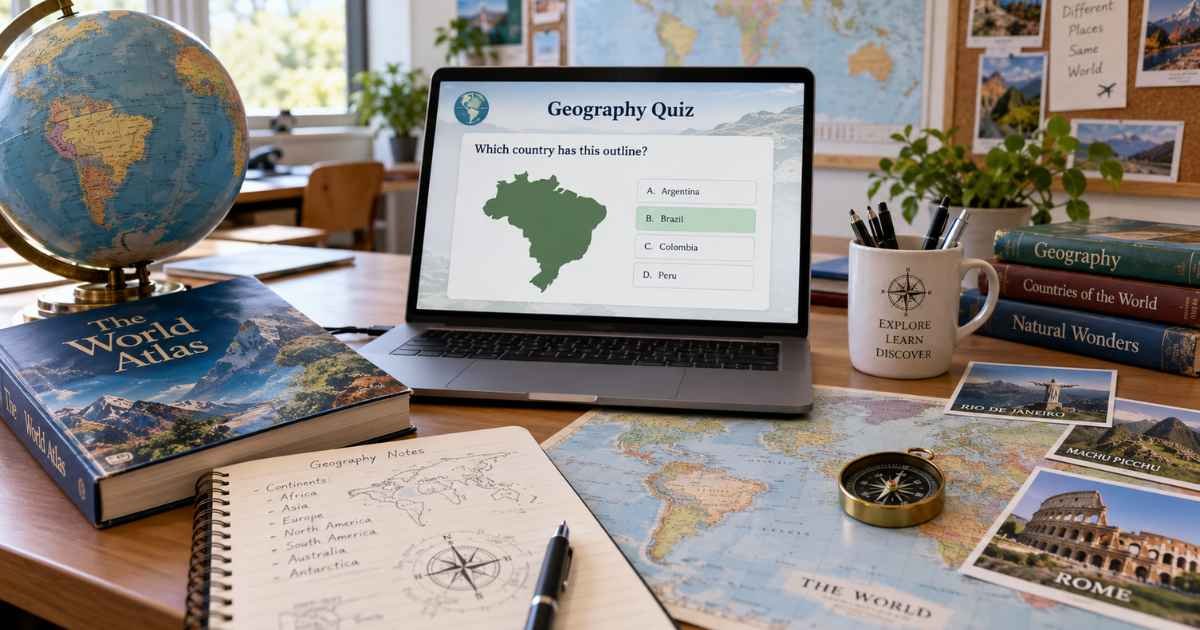
- Open the quiz. Go to today's Bing Geography Quiz.
- Check today's topic. The top of the board shows the date, the day's geography topic and a short description of what it covers.
- Pick one answer per question. Compare all four choices before you decide. The 150-second countdown starts the moment you choose your first answer.
- Read the explanation. After each answer you see the correct choice, a short explanation and the Atlas Miles you earned. Questions 1–5 are on the first page and 6–10 on the second.
- Beat the clock. If time runs out, only the answers you already gave are scored.
- See your score. Your result, rank and a full answer review appear as soon as you finish.
- Replay to improve. Press “Explore This Quiz Again” for another go. It is a good way to lock in places you missed.
How much time is that?
150 seconds for 10 questions is about 15 seconds each. That is enough to read carefully but not enough to search a map, so your score reflects what you actually know.
Try Three Sample Questions
Here is the style of question you will meet. Choose an answer before you open the explanation. Guessing first, even wrongly, helps the right answer stick.
1. What is the capital of Australia?
- Sydney
- Melbourne
- Canberra
- Perth
Show answer
C. Canberra. Sydney and Melbourne both wanted the title, so Australia built a new capital between them as a compromise. Parliament moved there in 1927. Sydney, the largest city, is the most common wrong answer.
2. Which is the largest ocean on Earth?
- Atlantic
- Indian
- Pacific
- Arctic
Show answer
C. The Pacific. It covers about a third of Earth's surface, more than all the land on the planet combined. The Atlantic is second, about half the Pacific's size.
3. Which African country has the largest population?
- Egypt
- Ethiopia
- Nigeria
- South Africa
Show answer
C. Nigeria. With well over 200 million people, it is Africa's most populous country by a wide margin. Ethiopia is second and Egypt third. South Africa, often guessed because of its large economy, ranks well below them.
Notice the pattern in all three: the tempting wrong answer is the biggest or best-known name. Geography quizzes love that trap.
Capitals That Aren't the Biggest City
This is the single most common way people lose points. In each country below, the largest city is not the capital.
| Country | Capital | Common wrong guess |
|---|---|---|
| Australia | Canberra | Sydney |
| Canada | Ottawa | Toronto |
| Brazil | Brasília | São Paulo or Rio de Janeiro |
| Turkey (Türkiye) | Ankara | Istanbul |
| United States | Washington, D.C. | New York City |
| Nigeria | Abuja | Lagos |
| New Zealand | Wellington | Auckland |
| Morocco | Rabat | Casablanca |
| Kazakhstan | Astana | Almaty (the capital until 1997) |
Bonus: countries with more than one capital
South Africa splits its government across three cities: Pretoria (executive), Cape Town (legislative) and Bloemfontein (judicial). Bolivia's constitutional capital is Sucre, while the government sits in La Paz.
Country Names That Have Changed
Maps and memories fall out of date. These official name changes regularly catch people out.
TürkiyeTurkey · UN spelling adopted in 2022
EswatiniSwaziland · renamed in 2018
North MacedoniaMacedonia · renamed in 2019
CzechiaOfficial short name of the Czech Republic since 2016
MyanmarBurma · renamed in 1989
The NetherlandsThe government stopped using "Holland" as its official brand in 2020
Geography Myths and Surprising Facts
Some of the best quiz questions are built on things most people believe but aren't quite true.
✗ MythGreenland is about as big as Africa.
It only looks that way on common Mercator maps, which stretch land near the poles. Africa is about 14 times larger.
✗ MythThe Sahara is the world's largest desert.
A desert is defined by low rainfall, not heat. By that measure, Antarctica is the largest. The Sahara is the largest hot desert.
≈ It dependsMount Everest is the world's tallest mountain.
It is the highest above sea level, at 8,849 m. Measured from base to peak, Hawaii's Mauna Kea is taller, though most of it lies under the ocean.
≈ It dependsThe Nile is the world's longest river.
Most references say so, but some measurements put the Amazon slightly ahead. The answer depends on where you decide each river begins.
✓ FactIstanbul sits on two continents.
The Bosporus strait runs through the city, dividing its European side from its Asian side.
✓ FactRussia spans 11 time zones.
It is by far the largest country by area, stretching from Eastern Europe to the Pacific coast.
Tips for a Better Score
Better results come from careful reading and smart elimination, not from rushing.
Read every word
Country or capital? River or lake? Largest by area or by population? One word can change the right answer completely.
Beware the famous name
As the capitals table shows, the best-known city is often the wrong answer. Pause before picking the obvious one.
Rule out the wrong continent
Even if you don't know the answer, you can often spot an option on the wrong continent or a city posing as a country.
Keep moving
With about 15 seconds per question, don't let one hard item cost you three easy ones. Make your best guess and continue.
Find your misses on a map
After the quiz, look up one or two places you got wrong and note their neighbors and nearby water. A visual memory lasts far longer than a name alone.
Come back after a gap
Memory research shows that recalling something after a delay strengthens it more than instant repetition. Replaying a day later is a better test than replaying immediately.
Atlas Miles and Ranks
Your pass mark depends only on correct answers, but every right answer also earns Atlas Miles, a bonus score that rewards quick and steady play.
100
Atlas Miles for every correct answer. A wrong answer earns nothing.
+10 to +50
Speed bonus, based on how fast you answer after the question appears: within 5 seconds +50, within 10 +35, within 15 +20, slower +10.
up to +75
Streak bonus: +15 for each correct answer in a row after the first, capped at +75. A wrong answer resets the streak.
A perfect round answered quickly tops out at 2,025 Atlas Miles. Your final screen also shows your best streak and one of five ranks:
10Master Cartographer
8–9World Navigator
6–7Atlas Scholar
5Atlas Explorer
0–4Geography Traveler
What to Do With Your Score
A score is a starting point. Someone who scores 6 and looks up four missed answers often learns more than someone who scores 9 and moves on.
0–4
Pick two missed places and find them on a map. Don't try to memorize the whole round.
5–7
A solid base. Notice which type of question, such as capitals or physical features, cost you the most.
8–9
Look closely at the one or two facts that stood between you and a perfect score.
10
Try explaining why each answer is right, not just recognizing it.
How our questions are made
Every question is written by our team and checked against reliable references, such as United Nations country lists and established encyclopedias. Country names, capitals and borders do change, and some are disputed or recognized differently by different governments. We avoid disputed cases and update questions when official information changes. If you spot an error, please tell us through our contact page.
Frequently Asked Questions
How many questions are in each round?
Each round has 10 multiple-choice questions, each with four possible answers.
How long do I have?
You have 150 seconds, or two and a half minutes, for all 10 questions. The timer starts with your first answer. If time runs out, only the answers you gave are scored.
What score do I need to pass?
Five correct answers out of 10 counts as a pass.
Does the topic change every day?
Yes. A new geography topic appears each day, following the Philippine calendar date (Asia/Manila time), and the quiz rotates through 100 topics.
Do I need an account?
No. You can play straight away in any web browser, with no registration.
Can I play more than once?
Yes. Replaying is a good way to review missed facts and improve your score. Each replay shuffles the question order and the answer choices.
Is the quiz good for beginners?
Yes. The four-choice format and a pass mark of 5 out of 10 make it approachable, although some questions are harder than others.
Is this quiz made by Microsoft?
No. Bing Quizzes is an independent website, and the Bing Geography Quiz is our own quiz. It is not affiliated with or endorsed by Microsoft.
Ready to Test Your Map Skills?
Ten questions, four choices, 150 seconds. Play a round, look up one place you missed, and come back tomorrow to see what stuck.
Want a mix of subjects too? Try Today's Bing Quiz for daily general knowledge.
Play the Bing Geography Quiz →Sources and Further Reading
- United Nations, "Member States": un.org
- Encyclopaedia Britannica, "Canberra": britannica.com
- Encyclopaedia Britannica, "Mount Everest": britannica.com
- Roediger, H. L., & Karpicke, J. D. (2006). Test-enhanced learning: Taking memory tests improves long-term retention. Psychological Science, 17(3), 249–255. doi.org/10.1111/j.1467-9280.2006.01693.x
This quiz is for general education and entertainment. Place names, borders and capitals can change and may be shown differently by different authorities. Bing Quizzes is an independent website and is not affiliated with, sponsored by or endorsed by Microsoft, schools, exam boards or government agencies. Bing is a trademark of Microsoft Corporation.