
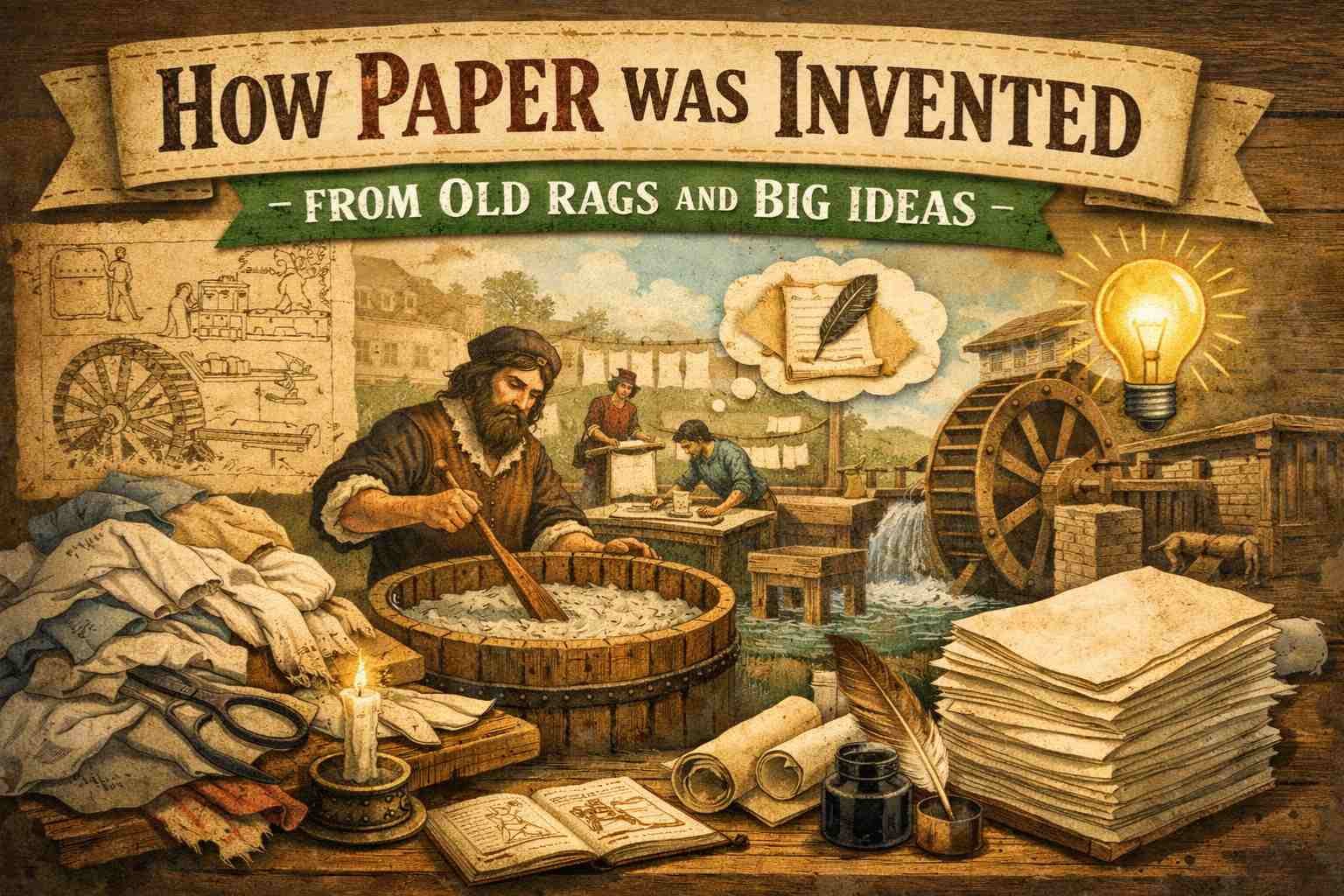
How Paper Was Invented from Old Rags and Big Ideas
A sheet of paper looks almost too ordinary to have changed civilization. Yet this thin web of interlocked plant fibers made records lighter, books more affordable, administration more efficient and ideas easier to copy across distance and time.
The history behind it is more interesting than the familiar story of one inventor working alone. Papermaking emerged from experimentation in ancient China, was improved and promoted at the Han imperial court, adapted by craftspeople across Asia and the Islamic world, and transformed again in medieval Europe and the industrial age. Its development was not a single flash of inspiration but a long chain of material knowledge.
That chain began with a deceptively simple insight: fibers dispersed in water can settle into a thin mat, bond as they dry and become a flexible surface strong enough to carry ink.
What Makes Paper Different From Other Writing Surfaces?
Before paper became widespread, societies recorded information on many materials. Mesopotamian scribes impressed signs into clay tablets. Egyptians wrote on papyrus. Mediterranean and West Asian communities used parchment made from prepared animal skin. In ancient China, texts were commonly written on wooden or bamboo slips, while silk served as a lighter but costly alternative.
Paper is technically different from all of them. It is made by separating plant-based fibers, suspending them in water, collecting them as a thin layer and drying that layer into a sheet. The fibers overlap and bond into a felt-like structure.
Papyrus is not simply an early form of paper. Papyrus sheets are made by arranging and pressing strips cut from the papyrus plant. True paper is formed from loose, pulped fibers that have been dispersed in water and reassembled into a new sheet.
Paper Existed Before Cai Lun’s Famous Report
Cai Lun, an Eastern Han court official, is traditionally celebrated as the inventor of paper in 105 CE. That date remains important because a later Chinese historical account records that he presented an improved method to the imperial court using materials such as tree bark, hemp waste, old cloth and worn fishing nets.
Archaeological evidence, however, shows that paper-like sheets were already being produced in China well before 105 CE. Surviving fragments associated with the Western Han period have been dated to roughly the second century BCE. Some early examples were coarse and may not all have been intended for formal writing, but they demonstrate that papermaking developed before Cai Lun’s court presentation.
For that reason, historians increasingly describe Cai Lun as a major innovator, organizer and promoter of papermaking rather than a lone inventor who created it from nothing. His importance is still enormous. Standardizing useful raw materials and bringing the process to imperial attention could have helped turn an experimental craft into a more practical and widely supported technology.
How Early Papermaking Worked
Methods varied by place and period, but the central principle has remained remarkably consistent for nearly two millennia. Plant fibers must be separated, dispersed in water, formed into a layer and dried.
Preparing the fiber
Bark fibers, hemp remnants, textile rags or old nets were cleaned and cut. Some materials required soaking, fermenting or cooking to soften them.
Beating into pulp
The softened material was pounded until the fibers separated. The goal was not to dissolve them, but to free and spread them.
Forming the sheet
The pulp was mixed with water. A screen-like mould lifted a thin, even layer of fibers while excess water drained away.
Pressing and drying
The wet sheet was transferred, pressed or smoothed, then dried. Sizing and polishing could later improve strength and ink control.
The original description is often framed as an early recycling story, and there is truth in that idea: worn textiles and fishing nets could become valuable raw material. But early Chinese paper was not made only from discarded rags. Hemp and bast fibers from the inner bark of plants such as paper mulberry were also important, and different regions developed their own preferred fiber recipes.
Why Paper Was So Useful in China
Paper did not replace every older writing material overnight. New technologies rarely spread that neatly. Bamboo and wooden slips continued to be used, and silk retained cultural value. Paper’s advantages nevertheless became difficult to ignore.
Compared with bundles of bamboo slips, paper was lighter and easier to store. Compared with silk, it could be produced from less costly materials. It accepted brush writing, could be folded or joined, and eventually worked well with woodblock printing. These qualities supported government records, letters, literature, religious texts, calligraphy and painting.
Paper also became part of a broader East Asian information system. China developed sophisticated traditions of ink, brushwork, bookmaking and printing. The world’s oldest surviving dated printed book, the Diamond Sutra of 868 CE, belongs to a culture in which paper and woodblock printing had already become deeply connected.
From East Asia to Central Asia and the Islamic World
Papermaking moved through travel, migration, diplomacy, religion, commerce and conquest. Knowledge of the craft reached Korea and Japan, where artisans adapted fibers and techniques to local plants and artistic traditions. It also moved westward through Central Asia, a region linked by overlapping trade and manuscript networks rather than by one simple route.
A popular story says that Chinese papermakers captured after the Battle of Talas in 751 revealed the craft to their captors. The battle may have played a role in later memories of technological transfer, but historians caution against treating it as the single moment when papermaking suddenly entered the Islamic world. Paper and papermaking knowledge were already moving through Central Asia, and the surviving evidence does not support an overly tidy “one battle, one secret” explanation.
By the late eighth and ninth centuries, paper production was established in major centers of the Abbasid world. Papermakers used materials available to them, especially linen and hemp rags, and refined methods for sizing and polishing sheets. Paper became valuable for government administration, commerce, scholarship and book production.
This was not passive transmission. Craftspeople in Islamic societies expanded the industry, developed regional paper types and helped create the conditions for a flourishing written culture stretching from Central Asia and the Middle East to North Africa and Iberia.
Paper Reached Europe Before Gutenberg
Another common misconception is that paper arrived in Europe only in the fifteenth century. In reality, paper was used and produced in parts of Europe centuries earlier. Manufacturing was present in Islamic Iberia by the medieval period, and paper circulated through Mediterranean trade. Italian papermaking centers grew during the thirteenth century.
Fabriano, in central Italy, became especially influential. Its papermakers used water-powered stampers to process rag fibers, applied animal-gelatin sizing to create a stronger writing and printing surface, and developed watermarks that identified a mill, maker or paper type. Surviving Fabriano watermarks date from the late thirteenth century.
Parchment did not immediately disappear. It remained desirable for ceremonial, legal and luxury manuscripts because of its durability and prestige. Paper instead expanded alongside it, gradually becoming the practical choice for many commercial records, letters, drafts and books.
When movable-type printing spread through Europe in the mid-fifteenth century, paper was already available. Printing dramatically increased demand, but paper was not merely a by-product of the printing revolution. It was one of the material foundations that made large-scale printing economically possible.
A Compact Timeline of Papermaking
BCE
Archaeological fragments show that fiber-based sheets existed before Cai Lun’s lifetime.
CE
The traditional account credits him with reporting an improved process using bark, hemp waste, rags and fishing nets.
centuries
Papermaking traditions spread through Korea, Japan and Central Asian networks.
centuries
Paper production developed in cities connected to Abbasid administration, trade and scholarship.
centuries
Production appeared in Iberia and Italy; Fabriano became a major center of technical innovation.
century
European movable-type printing turned paper into a crucial material for mass-produced books and pamphlets.
century
Mechanization and new fiber sources reduced costs and supported newspapers, packaging and mass literacy.
The Industrial Transformation of Paper
For centuries, European mills depended heavily on linen and cotton rags. As literacy, government paperwork, publishing and commerce expanded, demand began to strain the rag supply. Industrial inventors therefore pursued faster machines and more abundant fibers.
In 1798, French inventor Nicolas-Louis Robert patented a machine designed to produce a continuous web of paper rather than one handmade sheet at a time. The technology was further developed in Britain with financial support from Henry and Sealy Fourdrinier, whose name became attached to the continuous papermaking machine.
During the nineteenth century, mechanical and chemical methods made wood a major source of pulp. Paper became cheaper and more plentiful, helping fuel the growth of newspapers, schoolbooks, advertising, offices and consumer packaging. The change also introduced new preservation problems: many mass-produced papers contained acidic compounds or unstable wood components that caused pages to yellow and become brittle over time.
Paper Became More Than a Writing Surface
Paper’s influence cannot be measured only by the number of books it carried. Its flexibility, absorbency, printability and relatively low weight allowed it to serve countless purposes.
Artists used it for drawing, watercolor, printmaking, collage and sculpture. Governments turned specialized paper into banknotes, certificates, stamps and identity documents. Scientists relied on it for maps, field notes, diagrams and filters. Manufacturers developed paperboard, corrugated boxes, tissue, labels, insulation and engineered fiber products.
Each use demanded a different balance of strength, smoothness, thickness, porosity, brightness and resistance to water or grease. In other words, “paper” is not one material but a broad family of fiber-based materials designed for different jobs.
How Modern Paper Is Made
Modern mills operate at a scale ancient papermakers could scarcely imagine, yet the underlying sequence remains familiar. Fibers are separated, mixed with water, formed into a sheet, pressed and dried.
Today’s pulp may come from responsibly sourced wood, recovered paper, agricultural residues or nonwood plants. Mechanical pulping separates fibers mainly through grinding or refining and retains much of the wood’s lignin. Chemical pulping removes more lignin and generally produces stronger, more durable fibers. Recycled paper is sorted, repulped and cleaned; some grades are deinked before reuse.
The diluted pulp travels onto a moving mesh where water drains away. Press rollers remove additional moisture, heated cylinders dry the sheet, and finishing equipment may smooth, coat, cut or wind it. Different additives control properties such as opacity, color, absorbency and print performance.
Paper, Recycling and Environmental Responsibility
Paper is made from renewable biological material, but that does not make every paper product automatically sustainable. Its environmental footprint depends on forest management, energy sources, water use, chemicals, transportation, product design, recovery systems and what happens after use.
Recycling reduces demand for some virgin fiber and keeps useful material in circulation. It also has physical limits. Each trip through repulping and cleaning shortens and weakens cellulose fibers. After several cycles, many fibers become too short to form a strong new sheet, so paper systems continue to require an input of fresh fiber.
Coatings, plastic laminates, food contamination, adhesives and metallic decorations can also make certain products difficult or impossible to recycle in a local program. The practical approach is to reduce unnecessary use, reuse items when sensible, choose appropriately certified or recycled-content products, and follow local collection rules rather than assuming every paper-like object belongs in the recycling bin.
Four Myths Worth Retiring
Better understanding: Paper existed earlier. Cai Lun is remembered for improving, documenting and promoting a practical process at the Han court.
Better understanding: Papyrus is assembled from pressed plant strips; paper is formed from dispersed fibers that bond into a new sheet.
Better understanding: The famous story is likely an oversimplification of a longer transfer through Central Asian trade, migration and craft networks.
Better understanding: European papermaking existed centuries before Gutenberg. Printing expanded demand for an industry already in place.
Why the History of Paper Still Matters
Paper demonstrates how world-changing technologies often emerge: not from one isolated genius, but from generations of experimentation, adaptation and exchange. Chinese craftspeople learned how to form useful sheets from plant fibers. Cai Lun’s name became associated with refinement and imperial promotion. Central Asian, Islamic and European papermakers altered materials and machinery to suit new environments. Industrial engineers then transformed a hand process into continuous production.
The result was more than a convenient writing surface. Paper became infrastructure for memory—carrying laws, prayers, equations, maps, poems, sketches, contracts and ordinary messages that would otherwise have disappeared.
Curious about the inventions, civilizations and turning points that shaped the modern world? Explore more educational challenges and historical trivia.
Explore Bing QuizzesSources and Further Reading
- Robert C. Williams Museum of Papermaking, Georgia Tech, “Early Papermaking.”
- Smithsonian National Museum of Asian Art, Timeline of Chinese History, Art, and Culture.
- Maya Shatzmiller, “The Adoption of Paper in the Middle East, 700–1300 AD.”
- Library of Congress, “Printed on Fabriano Paper: History and Use of Fabriano Handmade Paper.”
- Japan Technical Association of the Pulp and Paper Industry, “The History of Paper Machine Development.”
- United States Environmental Protection Agency, “Paper Making and Recycling.”
Educational article prepared with attention to current historical scholarship. Dates for early technologies are approximate because archaeological interpretation continues to develop.