
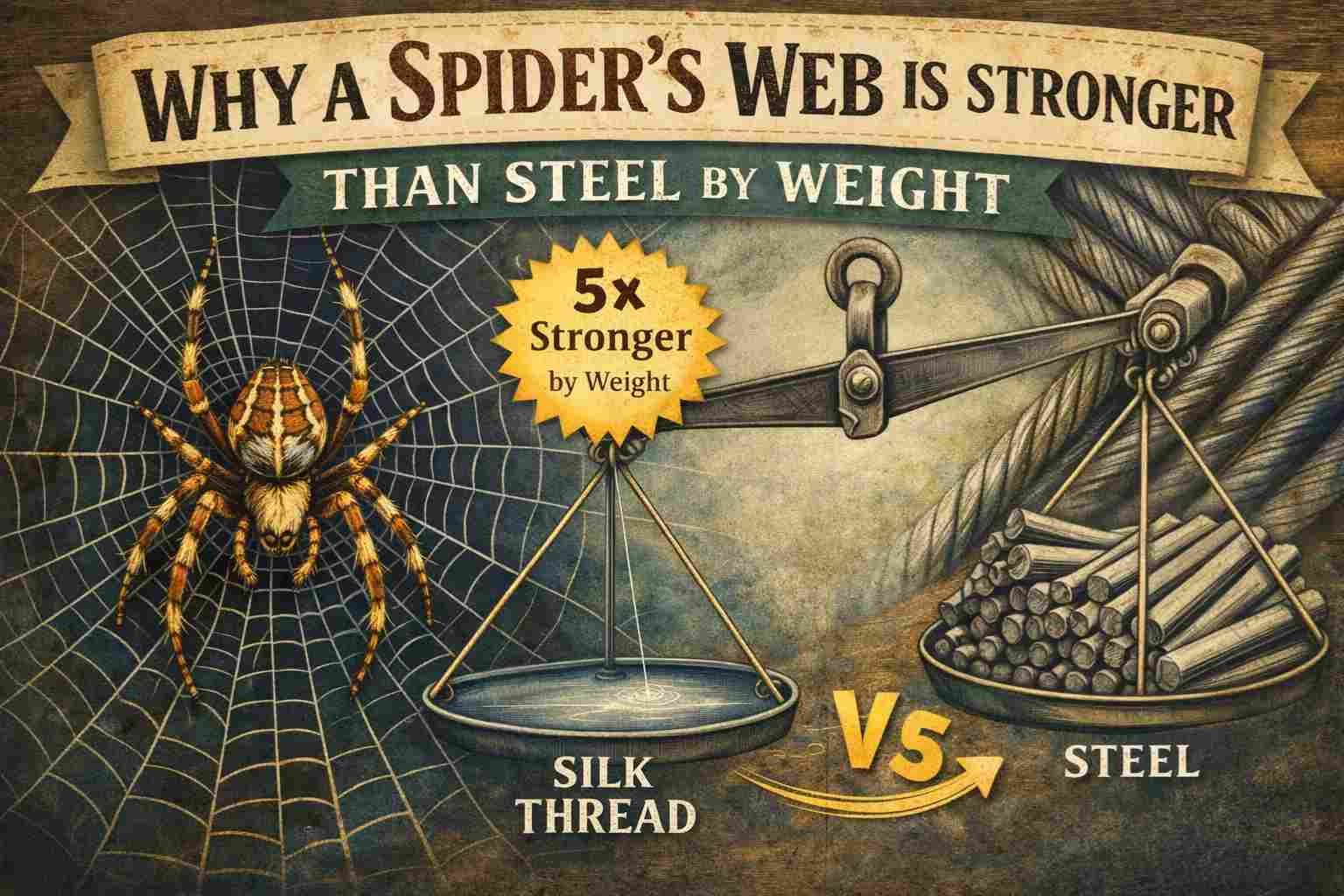
Why a Spider’s Web Is Stronger Than Steel by Weight
A dew-covered spider web can look almost weightless, yet the fibers holding it together rank among nature’s most impressive structural materials.
The familiar claim that spider silk is “stronger than steel” contains a kernel of truth, but the real science is more interesting than the slogan. Spider silk is not one uniform substance, and strength is only one way to judge a material. Its remarkable performance comes from a rare combination of tensile strength, low weight, flexibility, and toughness—all assembled from proteins under ordinary biological conditions.
Spiders produce several specialized silks for lifelines, web frames, capture threads, prey wrapping, attachment points, and egg protection.
Dragline silk can rival strong steels in tensile strength while weighing far less and absorbing substantially more energy before failure.
Its performance emerges from protein chemistry, nanoscale organization, fiber processing, and the damage-tolerant architecture of the web.
Spider Silk Is a Family of Specialized Materials
Spider silk is a protein-based fiber made primarily from large structural proteins called spidroins. These proteins are stored in a concentrated, water-rich mixture inside silk glands in the spider’s abdomen. As the material travels through a narrowing duct, changes in chemistry, pressure, molecular alignment, and water content help transform it from a liquid-like “spinning dope” into a solid fiber. The thread ultimately emerges through microscopic spigots located on the spinnerets.
It is tempting to imagine a spider carrying a single spool of universal thread. In reality, many species possess multiple silk glands, with each gland producing fibers or coatings suited to a particular job. The exact collection varies among spider groups, and not every spider builds the classic circular orb web.
- Major ampullate or dragline silk forms safety lines and, in many orb webs, the strong frame and radial supports.
- Flagelliform silk forms the highly extensible core of many orb-web capture spirals.
- Aggregate silk supplies the sticky droplets coating capture threads; the core fiber itself is not simply a strand of glue.
- Aciniform silk is commonly used for wrapping prey and can be exceptionally tough.
- Tubuliform silk helps construct protective egg cases, while piriform silk anchors threads to surfaces and to other strands.
Spinnerets do not manufacture the proteins by themselves. The proteins originate in internal silk glands. Spinnerets are movable, highly controlled outlets that help the spider place, combine, and manage the emerging fibers.
Is Spider Silk Really Stronger Than Steel?
Sometimes—but only after the comparison is carefully defined. “Strength” is often used as a catch-all term, even though materials scientists measure several different properties. Steel is much stiffer than spider silk and is better for many load-bearing structures. Spider silk’s advantage lies in the unusual way it combines strength with lightness and extensibility.
| Property | What it measures | Why it matters here |
|---|---|---|
| Tensile strength | The maximum pulling stress a material withstands before breaking. | High-performing dragline silks fall within the broad strength range occupied by many steels, although values vary among species, individual spiders, and testing conditions. |
| Stiffness | How strongly a material resists being stretched or deformed. | Steel is considerably stiffer. Spider silk is more compliant, allowing it to deform rather than behaving like a rigid wire. |
| Extensibility | How far a material can stretch before it breaks. | Dragline silk commonly extends by tens of percent, while specialized capture silks can stretch much farther. |
| Toughness | The total energy absorbed before the material fractures. | This is one of spider silk’s standout properties. Strength plus extensibility allows many silks to absorb substantial impact energy. |
| Specific strength | Strength relative to density or weight. | Because silk is far less dense than steel, it can perform extremely well when equal masses—not equal volumes—are compared. |
A steel wire and a dragline-silk fiber with the same diameter are therefore not guaranteed to produce the headline-friendly result people expect. Different grades of steel span a wide range of strengths, just as silk properties differ among species and silk types. Humidity, temperature, spinning speed, the spider’s diet, and the way a sample is collected and tested can also affect the result.
This is not a universal material constant. A more defensible statement is that some spider silks rival or exceed certain steels in tensile strength, offer a better strength-to-weight ratio, and can be far tougher because they stretch and absorb energy before breaking.
The Molecular Architecture Behind the Performance
Spider silk’s properties do not come from a single exceptionally strong chemical bond. They arise from a hierarchy of structures extending from amino-acid sequences to protein assemblies, nanofibrils, full fibers, and finally the web itself.
Within dragline silk, some protein segments organize into compact, crystal-like regions rich in tightly packed beta sheets. These nanoscale domains act as reinforcing elements. Other portions remain less ordered and more flexible, forming an amorphous or semi-amorphous matrix around the harder regions.
Repeating amino-acid patterns influence whether a region becomes ordered, flexible, water-sensitive, or elastic.
Small beta-sheet-rich domains reinforce the fiber and help transfer force between protein chains.
Less ordered chains uncoil, rearrange, and dissipate energy as the fiber stretches.
These components assemble into fibrils and larger fibers whose behavior exceeds what any isolated component could provide.
Hydrogen bonds are individually weaker than the metallic bonds holding steel together. In silk, however, many hydrogen bonds are positioned so that they can work cooperatively. Their nanoscale arrangement helps forces spread through the material, while controlled bond breaking and re-forming can dissipate energy instead of triggering an immediate, catastrophic crack.
The small size of the reinforcing domains also matters. If a crystal-like region becomes too large, stress can concentrate around defects. By distributing many tiny reinforcing regions through a softer matrix, silk balances rigidity and flexibility in a manner comparable to a carefully engineered nanocomposite.
A Web Is More Than a Collection of Strong Threads
The performance of a spider web cannot be explained by fiber chemistry alone. Its geometry determines how impact forces move through the structure. In an orb web, stiff radial threads help transmit vibrations and support the framework, while the more extensible capture spiral deforms as flying prey strikes it.
This division of labor helps the web slow an insect without making the entire structure equally rigid. The web can bend, redistribute stress, and sometimes allow a limited number of threads to fail while preserving the rest of the network. From an engineering perspective, localized damage can be preferable to a design that transfers every disturbance across the whole structure.
A web does not have to be indestructible to be effective. It must remain functional after wind, rain, debris, and struggling prey impose repeated, uneven loads. Controlled deformation and repairability are as important as raw fiber strength.
Why Artificial Spider Silk Is Difficult to Make
Collecting natural spider silk at industrial scale is impractical. Unlike domesticated silkworms, many spiders are territorial, predatory, and sometimes cannibalistic. They also produce relatively small quantities of different silks and use those materials continuously for survival.
Researchers therefore use recombinant biotechnology. Genes encoding spider-silk proteins can be introduced into production hosts such as bacteria, yeast, plants, insect cells, or modified silkworms. The host produces silk-inspired proteins that can be purified and processed into fibers, films, coatings, foams, hydrogels, particles, or three-dimensional scaffolds.
Producing protein is only part of the challenge. Natural spidroins are extremely large and repetitive, which makes their genetic instructions difficult for some host cells to copy and express efficiently. Even when a useful protein is produced, converting it into a fiber with the strength, toughness, diameter, and consistency of natural silk requires precise control over concentration, molecular alignment, flow, acidity, salts, water removal, and drawing.
In other words, a spider’s achievement is not merely biochemical. The animal combines protein production with a remarkably sophisticated miniature spinning process. Artificial fibers may contain spider-inspired proteins yet still fall short if their internal structure does not match the organization created inside a living spider’s spinning duct.
Possible Medical and Industrial Uses
Spider-silk-inspired materials are being studied for applications that benefit from low weight, tunable strength, biodegradability, or compatibility with living tissue. Biomedical research has explored their use in wound dressings, surgical threads, drug-delivery systems, nerve-guidance structures, tissue scaffolds, coatings, and materials designed to support bone, cartilage, skin, muscle, or blood-vessel research.
These possibilities should not be confused with routine clinical use. Much of the work remains experimental or preclinical, and a promising laboratory material must still pass extensive testing for purity, sterilization, immune response, degradation, manufacturing consistency, long-term safety, and effectiveness.
Outside medicine, researchers and companies have investigated silk-inspired fibers for lightweight textiles, protective materials, filtration, adhesives, sensors, flexible electronics, and composites. The material can also be processed into formats that look nothing like a natural thread, including transparent films and microscopic particles.
The most realistic future may not involve replacing steel beams or covering cities with giant webs. Spider-silk technologies are more likely to succeed first in specialized applications where low mass, biological compatibility, controlled degradation, or an unusual balance of softness and toughness justifies the added manufacturing complexity.
Is Spider Silk Automatically Sustainable?
Natural silk formation is an attractive model for greener manufacturing. Spiders assemble high-performance fibers from protein-based feedstocks, largely in water, and at approximately ambient temperature and pressure. Many silk-based materials can also be biodegradable under suitable conditions.
However, a laboratory-made biological material is not automatically environmentally superior. Fermentation vessels consume energy. Production organisms require nutrients. Protein recovery, purification, drying, fiber spinning, solvents, transportation, and waste treatment all contribute to a product’s environmental footprint.
Recent life-cycle research indicates that recombinant spider silk has the potential to become a lower-carbon alternative for some applications, but the outcome depends heavily on production yield, energy sources, purification requirements, manufacturing scale, product lifetime, and end-of-life treatment. Responsible comparisons must evaluate the complete process rather than assuming that “bio-based” always means impact-free.
What Engineers Can Learn From a Spider
Spider silk offers more than a recipe for making a strong fiber. It demonstrates how high performance can emerge from multiple modest components arranged intelligently. Its nanoscale crystals are small. Its hydrogen bonds are individually weak. Its flexible regions are not rigid reinforcements. Yet together, these features produce a material able to withstand tension, movement, and sudden impact.
The web adds another lesson: an effective structure does not need to resist every force without damage. It can redirect stress, isolate failure, remain useful after losing individual elements, and be repaired using limited resources. Those principles are relevant to resilient buildings, lightweight composites, protective equipment, communication networks, and many other engineered systems.
The next time morning light reveals a web between two branches, its beauty is worth appreciating—but so is its precision. Each strand is the result of specialized proteins, controlled molecular assembly, mechanical processing, evolutionary adaptation, and purposeful placement. What looks delicate is not simply strong. It is carefully balanced.
Frequently Asked Questions
Can spider silk really stop a bullet?
Natural spider silk can absorb substantial energy, but a single web cannot stop a bullet. Effective ballistic protection would require many controlled layers, reliable fiber production, appropriate construction, and extensive testing. Toughness alone does not make a material ready for body armor.
Is every strand in a spider web sticky?
No. Structural and radial threads in many orb webs are relatively dry. The capture spiral commonly combines an extensible fiber with adhesive droplets produced by separate glands.
Does every spider build a web to catch food?
No. All spiders can produce silk, but many hunt without a prey-catching web. Jumping spiders, wolf spiders, and other active hunters may use silk for safety lines, shelters, egg sacs, molting sites, or reproductive structures.
Why not simply raise spiders like silkworms?
Large-scale spider farming is difficult because many species are solitary, territorial, predatory, or cannibalistic. Their silk output is also small compared with the harvestable cocoons produced by domesticated silkworms.
How Much Do You Know About Spiders?
Put your knowledge of webs, silk, anatomy, hunting strategies, and spider behavior to the test with an engaging educational quiz.
Explore the Spider QuizResearch and Further Reading
This article distinguishes tensile strength, stiffness, extensibility, toughness, and strength-to-weight performance. Mechanical values vary among species, silk types, environmental conditions, collection methods, and testing procedures.
- Nature Reviews Materials: Uncovering the Structure–Function Relationship in Spider Silk
- Science Advances: Charting the Envelope of Mechanical Properties in Natural and Engineered Spider-Silk Fibers
- Review of Spider Silk Applications in Biomedical and Tissue Engineering
- ACS Biomaterials Science & Engineering: Potential and Feasibility of Spider-Silk Bioproduction
- Massachusetts Institute of Technology: How Spider Webs Achieve Their Strength
- Green Chemistry: Life-Cycle and Environmental Assessment of Recombinant Spider-Silk Production