
The Secret History of the First Online Course
If you have ever watched an online lecture, completed a digital assignment, joined a virtual class, or learned a new skill through an online course, you are benefiting from ideas that educators and technologists have been developing for more than half a century.
It is tempting to imagine that there was one specific moment when someone created the first online course. In reality, the history is far more complicated—and far more interesting.
What counts as an online course depends on how we define the term. Should early computer-based lessons count? Must students be connected through the internet? Does the course need to use the World Wide Web? Or should an online course resemble the modern experience of lessons, assignments, discussions, quizzes, and digital interaction?
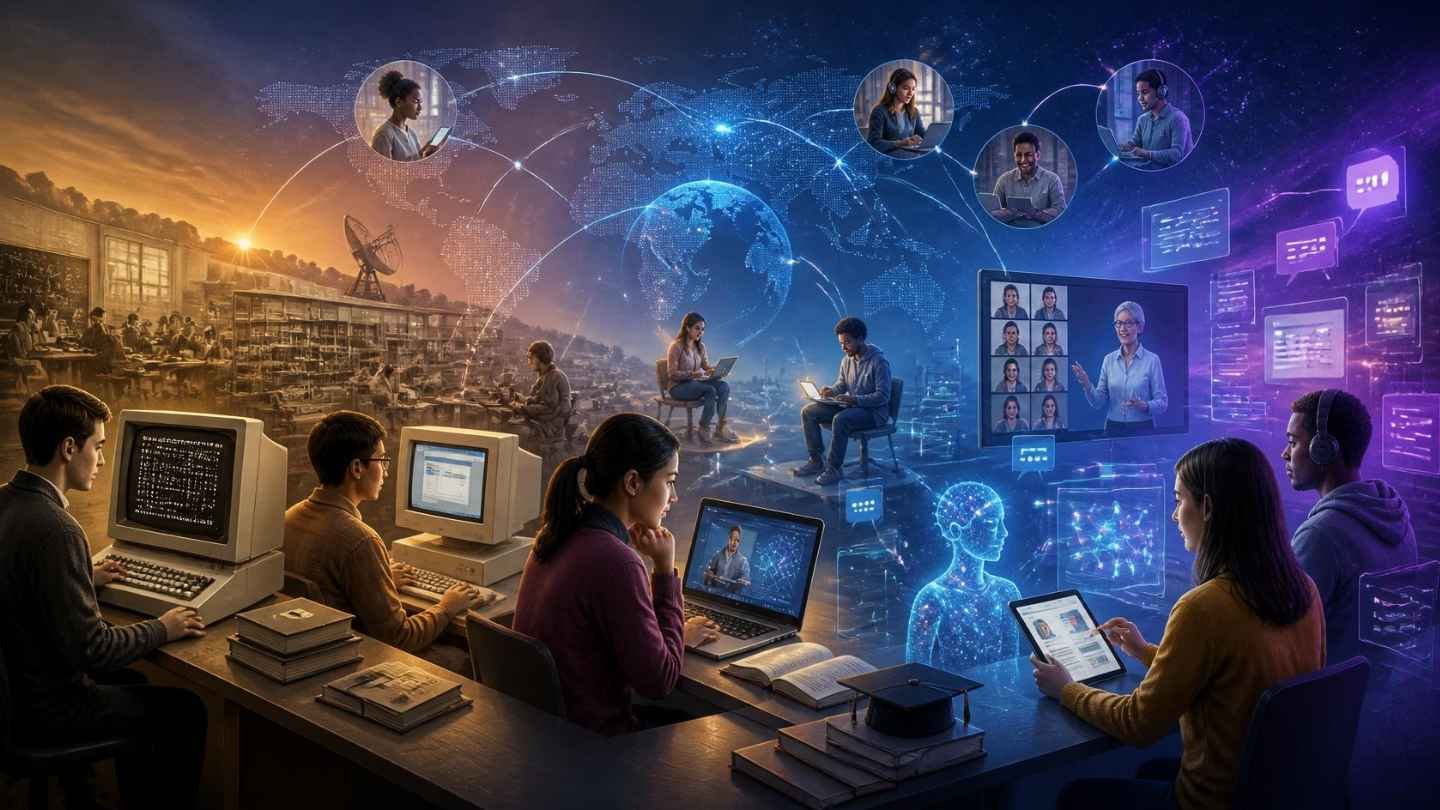
So, What Was the First Online Course?
There is no universally accepted answer because online education developed gradually rather than appearing as a single finished invention.
The history becomes easier to understand when we separate several related ideas. Computer-assisted instruction existed before most people had access to the internet. Networked learning existed before the World Wide Web. Web-based university courses appeared before today's sophisticated learning-management systems. Massive open courses arrived much later.
For that reason, asking who invented the first online course is similar to asking who invented the modern automobile. Many researchers, universities, technologies, and experiments contributed to what eventually became the system we recognize today.
A more accurate conclusion: modern online education emerged through a long series of innovations rather than one universally recognized first course.
The Roots of Online Learning Began Before the Modern Internet
Long before web browsers, smartphones, streaming video, and video conferencing, researchers were already investigating whether computers could become effective teaching tools.
One of the most important early systems was PLATO, developed at the University of Illinois. PLATO, short for Programmed Logic for Automated Teaching Operations, began in 1960 as a computer-based educational system.
Learners could interact with digital lessons through computer terminals. Over time, the system became increasingly sophisticated and developed communication and community features that were remarkably advanced for their era.
PLATO was not an internet course in the way we understand the term today. However, it demonstrated an idea that would later become fundamental to online education: computers could help deliver instruction and connect learners with educational resources beyond a traditional classroom.
Computer-Assisted Education Emerges
Early systems such as PLATO demonstrated how computers could deliver interactive lessons and provide students with digital feedback.
Networked Distance Learning Expands
Colleges and educational organizations increasingly experimented with personal computers and telecommunications networks for remote education.
The World Wide Web Opens New Possibilities
Web browsers, email, websites, and online discussion systems made digital educational material easier to distribute and access.
CCK08 Helps Define the MOOC
George Siemens and Stephen Downes offered the open course Connectivism and Connective Knowledge, helping shape the modern concept of the Massive Open Online Course.
MOOCs Enter the Mainstream
Large university courses attracted huge global audiences, while platforms such as Coursera and edX helped expand online learning worldwide.
Online Learning Becomes Mainstream Education
Remote learning expanded dramatically during the COVID-19 pandemic and became an increasingly familiar part of education and professional training.
How the World Wide Web Changed Education
The growth of the World Wide Web during the 1990s represented a major turning point in digital education.
Instead of relying primarily on specialized computer networks, learners could increasingly reach educational resources through ordinary web browsers.
Universities began experimenting with course websites, digital readings, email communication, electronic assignments, discussion boards, and eventually learning-management systems capable of organizing much of the classroom experience online.
This solved one of the major problems of traditional distance education: distribution.
An instructor could publish material once and potentially make it available to students hundreds or thousands of miles away.
The biggest question was no longer simply, “Can we put educational material online?” It became, “How do we create a meaningful learning experience when students and teachers are separated by distance?”
That question eventually inspired increasingly creative approaches to digital learning, including the course that became known as CCK08.
CCK08: The Course That Helped Define the MOOC
In 2008, educators George Siemens and Stephen Downes offered a course through the University of Manitoba called Connectivism and Connective Knowledge, commonly abbreviated as CCK08.
A relatively small group took the course formally for academic credit, while roughly 2,200 additional people registered to participate freely.
What made the course especially interesting was its structure.
Instead of placing everything inside one closed virtual classroom, the instructors distributed learning across several online spaces. Participants could interact through blogs, forums, wikis, feeds, online sessions, and their own websites.
Learners were therefore doing much more than reading lessons supplied by an instructor. They were also contributing ideas and helping shape the learning network itself.
Distributed Learning
Learning happened across multiple websites and digital spaces instead of depending entirely on one central platform.
Open Participation
People outside the formal university class could participate, greatly expanding the learning community.
Learner Contributions
Participants could create blog posts, discussions, resources, commentary, and other material rather than simply consuming lessons.
Learning Through Connections
Connections between people, ideas, resources, and communities became an important part of the educational experience.
The term MOOC, meaning Massive Open Online Course, became associated with CCK08.
Online education had existed long before it, but CCK08 became a landmark because it demonstrated how an open digital course could support a large network of learners participating from many different locations.
What Is Connectivism?
To understand why CCK08 was structured differently from a traditional class, it helps to understand the educational idea behind it.
Connectivism emphasizes the importance of networks. Learning is not viewed only as storing facts inside one person's memory. It also involves knowing how to connect with people, information sources, communities, and technologies that can help us develop knowledge.
Think about how you might investigate a complicated subject today.
You could read an article, watch a lecture, consult an expert, search an academic database, join a discussion community, listen to a podcast, compare several explanations, and use digital tools to explore the subject further.
Knowledge is encountered through many different pathways.
That also places greater responsibility on the learner.
When information comes from many directions, students must learn how to navigate it carefully.
- Identify trustworthy information.
- Compare different explanations.
- Recognize unreliable or misleading sources.
- Organize large amounts of information.
- Connect new knowledge with previous knowledge.
- Participate constructively in learning communities.
- Decide which information is actually relevant.
These skills have become even more important today because learners can access an enormous mixture of websites, videos, databases, podcasts, social posts, articles, and artificial intelligence tools.
How Online Learning Changed the Teacher-Student Relationship
Traditional teaching is sometimes imagined as information moving mainly in one direction: the teacher explains a subject, students listen, and later students are tested on what they remember.
Online education made it easier to explore different models.
In courses such as CCK08, instructors could function as guides, organizers, curators, and participants in an evolving learning community.
Students could contribute resources, discuss interpretations, answer questions, create content, and communicate with people they might never meet in person.
This did not make the instructor unnecessary. Expert guidance, thoughtful explanations, feedback, structure, and course design remained extremely important.
The difference was that students could play a much more active role in constructing their own learning experience.
| Traditional Classroom Model | Networked Online Model | Educational Benefit |
|---|---|---|
| Instructor provides most information. | Instructor guides learners through multiple resources. | Students practice evaluating information. |
| Students mainly consume course material. | Students can create and share material. | Participation may deepen understanding. |
| Learning happens mainly during class. | Learning can continue across digital communities. | Education becomes less dependent on location. |
| Peer interaction may be limited. | Discussion and collaboration can become central. | Learners encounter a broader range of perspectives. |
Why Community Matters in Online Education
One of the most important lessons from early online courses is that digital education does not have to be a lonely experience.
When learners discuss difficult ideas, explain concepts to one another, share resources, or realize that other people are struggling with the same topic, they become part of a learning community.
Modern online courses often encourage this through discussion boards, live sessions, group projects, peer assessments, collaborative documents, cohort groups, and instructor feedback.
The technology has changed dramatically, but the basic human need for interaction remains.
People frequently remember not only the information they encountered but also the conversations, challenges, explanations, and discoveries that helped that information make sense.
The Early Online Classroom Also Had Serious Challenges
Early experiments in open and networked learning were innovative, but that did not make them easy.
One major difficulty was information overload.
A large online course might generate hundreds of blog posts, discussion messages, links, comments, videos, and resources. Learners had freedom, but they also had to decide which information deserved their attention.
Information Overload
Too many resources can make it difficult for learners to determine what deserves attention.
Self-Direction
Flexible online learning often requires strong time-management and independent-study skills.
Technology Barriers
Devices, internet access, software, and digital literacy can all affect a learner's ability to participate.
Maintaining Engagement
Learners who feel disconnected from instructors or classmates may find it easier to stop participating.
Many modern learning platforms address these challenges through structured modules, calendars, notifications, search tools, quizzes, progress indicators, automated feedback, and carefully organized learning paths.
Much of modern online-course design therefore involves balancing two valuable ideas: the freedom of the internet and the clarity of a well-organized classroom.
From Early MOOCs to Global Learning Platforms
CCK08 did not immediately transform the entire education industry. The larger MOOC movement expanded several years later.
In 2011, large open university courses attracted enormous international participation and demonstrated that a single online class could potentially reach a global audience.
In 2012, new platforms helped bring online courses even further into the mainstream.
Coursera, founded by Stanford professors Daphne Koller and Andrew Ng, began working with universities and other institutions to distribute courses online.
edX, originally founded by Harvard University and MIT, also became an important platform for large-scale digital education.
These newer platforms differed from the more distributed approach of CCK08. Most offered centralized course environments containing organized modules, videos, assignments, assessments, and discussion features.
However, several important ideas remained: global access, learner flexibility, online discussion, self-directed study, and the possibility of bringing together students who might otherwise never share the same classroom.
Online Learning Became Much More Than MOOCs
Today, online education includes a huge variety of learning experiences.
University Education
Students can complete individual classes and, in some cases, entire academic programs online.
Professional Training
Professionals can develop technical, business, creative, and career-specific skills remotely.
Skill-Based Courses
Digital platforms make it possible to learn programming, languages, design, writing, finance, and countless other skills.
Informal Learning
Articles, podcasts, quizzes, videos, communities, and interactive tools allow learning to happen outside formal courses.
This flexibility is one of online education's greatest strengths.
A person may spend several years completing an online degree or only a few minutes learning about a subject that suddenly sparked their curiosity.
The COVID-19 Pandemic Accelerated Online Education
Online education was already well established before 2020, but the COVID-19 pandemic caused schools and universities throughout the world to depend heavily on remote learning.
According to UNESCO, pandemic-related disruption affected more than 1.6 billion learners worldwide.
Teachers rapidly adapted lessons for video calls, learning platforms, electronic assignments, recorded lectures, digital assessments, and other remote formats.
This global transition also demonstrated an important difference between carefully designed online education and emergency remote teaching.
Creating an effective online course involves much more than placing classroom material on a screen.
Good digital education requires clear instructional design, accessibility, communication, feedback, interaction, suitable technology, and thoughtful learning activities.
The pandemic also exposed inequalities. Online learning cannot provide equal opportunities when students lack reliable internet access, suitable devices, appropriate learning environments, or adequate support.
Digital education therefore represents both a tremendous opportunity and an ongoing challenge.
What Makes an Online Course Effective?
The history of digital learning provides several valuable lessons for modern students and educators.
- Clear structure matters. Learners should always know what to study and what to do next.
- Interaction matters. Discussion and feedback can transform information into a richer learning experience.
- Active participation matters. Projects, quizzes, exercises, and problem-solving encourage learners to use knowledge.
- Flexibility matters. Online education can accommodate different schedules, locations, and learning styles.
- Information literacy matters. Learners need to distinguish reliable knowledge from misinformation.
- Accessibility matters. Digital courses should work for people using different devices, internet connections, and learning environments.
- Human connection matters. Technology delivers information, but education remains fundamentally human.
Turn Curiosity Into a Learning Challenge
Learning does not always require enrolling in a complete course. Interactive quizzes can help you recall information, explore unfamiliar topics, and discover subjects you may want to investigate further.
Explore Quizzes at BingQuizzes.com →Why Quizzes Can Be Useful Learning Tools
Quizzes are often viewed simply as tests, but they can also support learning.
Trying to retrieve information from memory requires a different kind of mental effort than simply rereading the same information.
A quiz can also reveal gaps in understanding. Getting an answer wrong does not necessarily mean the activity failed. Instead, the incorrect answer can show exactly which idea deserves another look.
For curious learners, quizzes can also encourage discovery.
A question about history, geography, science, culture, language, or current events may introduce an unfamiliar subject and encourage a person to learn more about it.
Interactive learning is therefore part of the same broader story as online courses: technology can do more than simply display information. It can encourage people to actively engage with knowledge.
What Does the Future of Online Education Look Like?
Predicting the future of education is difficult because technology continues to evolve rapidly.
Artificial intelligence, adaptive learning systems, virtual and augmented reality, interactive simulations, automated translation, personalized tutoring systems, and learning analytics are already expanding what digital education can do.
History, however, teaches an important lesson:
PLATO mattered because educators explored how computers could support instruction.
Early networked classrooms mattered because teachers experimented with communication across distance.
CCK08 mattered because it explored learning through networks and connections.
MOOCs demonstrated the extraordinary scale that online education could achieve.
Pandemic-era remote learning revealed both the potential and limitations of digital education under extraordinary circumstances.
Each development ultimately mattered less because of the machine itself and more because of the learning experience people created around it.
The Human Side of Digital Learning
Think about a learning experience you remember clearly.
Was it memorable simply because you saw information on a page?
Or did something suddenly make sense because a teacher explained it differently, another learner challenged your assumptions, a question sparked your curiosity, or you discovered a connection you had never noticed before?
Technology changes how these moments happen, but it does not remove their human character.
A classroom can exist inside a school building, across a video call, within an online course, inside a discussion community, or even through an interactive quiz.
The format may change, but the fundamental motivation remains remarkably similar.
People want to understand the world, improve their abilities, solve problems, exchange ideas, and share what they discover.
Frequently Asked Questions About Online Course History
Who created the first online course?
There is no universally accepted single creator because the answer depends on how “online course” is defined. Computer-assisted education existed by the 1960s, networked distance learning developed later, and web-based courses expanded during the 1990s.
Was CCK08 the first online course?
No. Online and computer-assisted learning existed long before 2008. CCK08 is historically important because it became one of the defining early examples of a Massive Open Online Course.
What was CCK08?
CCK08 stands for Connectivism and Connective Knowledge 2008. George Siemens and Stephen Downes led the course through the University of Manitoba, with formal students and thousands of additional open participants.
What does MOOC mean?
MOOC stands for Massive Open Online Course. It generally describes an online course capable of supporting large numbers of participants, often with relatively open access to educational material.
What was PLATO?
PLATO was an influential computer-assisted learning system developed at the University of Illinois beginning around 1960. It allowed learners to interact with digital educational material through computer terminals and later supported advanced communication features.
When did online courses become mainstream?
Web-based education expanded throughout the 1990s and 2000s. MOOCs gained major attention during the early 2010s, while the COVID-19 pandemic dramatically accelerated remote and online learning beginning in 2020.
Are online courses the same as distance education?
Not exactly. Distance education existed long before the internet and historically used methods such as correspondence courses, radio, television, and mailed educational materials. Online learning is a modern form of distance education that relies heavily on internet-connected technology.
Final Thoughts: Online Education Was Built One Connection at a Time
The history of online education becomes more meaningful once we stop looking for a single inventor.
Traditional education did not suddenly transform into the modern virtual classroom.
Instead, generations of educators, researchers, engineers, universities, and learners experimented with new ways to overcome distance and make knowledge easier to share.
Early computer systems demonstrated that technology could assist instruction. Communication networks made remote interaction possible. The World Wide Web made educational material easier to distribute. Open online courses explored collaboration at unprecedented scale. Modern platforms brought structured digital learning to global audiences.
CCK08 deserves an important place in this history—not because it was the first online course, but because it challenged people to think differently about what an online course could become.
Rather than seeing learning simply as information moving from a teacher to a student, it emphasized relationships among people, resources, conversations, technology, and ideas.
That concept remains relevant today.
Technology will continue to change, and today's learning platforms may eventually look as old-fashioned as early computer terminals do now.
But curiosity, critical thinking, interaction, and the desire to understand something new will remain at the heart of education.
The history of online learning is therefore not simply a history of computers.
It is the story of people continually discovering new ways to teach and learn from one another—and proof that wherever people can connect, learning can follow.
References & Further Reading
- University of Illinois Grainger College of Engineering — historical information about the development of the PLATO computer-assisted learning system.
- Stephen Downes — writings and documentation concerning Connectivism and Connective Knowledge 2008 (CCK08).
- EDUCAUSE Review — historical discussions of CCK08, connectivism, and the development of Massive Open Online Courses.
- Coursera — official information concerning the platform's history and development.
- edX — official information about the online learning platform originally established by Harvard University and MIT.
- UNESCO — reports and educational resources concerning global disruption and remote learning during the COVID-19 pandemic.