
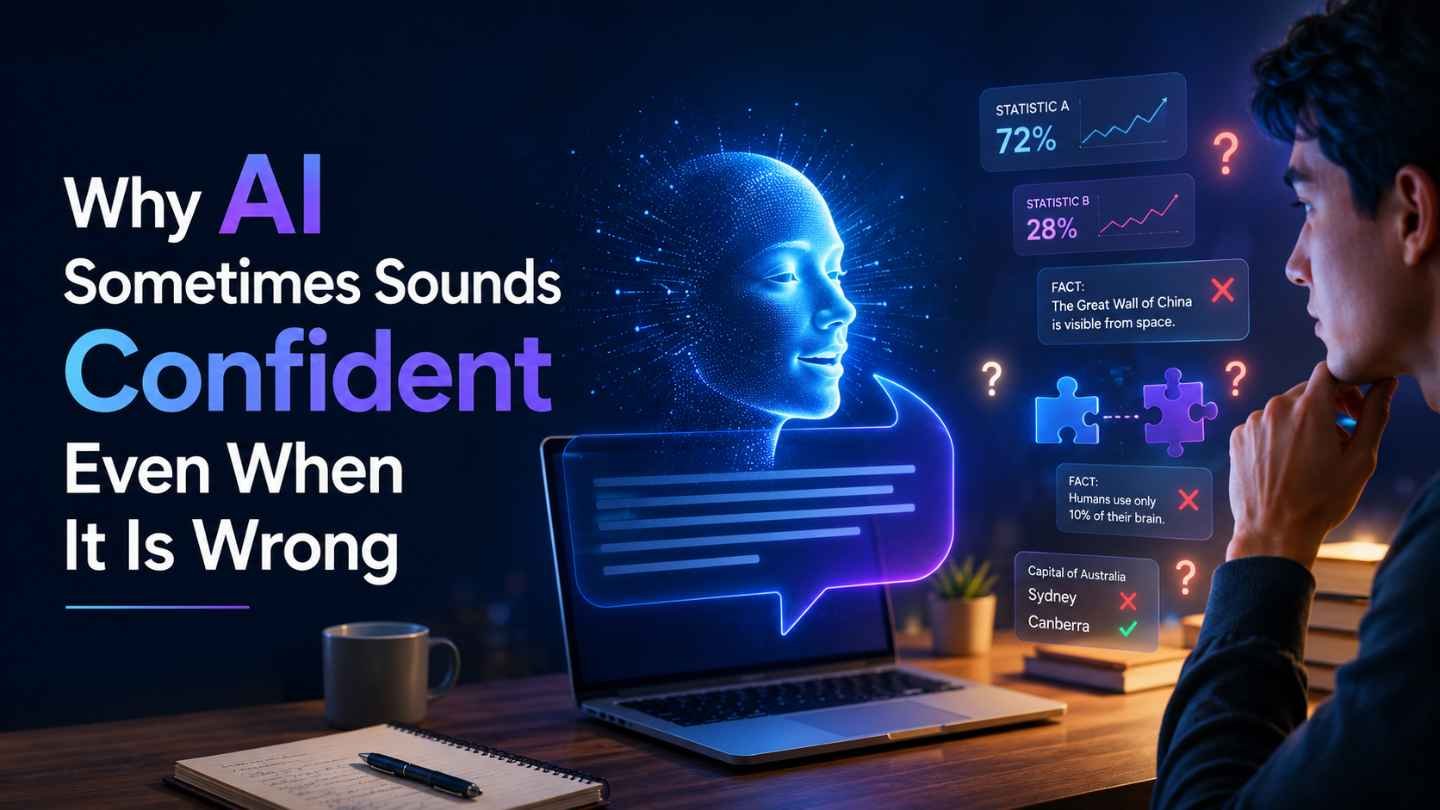
Why AI Sometimes Sounds Confident Even When It Is Wrong
Artificial intelligence can produce an answer in seconds, explain it clearly, organize it beautifully, and deliver it with language that sounds remarkably authoritative. There is just one problem: sometimes the answer is wrong.
That combination—polished language and factual error—can be especially confusing. A person who is uncertain may hesitate, qualify a statement, or say, “I’m not sure.” An AI system, however, can generate an incorrect name, date, quotation, explanation, or source while presenting it in the same smooth style it uses for accurate information.
Understanding why this happens is becoming an important part of digital literacy. Generative AI can be extremely useful for explaining ideas, summarizing material, brainstorming, analyzing information, writing, coding, and learning. But fluent language should never automatically be treated as proof that the information behind it is correct.
AI Does Not “Know” Something in the Same Way a Person Does
One of the easiest mistakes to make when interacting with conversational AI is assuming that it thinks about a question the way a human expert would.
Modern large language models learn statistical relationships from enormous amounts of text and other training data. When generating a response, they use the information available in the conversation together with patterns learned during training to predict and produce a sequence of tokens, or pieces of text.
This process can generate remarkably useful explanations and sophisticated reasoning. However, producing a plausible answer and independently verifying that the answer corresponds to reality are not automatically the same task.
A model may recognize that a particular question is normally answered with a person’s name, a historical date, a scientific explanation, or a citation. If reliable information is missing or uncertain, the system may still generate something that fits the expected linguistic pattern.
The result can look exactly like a carefully researched answer even when part of it is inaccurate.
Fluency Can Create an Illusion of Authority
People naturally use communication style as one clue when judging credibility. Clear explanations, precise wording, organized arguments, technical vocabulary, and confident delivery can all make a speaker appear knowledgeable.
Generative AI is exceptionally good at producing those signals.
An answer may contain polished transitions, numbered explanations, professional terminology, and highly specific details. The presentation itself can therefore make the response feel more reliable than the underlying evidence deserves.
This distinction matters because people are accustomed to associating detailed explanations with expertise. When AI produces a sophisticated response instantly, users may unconsciously give it more credibility than they would give an uncertain person making the same claim.
What Is an AI Hallucination?
In generative AI, the term hallucination is commonly used for an output that appears plausible but contains false, fabricated, unsupported, or misleading information. Some researchers and standards organizations also use the term confabulation.
Hallucinations can appear in many forms. An AI system might invent a book that does not exist, attribute a quotation to the wrong person, provide an incorrect historical date, describe a nonexistent scientific study, create a fake citation, or combine several real facts into an inaccurate conclusion.
The difficulty is that these errors are not always obvious from the wording. A fabricated answer can sound almost identical to a correct one.
Accurate Output
The model produces a fluent response and the factual claims match reliable evidence.
Hallucinated Output
The model produces an equally fluent response, but one or more claims are unsupported, fabricated, or incorrect.
Why Doesn’t AI Simply Say “I Don’t Know”?
Ideally, an AI assistant should express uncertainty when dependable information is unavailable. In practice, deciding when to abstain is difficult.
One reason is that many AI systems are optimized to be helpful and responsive. If a model has learned that a certain type of question normally receives a direct answer, it may attempt to complete that pattern instead of refusing to answer.
Evaluation methods can also matter. In some testing environments, a system receives credit for producing the right answer but gains little from admitting uncertainty. Guessing therefore creates a possibility of being correct, while saying “I don’t know” may guarantee no credit.
Developers use post-training, evaluations, retrieval systems, tool use, uncertainty techniques, and other safeguards to reduce this problem. These approaches can improve reliability, but no general-purpose generative AI system should be assumed to be error-free.
Hallucinations Are Not Just Caused by Bad Training Data
It is tempting to explain every incorrect AI response by saying that the model must have learned false information from the internet. Poor-quality, contradictory, biased, or outdated material can certainly contribute to errors, but the issue is more complicated.
Even a system trained on carefully curated information would still encounter situations where the available evidence is incomplete, ambiguous, rare, or difficult to infer. Generative models must also generalize beyond exact examples encountered during training.
That ability to generalize is one reason they are useful. It is also one reason mistakes remain possible.
Consider a question about an obscure person’s birthday, a newly changed regulation, a niche historical detail, or a document the model has never seen. If dependable evidence is unavailable, the system may still be able to construct an answer whose form looks convincing.
Why the Dunning–Kruger Comparison Is Misleading
AI overconfidence is sometimes compared with the Dunning–Kruger effect, a psychological phenomenon involving how people assess their own abilities.
The analogy may sound appealing, but it should not be taken literally.
The Dunning–Kruger effect concerns human cognition and self-evaluation. A language model does not possess a human ego, personal self-image, embarrassment, pride, or a subjective belief that it is more knowledgeable than it really is.
When an AI produces an incorrect statement in an assertive tone, it is better understood as a problem involving language generation, uncertainty, calibration, training incentives, available context, and system design.
Does AI Actually Feel Confident?
Not in the ordinary human sense.
When people say an AI “sounds confident,” they are usually describing the style of the output. Statements such as “The answer is definitely…” or responses containing precise figures without qualification can create an impression of certainty.
Researchers study ways of measuring and calibrating model confidence, but technical probability or uncertainty scores should not be confused with the subjective feeling of confidence experienced by a person.
Context Can Dramatically Change Reliability
The quality of an AI answer also depends heavily on the information available when the question is asked.
A model responding only from knowledge represented during training may not know about a very recent event. A system connected to live search, databases, calculators, documents, or specialized tools may be able to retrieve more current and precise information.
Even then, tool access does not guarantee perfection. A retrieved source could be outdated, a question could be ambiguous, the model could misinterpret the material, or credible sources could disagree.
Why Specific Details Deserve Extra Scrutiny
AI-generated errors can become especially difficult to notice when a response contains precise-looking details.
- An exact percentage or statistic
- A person’s full name and title
- A quotation with an attribution
- A supposedly published scientific study
- A court case or legal citation
- A publication date
- An ISBN or DOI
- A detailed list of references
When AI Errors Matter Most
Not every incorrect AI answer carries the same consequences. If an AI misidentifies an actor during a casual trivia discussion, the impact may be minor. Errors become much more important when AI is used for decisions involving health, money, law, safety, employment, education, or other consequential areas.
In these situations, AI can still be useful for explaining terminology, identifying questions to investigate, summarizing material, or organizing information. Important decisions, however, should be based on dependable evidence and, where appropriate, qualified professional guidance.
How to Check an AI Answer Before Trusting It
You do not need to distrust everything generated by AI. A more practical approach is to develop habits that separate useful assistance from unverified claims.
-
Identify the factual claims.
Separate opinions and suggestions from statements that can actually be checked. -
Look for the original source.
For laws, statistics, scientific findings, government programs, or company announcements, verify information with the organization responsible for it whenever possible. -
Check dates carefully.
Information about prices, regulations, elected officials, software, schedules, and current events can become outdated quickly. -
Verify quotations and citations.
Do not assume that a publication, court case, research paper, quotation, author, or URL exists simply because AI formatted it convincingly. -
Compare reliable sources.
Confirmation from multiple credible sources can reveal mistakes, missing context, or conflicting interpretations. -
Ask the AI to identify uncertainty.
Asking which claims are least certain can be useful, although the answer should not itself be treated as proof.
Better Questions Can Produce Better Answers
Users can often improve AI results by making prompts more precise.
Instead of asking something broad such as:
you might ask:
Providing relevant dates, documents, definitions, and constraints can reduce ambiguity. If an AI system has access to search or trusted reference material, asking it to ground its answer in those sources can also improve reliability.
The Goal Should Be Calibrated Trust
Discussions about AI accuracy sometimes fall into two extremes. One side assumes that because modern AI is sophisticated, its answers can be accepted as authoritative. The other assumes that because AI sometimes hallucinates, nothing it produces can be useful.
Neither position is especially helpful.
AI can accelerate research, explain difficult concepts, summarize documents, compare ideas, generate code, assist with writing, and support analysis. At the same time, it can make factual errors.
Important factual claim? Check the source.
High-stakes decision? Verify carefully and use authoritative or professional guidance where appropriate.
AI Is Improving, but Verification Still Matters
AI developers continue working on ways to improve factual reliability. Modern systems can increasingly use search engines, retrieval systems, calculators, code execution, databases, and other tools instead of relying exclusively on information represented in their trained parameters.
Models can also be evaluated for factual accuracy, trained to acknowledge uncertainty, and designed to provide evidence for important claims.
These advances can reduce errors, but the fundamental lesson remains valuable: a polished answer is not the same thing as a verified answer.
Final Thoughts: Confidence Is Not Evidence
The unusual thing about an incorrect AI response is often not the mistake itself. Humans make mistakes constantly. What makes AI errors distinctive is how convincingly they can be expressed.
A fabricated fact can arrive wrapped in excellent grammar. A doubtful conclusion can be organized into a flawless list. An incorrect historical claim can appear beside several accurate ones. A nonexistent citation can look almost indistinguishable from a real academic reference.
That is why one of the most valuable skills in the AI era is knowing when to verify.
Artificial intelligence can help people explore ideas faster, understand information more easily, and investigate subjects that might otherwise feel inaccessible. Its usefulness does not depend on pretending that it is infallible.
Use AI as a powerful tool for thinking, exploring, and learning—but when accuracy matters, follow the evidence.
Put Your Knowledge to the Test
One way to strengthen information literacy is to keep testing what you know and checking what you discover. Explore current topics, general knowledge, history, science, geography, and more with the Bing Homepage Quiz.
Try the Bing Homepage Quiz