
A Fresh General Knowledge Quiz Every Day
Most trivia games throw ten unrelated questions at you. The Daily General Knowledge Quiz does something different: each day it picks one topic and asks ten questions about it, so a round feels less like a random test and more like a short, guided lesson.
One day it might be Nobel Prizes or word origins. The next, clouds, lighthouses, fungi or forensic science. Every question has four choices and an explanation, and the whole round runs on a single 150-second clock. You pass with five correct answers, and finishing early earns you a speed bonus on top of your points.
10questions on one topic
150sfor the whole round
5/10correct answers to pass
100topics in the rotation
How the Daily Quiz Works
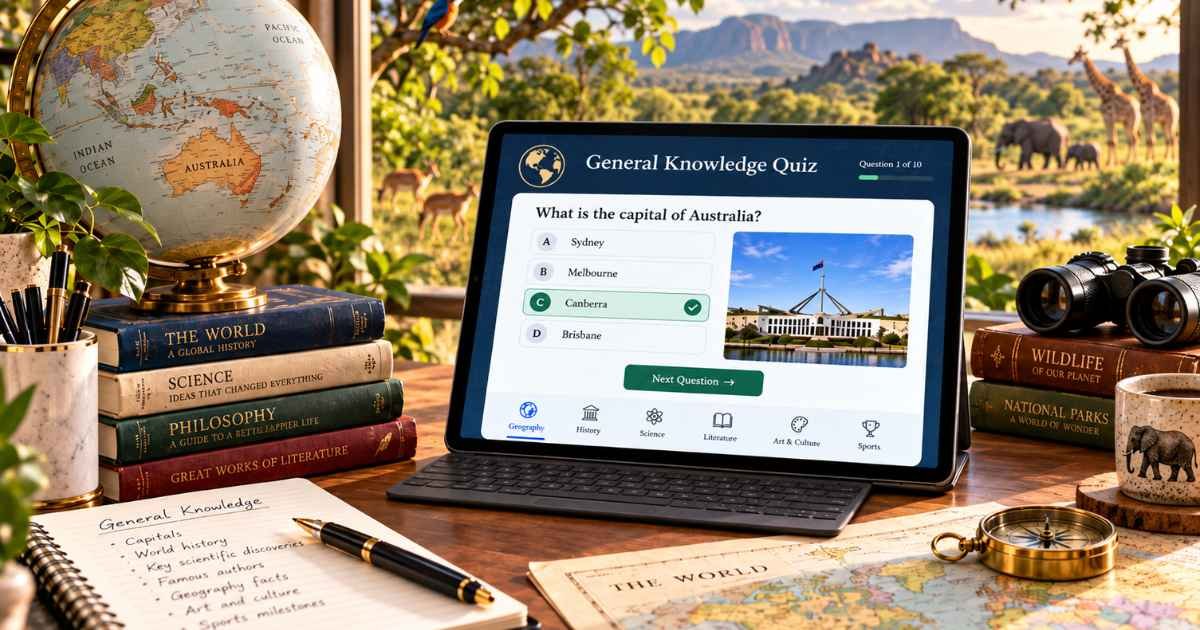
The quiz draws from a library of 100 topics, each with its own set of ten questions, for 1,000 questions in all. The topics run in a fixed order, so everyone sees the same topic on the same calendar date (Philippine time), and refreshing the page won't swap it for another. After Topic 100, the rotation starts again at Topic 1.
Every time you play, the four answer choices are shuffled into a new order, so you can't simply remember that "the answer was B."
One topic per day
All ten questions explore the same subject, so each answer builds on the last.
One shared timer
The 150-second clock starts when you choose your first answer and runs across all ten questions until the round ends.
Feedback after every answer
You see the correct choice and a short explanation, whether you got it right or not.
A reason to come back
Each new day brings the next topic, so a few minutes a day adds up across 100 subjects.
Why the rotation helps you remember
Because each topic returns after 100 days, the quiz gives you built-in spaced review. Memory research consistently finds that revisiting material after a gap leads to better long-term recall than studying it all at once.
Points & Ranks
How Scoring Works
Every correct answer is worth 1,000 points. Wrong or unanswered questions earn zero, and points are never taken away, so a mistake never costs you what you already have.
If you answer all ten questions before the clock runs out, you also earn a speed bonus of up to 2,000 points. It depends on two things: how much of the 150 seconds you have left, and how many questions you got right. If the timer runs out, there is no speed bonus.
Speed bonus = 2,000 × (seconds left ÷ 150) × (correct answers ÷ 10)
Your total points decide your rank:
Knowledge Beginnerunder 5,000Knowledge Explorer5,000+Knowledge Scholar7,000+Knowledge Expert9,000+Knowledge Grandmaster11,000+
A worked example
Here is how a few realistic rounds add up. Look at rows A and B: the same eight correct answers, but finishing faster earns a bigger bonus.
| Round | Correct | Seconds left | Correct-answer points | Speed bonus | Total & rank |
|---|---|---|---|---|---|
| A | 8/10 | 60 | 8,000 | 2,000 × 60/150 × 8/10 = 640 | 8,640 · Knowledge Scholar |
| B | 8/10 | 30 | 8,000 | 2,000 × 30/150 × 8/10 = 320 | 8,320 · Knowledge Scholar |
| C | 10/10 | 60 | 10,000 | 2,000 × 60/150 × 10/10 = 800 | 10,800 · Knowledge Expert |
| D | 10/10 | 90 | 10,000 | 2,000 × 90/150 × 10/10 = 1,200 | 11,200 · Knowledge Grandmaster |
| E | 6/10 | 0 (time ran out) | 6,000 | 0 | 6,000 · Knowledge Explorer |
Notice what accuracy does: each correct answer adds 1,000 points and makes your speed bonus bigger. That is why accuracy matters more than raw speed.
Passing is about correct answers only
You need at least 5 correct answers out of 10 to pass. The speed bonus can raise your rank, but it can't make up for a sixth wrong answer.
What Subjects Can Appear?
The 100 topics are grouped around lasting knowledge rather than headlines, so the questions don't go out of date the way current-events trivia does.
Society and civics
International organizations, forms of government, constitutions, human rights milestones, elections, diplomacy, economics, banking and trade.
Ideas and human behavior
Archaeology, anthropology, sociology, psychology, philosophy, ethics, education, universities, libraries and museums.
Media and storytelling
Journalism, radio, television, film, animation, comics, children's books, detective fiction, science fiction, folklore and fairy tales.
Inventions and infrastructure
Ships, lighthouses, canals, dams, tunnels, roads, postal systems, the telegraph, printing, codes, ciphers, symbols and simple machines.
Nature and Earth science
Fossils, insects, fish, animal behavior, seeds, fungi, caves, waterfalls, wetlands, soils, clouds, light and sound.
Health and everyday life
Medical discoveries, public health, first-aid basics, emergency preparedness, cooking science, spices, beverages and etiquette.
Try Three Sample Questions
Here is a taste of three different topics. Choose your answer before opening the explanation. The quiz works the same way: you commit first, then learn why.
Nobel Prizes
In what year were the first Nobel Prizes awarded?
- 1895
- 1901
- 1914
- 1920
Show answer
B. 1901. Alfred Nobel signed the will that created the prizes in 1895 and died the following year, which is why 1895 is a tempting wrong answer. The economics prize came much later: it was established by Sweden's central bank in 1968.
Lighthouses
Which of the Seven Wonders of the Ancient World was a lighthouse?
- The Colossus of Rhodes
- The Pharos of Alexandria
- The Hanging Gardens of Babylon
- The Temple of Artemis
Show answer
B. The Pharos of Alexandria. Built in the 3rd century BCE on the island of Pharos in Egypt, it was so famous that its name became the word for "lighthouse" in several languages, including phare in French and faro in Italian and Spanish.
Clouds
Which type of cloud is most associated with thunderstorms?
- Cirrus
- Stratus
- Cumulonimbus
- Altostratus
Show answer
C. Cumulonimbus. These towering clouds can reach the top of the lower atmosphere and often spread into a flat "anvil" shape. They bring lightning, heavy rain and sometimes hail. Cirrus clouds are thin and wispy, and stratus clouds form flat gray layers.
Tips for a Higher Score
Smart play beats hurried guessing, as the worked example shows.
Accuracy first, speed second
A fast wrong answer earns nothing and shrinks your speed bonus. A correct answer after a few extra seconds still earns 1,000 points.
Read all four choices
The first familiar phrase isn't always the most precise answer. A quick scan of every option saves points.
Keep a steady pace
With 150 seconds for ten questions, you have about 15 seconds each. Answer the ones you know quickly and save time for the harder ones.
Read the explanations
Getting feedback after answering, especially after a wrong answer, is one of the most reliable ways to learn from a quiz. The explanation is often the exact detail you'll need next time.
How our questions are made
Every question is written around established knowledge rather than temporary headlines, rankings or current officeholders, and is checked against reliable reference sources before it goes live. First-aid and public-health questions are kept general and educational; they don't replace advice from emergency services or qualified health professionals. If you spot an error, please tell us through our contact page.
Frequently Asked Questions
Does the quiz change every day?
Yes. It moves to the next topic each calendar day, based on Philippine time (Asia/Manila). There are 100 topics, and the rotation starts again after the hundredth day.
Will refreshing the page change today's topic?
No. The topic is set by the date, so it stays the same all day however many times you reload.
How many correct answers do I need to pass?
At least 5 out of 10. Your points decide your rank, but the speed bonus can't replace the five-correct-answer requirement.
How is my score calculated?
Each correct answer is worth 1,000 points. If you finish before the 150-second timer runs out, you also get a speed bonus of up to 2,000 points, based on how much time is left and how many answers you got right. The highest possible score is 12,000.
What happens when the timer reaches zero?
The round ends immediately and your results appear. Any questions you haven't answered count as wrong, and there is no speed bonus.
Can I try again?
Yes. The Play Again button lets you replay the same topic. The answer choices are reshuffled, but the topic stays the same.
Does the quiz save my results?
Your answers are kept only while your browser tab is open, so you can move between the two pages of questions without losing your place. Nothing is kept after you close the tab, and the quiz doesn't ask for any personal information.
Is this quiz made by Microsoft?
No. Bing Quizzes is an independent website, and this quiz is our own. It is not affiliated with or endorsed by Microsoft.
Ready for Today's Topic?
Head back to the quiz, choose your first answer to start the clock, and aim for five correct answers to pass. Then see which rank you can reach. Some days will confirm what you know; others will hand you ten new things to remember. Both are worth it.
Want another challenge afterward? Try Today's Bing Quiz too.
Return to the QuizSources and Further Reading
- The Nobel Prize, official site: nobelprize.org
- Cepeda, N. J., Pashler, H., Vul, E., Wixted, J. T., & Rohrer, D. (2006). Distributed practice in verbal recall tasks: A review and quantitative synthesis. Psychological Bulletin, 132(3), 354–380. doi.org/10.1037/0033-2909.132.3.354
- Butler, A. C., & Roediger, H. L. (2008). Feedback enhances the positive effects and reduces the negative effects of multiple-choice testing. Memory & Cognition, 36(3), 604–616. doi.org/10.3758/MC.36.3.604
Bing Quizzes is an independent website and is not affiliated with, sponsored by or endorsed by Microsoft. Bing is a trademark of Microsoft Corporation.