
Between Two Blinks An Endoscopy, a Lost Afternoon, and the Shape of Eternity
I closed my eyes for what I believed was a single second. When I opened them, I asked the nurse if we could finally begin. She smiled and told me it had been over for hours.
That small exchange in a recovery room has stayed with me more than almost anything else that happened this year. It began as an ordinary medical appointment, the kind millions of people go through every day. It ended as a quiet, unsettling lesson about memory, consciousness, and what time really means to a mind that is not there to experience it.
This article is part personal story and part explanation. I will share exactly what I experienced, walk through what doctors and researchers say actually happens during endoscopy sedation, and then offer the reflection that has changed how I think about death and eternity. I am not a doctor, so where I talk about medicine I lean on trusted clinical sources, which are linked throughout and listed at the end.
1. The Morning of the Procedure
If you have never had an endoscopy, the idea of a camera traveling down your throat can sound far worse than it is. An upper endoscopy, sometimes called an EGD, lets a doctor look at the lining of the esophagus, the stomach, and the first part of the small intestine using a thin, flexible tube with a camera at the tip. The Mayo Clinic explains that the procedure is usually performed with sedation or anesthesia, and that the risk of a reaction to that sedation is low.
I arrived with the usual mix of feelings: mild nerves, an empty stomach, and a head full of what-ifs. I was not afraid of the result so much as the process itself. Would I gag? Would I feel it? Would I be awake and aware of every second?
Those were the questions I carried into the procedure room. As it turned out, the answer to all of them would arrive in a way I never expected.
2. The Spray, the Blink, and the Question
The nurse spoke kindly and explained what she was about to do. She sprayed something into my mouth and toward the back of my throat. It had a strange, slightly bitter taste, and my throat began to feel thick and numb.
Then I blinked.
That is honestly how it felt: one ordinary blink. When my eyes opened, I was a little groggy, and my first instinct was to be helpful and ready. I turned to the nurse and asked if they could now start the endoscopy.
She told me, gently, that the whole procedure was already done, hours ago.
I remember the feeling more than the words. It was not fear. It was a deep, quiet astonishment. A whole stretch of my life had taken place without me in it. The doctor had worked, the nurses had monitored me, time had moved forward on every clock in the building, and yet for me, not a single moment had passed.
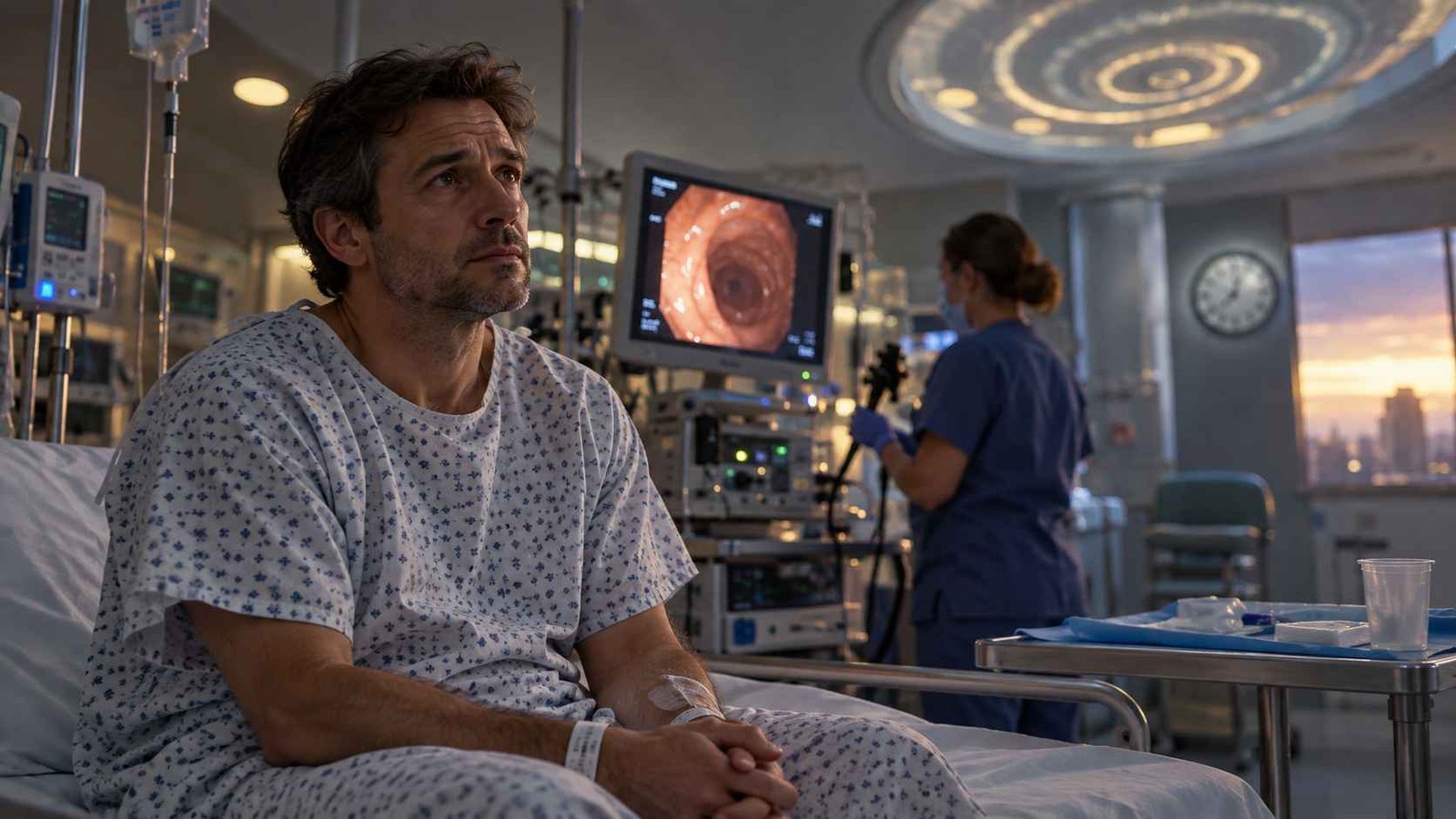
3. What Actually Happened: The Science of Sedation
Once the grogginess lifted, I wanted to understand what had really happened to me. My experience, it turns out, is extremely common, and there is a clear medical explanation for it. I cannot tell you exactly which medicines my own care team used, since only my medical records can confirm that, but here is what trusted sources say generally happens.
The spray: numbing, not sleeping
The spray many patients receive is typically a local anesthetic such as lidocaine. According to Nottingham University Hospitals NHS Trust, lidocaine throat spray numbs the back of the throat and reduces the gag reflex, making it easier to tolerate the scope. It is the same drug a dentist uses, only sprayed rather than injected. The U.S. National Institute of Diabetes and Digestive and Kidney Diseases (NIDDK) also describes spraying or gargling an anesthetic to numb the throat and calm the gag reflex.
In other words, the spray itself is usually not what makes you drift away. It simply prepares your throat.
The sedative: where the missing time comes from
The drowsiness usually comes from a sedative given through an IV line in the arm. The American Society of Anesthesiologists notes that moderate or deep sedation is the most common choice for upper endoscopy, and that under these levels patients are likely to have no memory of the procedure. Many centers use medicines such as midazolam, often combined with a pain reliever, or propofol, a fast-acting sedative. A 2013 meta-analysis in PLOS ONE lists amnesia as one of the stated goals of endoscopic sedation, alongside comfort and a smooth recovery.
Throat Spray
Numbs the throat and reduces gagging. Works locally; it is not what causes the "blink."
Sedative
Relaxes you and often prevents new memories from forming during the procedure.
Recovery Area
You rest while the medicine wears off. The Mayo Clinic says this can take an hour or so.
Why it felt like "hours"
The scope work itself is often brief. Many clinics describe upper endoscopy as taking roughly 10 to 20 minutes, and the NIDDK notes that patients commonly stay one to two hours afterward while the sedative wears off. Add check-in, preparation, and recovery, and you can easily lose a long stretch of the day. For me, all of it folded into a single blink.
| Stage | What was actually happening | What I experienced |
|---|---|---|
| Throat spray | Local anesthetic numbing the throat | A bitter taste and a thick, numb throat |
| Sedation | Medication taking effect | Nothing |
| The procedure | Camera examining my upper digestive tract | Nothing |
| Early recovery | Monitoring while the sedative wore off | Nothing |
| Waking | Awareness and memory returning | "Can we start now?" |
4. Why Hours Felt Like Nothing
We tend to think of time as something we directly feel, like temperature. In everyday life, though, our sense of duration depends heavily on memory. We know an afternoon has passed because we can recall moments within it: a conversation, a meal, the light changing through a window. When no new memories are recorded, the mind has nothing to measure.
Ordinary sleep is different from what I went through. When you sleep naturally, you often wake with clues that time has passed: you may remember dreams, feel stiff from lying still, or sense that the room has grown brighter. Anesthesia researchers have spent years explaining that drug-induced unconsciousness is not the same thing as sleep. In a widely cited 2010 review in the New England Journal of Medicine, Dr. Emery Brown and colleagues described general anesthesia as a drug-induced, reversible coma rather than sleep. As MIT News reported, their brain-wave comparisons showed that even the deepest natural sleep is not as deep as the lightest general anesthesia.
To be clear, most endoscopy patients receive sedation, which is lighter than full general anesthesia. But the shared principle holds: when the brain is not forming memories, there is no felt passage of time. The clocks keep moving. The self simply does not.
5. The Shape of Eternity: What the Blink Taught Me About Death
This is where my experience stopped being purely medical and became personal. I want to be careful here, because what follows is reflection, not science. No doctor, researcher, or instrument can tell us with certainty what happens to consciousness after death. But the blink gave me a new way to imagine it.
Lying in that recovery room, I realized something. If a person's consciousness is absent, there is no one there to experience waiting. For the one who is gone, time is, in effect, frozen. The world continues, but the mind is not counting.
Now imagine that consciousness were somehow to awaken again. Whether it happened after a thousand years, a million years, a billion years, or even a trillion years, it would feel exactly the way my recovery room felt. One blink. Close your eyes, open them, and the gap is nothing. Unimaginable spans of time would shrink to the same size as the hours I lost on a hospital bed.
When I first grasped this, it did not feel morbid. It felt oddly peaceful. So much of our fear of death is really a fear of endless waiting in the dark, of being trapped somewhere and aware of it. My blink suggested something different. Without awareness, there is no dark to sit in and no clock to watch. The time gap, however enormous, is experienced as nothing.
For people who believe in an afterlife or a future resurrection, this idea can bring comfort: the reunion, from the perspective of the one who died, would feel immediate. For people who do not, it points to a different kind of peace: whatever comes after is not suffered. I found that both roads led me away from dread.
6. How Philosophy and Faith Have Framed the Same Idea
I was humbled to learn that my recovery-room insight is not new. Thinkers and believers across thousands of years have reached for similar ideas.
Ancient philosophy
The Greek philosopher Epicurus argued that death should not frighten us, because where death is, we are not, and where we are, death is not. The Stanford Encyclopedia of Philosophy summarizes his view that death involves the absence of sensation and therefore cannot be experienced as harmful by the one who has died. The Roman poet Lucretius added a mirror image: the ages before we were born did not trouble us, so the ages after death need not either. The encyclopedia's entry on the philosophy of death explores these arguments and the debates they still spark.
A saying often attributed to Mark Twain makes the same point with humor: he claimed to have been dead for billions of years before his birth without the slightest inconvenience. Whether or not Twain actually said it, the thought mirrors my blink almost exactly.
Scripture and sleep
The Bible frequently uses the language of sleep and waking when speaking about death. When Jesus spoke of his friend Lazarus, he described death as sleep:
The book of Ecclesiastes describes the dead as unaware of the passing world, and Daniel speaks of a future awakening:
For believers, a blink between death and awakening is a hopeful picture. For thoughtful skeptics, the same image carries its own calm. Either way, I found it striking that a routine hospital visit could connect me to questions humanity has asked since the beginning.
7. Practical Advice If You Are Scheduled for an Endoscopy
If my story has you curious or a little nervous about your own upcoming procedure, here is what I learned, backed by trusted medical guidance. Always follow the specific instructions from your own doctor, since practices vary.
- Follow fasting instructions exactly. The Cleveland Clinic advises avoiding food for about eight hours before an EGD, with clear liquids allowed up to two hours before, unless your doctor says otherwise.
- Tell your doctor about every medication. Blood thinners and diabetes medicines may need adjusting beforehand.
- Bring a responsible adult. Because sedation affects judgment and reaction time, you will need someone to take you home. You should not drive or operate machinery afterward.
- Expect some "missing time." The Mayo Clinic notes that you may feel alert while your memory and judgment are still impaired. Do not panic if you remember nothing; that is often the intended effect.
- Avoid big decisions for the rest of the day. Rest, skip signing important documents, and let the sedative fully wear off.
- Ask for your results in writing. You may not remember what the doctor told you in recovery, so request a printed summary or have your companion listen in.
- Know the warning signs. Contact your doctor promptly if you have severe pain, fever, trouble swallowing, vomiting, or black or bloody stools after the procedure.
8. How One Blink Changed the Way I Live
It would be easy to file this experience away as a funny hospital story. I tell it that way sometimes, and people laugh at the moment I asked the nurse to start a procedure that had long since finished. But privately, it rearranged some of my priorities.
If an entire stretch of time can vanish without my noticing, then the moments I do experience are the only ones that are truly mine. The conversations, the sunsets, the quiet cups of coffee, the chance to apologize or say thank you: these are the frames of life that actually register. I have become less willing to sleepwalk through my waking hours.
The blink also softened a fear I did not realize I carried. I used to picture death as a long, lonely wait. Now I picture it as the recovery room: before, and then after, with nothing in between that I will ever have to endure. Whatever you believe about what comes next, I hope that picture brings you a little of the peace it brought me.
9. Frequently Asked Questions
Is it normal to remember nothing after an endoscopy?
Yes. Under moderate or deep sedation, many patients have little or no memory of the procedure, as the American Society of Anesthesiologists explains. This is usually an intended effect of the medication, not a sign that something went wrong.
What is the spray they use before an endoscopy?
It is commonly a local anesthetic such as lidocaine. It numbs the back of the throat and reduces the gag reflex. It generally does not put you to sleep; that effect usually comes from a sedative given through an IV.
How long does an upper endoscopy take?
The procedure itself often takes around 10 to 20 minutes, but you may spend one to two hours in recovery while the sedative wears off, plus time for check-in and preparation.
Is sedation the same as sleep?
Not exactly. Researchers such as Dr. Emery Brown have shown that drug-induced unconsciousness under general anesthesia differs markedly from natural sleep. Sedation for endoscopy is usually lighter than general anesthesia, but it can still prevent memories from forming, which is why time can seem to disappear.
Does science prove what happens to consciousness after death?
No. Science can describe how memory and awareness work in the living brain, but it cannot confirm what happens to consciousness after death. The reflection in this article is a personal and philosophical one, inspired by the experience of lost time under sedation.
Curious Minds Welcome
Enjoy learning surprising facts about the body, the mind, and the world? Put your knowledge to the test with today's quiz.
Take Today's Bing Quiz10. Sources and Further Reading
- Mayo Clinic. Upper endoscopy.
- Cleveland Clinic. EGD Procedure (Upper Endoscopy).
- National Institute of Diabetes and Digestive and Kidney Diseases. Upper GI Endoscopy.
- American Society of Anesthesiologists, Made for This Moment. Upper Endoscopy: Risks, Prep, and Procedure.
- Nottingham University Hospitals NHS Trust. Sedation Options.
- Wang D, et al. (2013). The Use of Propofol as a Sedative Agent in Gastrointestinal Endoscopy: A Meta-Analysis. PLOS ONE.
- Folino TB, et al. Propofol. StatPearls, NCBI Bookshelf.
- Brown EN, Lydic R, Schiff ND. (2010). General Anesthesia, Sleep, and Coma. New England Journal of Medicine.
- MIT News. Anesthesia, sleep and coma.
- Quanta Magazine. Emery Brown and the Truth About Anesthesia.
- Stanford Encyclopedia of Philosophy. Epicurus and Death.
- The Holy Bible, King James Version: John 11:11; Ecclesiastes 9:5; Daniel 12:2.