
A 19th-Century Scientist Quizzed Himself on Nonsense Words to Discover How We Forget
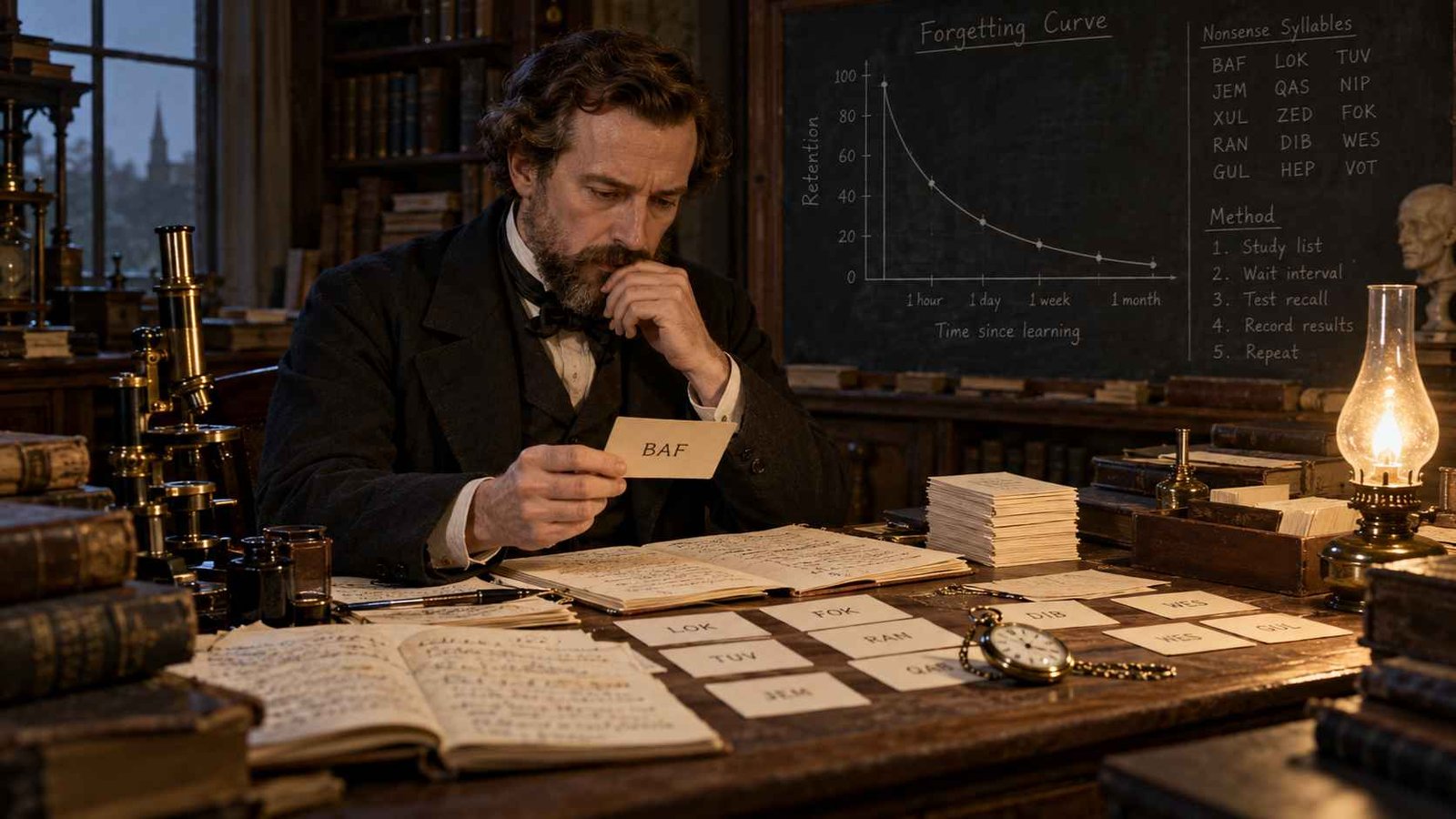
In the late 1870s, a German philosopher named Hermann Ebbinghaus spent months memorizing gibberish like "DAX" and "BOK," then timed how fast it slipped away. The graph he produced, the forgetting curve, still shapes how teachers teach and how study apps schedule your flashcards.
Key takeaways
- Hermann Ebbinghaus ran the first careful, numbers-based experiments on memory, published in 1885 as Über das Gedächtnis (On Memory).
- He memorized lists of meaningless three-letter syllables so that prior knowledge couldn't muddy his results.
- Forgetting was fastest right after learning, then slowed dramatically. That shape is the famous forgetting curve.
- He also found that spreading practice over several days beats cramming, an idea now known as the spacing effect.
- A faithful 2015 replication produced a strikingly similar curve, 130 years later.
Most of us have lived the same small tragedy. You read a chapter, feel great about it, and by the next morning it has quietly packed its bags. It's easy to assume forgetting is random, a leak we can't predict or measure.
Hermann Ebbinghaus disagreed. He suspected forgetting followed rules, and he was stubborn enough to spend long stretches of his life reciting nonsense out loud to prove it. The result was one of the most durable findings in the history of psychology.
Who Was Hermann Ebbinghaus?
Hermann Ebbinghaus was born on January 24, 1850, in Barmen, a textile town in what is now Wuppertal, Germany. He studied history and philosophy at the universities of Bonn, Halle, and Berlin, and earned his doctorate at Bonn in 1873 with a dissertation on the philosophy of the unconscious.
So far, that's a fairly ordinary résumé for a 19th-century scholar. The turn came afterward. While living and tutoring abroad, Ebbinghaus came across Gustav Fechner's Elements of Psychophysics, a book that showed you could measure the mind's responses to physical sensations, like how much heavier a weight must be before you notice the difference. The story usually told is that he found a secondhand copy in Paris.
Fechner had measured perception. Ebbinghaus wondered whether the same rigor could be pointed at something messier: memory. At the time, most scholars thought memory was too personal and slippery to put numbers on. Ebbinghaus decided to try anyway.
Born: 1850, Barmen, Germany · Died: 1909, Halle, Germany · Taught at: Berlin, Breslau, and Halle · Best known for: the forgetting curve, the learning curve, the spacing effect, and the Ebbinghaus illusion (the one where two identical circles look different sizes depending on what surrounds them).
Why Nonsense Syllables?
Here's the problem Ebbinghaus faced. If you test memory with real words, poems, or facts, you're not measuring a clean slate. Someone who loves football will remember a list of team names far better than someone who doesn't. Real material comes pre-loaded with meaning, emotion, and associations, and all of that distorts the results.
His workaround was clever and a little absurd. He built a pool of roughly 2,300 syllables, each made of a consonant, a vowel, and another consonant. Syllables in this style look like:
These pronounceable scraps had, in theory, no meaning, so every list started out equally unfamiliar. In practice, a few accidentally resembled real German words, and Ebbinghaus acknowledged this. Still, the syllables were far more uniform than any collection of real words could be, which was the whole point.
He later ran a revealing side test. He memorized stanzas of Lord Byron's poem Don Juan and compared the effort with an equivalent amount of nonsense. The poetry took only a small fraction of the repetitions. Meaning, rhythm, and rhyme are powerful memory aids, which is exactly why he had to strip them out to see forgetting in its rawest form.
How the Self-Experiment Worked
Ebbinghaus had no lab assistants, no volunteer pool, and no grant committee. He had himself. That made him both the scientist and the only test subject, which sounds like a recipe for bias, so he built strict routines to keep himself honest.
In his main forgetting study, run in 1879 and 1880, the process looked like this:
- Build the lists. Each test used a set of lists (usually eight) of 13 nonsense syllables apiece, drawn from his syllable pool.
- Read at a steady beat. He read the syllables aloud at a fixed pace, about four-tenths of a second per syllable, so speed stayed constant from session to session.
- Learn to a strict standard. He kept going until he could recite a list without error twice in a row. The time it took was recorded.
- Wait. He then let a set amount of time pass: about 20 minutes, 1 hour, 9 hours, 1 day, 2 days, 6 days, or 31 days.
- Relearn and compare. After the wait, he relearned the same lists to the same standard and compared the time to his first attempt.
In total, he logged 163 of these learn-then-relearn "double tests." He also tried to control the rest of his life: keeping his daily habits steady and noting the time of day, because he found he learned more slowly in the evening.
The genius move: the "savings" method
Ebbinghaus didn't just ask, "How many syllables can I still recall?" Often the answer would be zero, which tells you almost nothing. Instead he measured how much easier relearning was the second time.
Say a list took 1,000 seconds to learn at first, and 400 seconds to relearn a day later. He saved 600 seconds, or 60% of the original effort. That saving is a trace of memory that's still there even when you can't consciously pull anything up. It's the same reason picking up a language you studied years ago feels faster than starting fresh, even if you swear you've forgotten it all.
The Forgetting Curve: What He Found
When Ebbinghaus lined up his savings scores across the different delays, a clear pattern emerged. Here are his published averages from the 1879–1880 study:
| Time after learning | Effort saved when relearning |
|---|---|
| About 20 minutes | 58.2% |
| 1 hour | 44.2% |
| About 9 hours | 35.8% |
| 1 day | 33.7% |
| 2 days | 27.8% |
| 6 days | 25.4% |
| 31 days | 21.1% |
Ebbinghaus's savings scores plotted over time (intervals are evenly spaced for readability, not to scale).
Two things jump out. First, the drop is brutal at the start. Within an hour, more than half the benefit of his original effort was gone. Second, the curve flattens out. Between day 6 and day 31, he lost only a few more percentage points. What survives the first couple of days tends to stick around for a long time.
Ebbinghaus even fitted a mathematical formula to his numbers, a logarithmic relationship between time and retention. He was careful to say it described his own results under his own conditions, and he didn't claim to have found a universal law. That kind of honest hedging is one reason his work has aged so well.
Other Discoveries Hiding in His Notebooks
The forgetting curve gets the headlines, but Ebbinghaus's 1885 book is packed with findings that still hold up. A few highlights:
Spacing beats cramming
He found that about 38 repetitions spread over three days did roughly as much good as 68 repetitions crammed into a single day. That's the spacing effect.
The learning curve
Longer lists took disproportionately more effort to learn. A list slightly beyond what he could hold in one go took far more repetitions than a short one.
Extra practice pays off
The more times he rehearsed a list on the first day, the less work it took to relearn it the next day, even past the point where he already "knew" it.
Hidden connections
By reshuffling lists, he showed his brain linked not only neighboring syllables but also ones several steps apart, forming associations he never noticed making.
After On Memory, Ebbinghaus went on to co-found an influential psychology journal in 1890, develop an early sentence-completion test used to assess schoolchildren's mental abilities, and write popular textbooks. He died of pneumonia in 1909, still in his fifties. One of his most quoted lines comes from a 1908 textbook:
"Psychology has a long past, but only a short history." — Hermann Ebbinghaus, Abriss der Psychologie (1908)
He meant that people had wondered about the mind for thousands of years, but measuring it scientifically had only just begun. He was one of the people who began it.
Does It Hold Up Today?
A single scientist testing himself on made-up syllables doesn't sound like bulletproof evidence. Plenty of famous psychology findings have crumbled when researchers tried to repeat them. So how does Ebbinghaus fare?
Remarkably well. In 2015, researchers Jaap Murre and Joeri Dros at the University of Amsterdam repeated his forgetting experiment as closely as they could, using the same savings method and the same delays, with one dedicated subject learning lists over many weeks. Their results, published in PLOS ONE, closely matched the original curve.
They also noticed something Ebbinghaus himself had puzzled over. In his data, the 24-hour result looked slightly too high compared with its neighbors. The replication showed the same small bump at the one-day mark. Murre and Dros suggested sleep as a likely reason, since a night's sleep appears to help the brain consolidate what it learned during the day.
The fair criticisms
That doesn't make Ebbinghaus's work the final word. Critics have raised good points over the years:
- One subject. His results describe one well-trained, highly motivated man. Your curve may be steeper or gentler depending on the material, your sleep, your stress levels, and how well you learned it in the first place.
- Artificial material. Real life isn't made of nonsense syllables. In 1932, British psychologist Frederic Bartlett showed that when people remember meaningful stories, they don't just lose details; they reshape them to fit their expectations. Memory is a reconstruction, not just a fading recording.
- Savings isn't recall. His numbers measure how much easier relearning is, not how much you can spontaneously remember. The two are related but not the same thing.
Even so, the core pattern (fast early loss, then a long, slow tail) has shown up across many later studies with different people and materials. The specific percentages change; the shape keeps returning.
How to Use the Forgetting Curve in Real Life
The good news hidden in all this gibberish is that the curve isn't fixed. Every well-timed review resets it and makes the next drop gentler. A widely cited 2013 review of learning techniques by Dunlosky and colleagues rated two strategies as the most useful across many studies: spreading practice out over time, and testing yourself. Both trace a line back to Ebbinghaus.
Review early
The steepest loss happens in the first hours. A quick review the same evening or the next morning catches memories before they slide.
Then stretch the gaps
After the first review, space the next ones further apart: a few days, then a week, then longer. This is how spaced-repetition flashcard apps work.
Quiz yourself
Pulling an answer out of your head strengthens memory more than rereading. Ebbinghaus reciting his lists from memory was an early form of this.
Add meaning
His Don Juan test proved it: meaningful material sticks far better. Connect new facts to things you already know, or turn them into a story.
Sleep on it
That little bump at the 24-hour mark hints at sleep's role. Pulling an all-nighter before a test works against your own memory.
Overlearn what matters
Practicing past the point of "I've got it" pays off later. For anything important, one correct run-through isn't enough.
Put Ebbinghaus to the test 🧠
Self-quizzing is one of the best ways to beat the forgetting curve, and it's a lot more fun with real questions than with "ZEF" and "KUP."
Try Today's Bing QuizCommon Myths About the Forgetting Curve
Myth: "We forget 70% of what we learn within 24 hours."
Reality: This figure gets passed around in slide decks and corporate training, usually credited to Ebbinghaus. His numbers measured the effort saved in relearning nonsense syllables, not the share of real information people forget. How much you actually lose depends heavily on what you learned and how well.
Myth: "Once something is forgotten, it's gone."
Reality: The entire savings method rests on the opposite idea. Even when Ebbinghaus couldn't recite a list, relearning it was faster a month later. Traces linger long after conscious recall fails.
Myth: "Ebbinghaus invented spaced-repetition apps."
Reality: He documented the spacing effect, but the expanding review schedules used in modern flashcard software were developed much later by other researchers and programmers who built on his findings.
Frequently Asked Questions
What is the Ebbinghaus forgetting curve?
It's a graph showing how memory of newly learned material declines over time when you don't review it. The decline is steep in the first hours and days, then levels off into a long, slow fade.
Why did Ebbinghaus use nonsense syllables?
Real words carry meaning and personal associations, which make some items easier to remember than others. Meaningless consonant-vowel-consonant syllables gave him more uniform material, so he could measure forgetting itself rather than the effects of prior knowledge.
When did Ebbinghaus publish his findings?
His book Über das Gedächtnis (On Memory) was published in 1885. An English translation, Memory: A Contribution to Experimental Psychology, appeared in 1913.
Has the forgetting curve been proven by modern research?
Yes, in its general shape. A 2015 replication by Jaap Murre and Joeri Dros reproduced a curve very similar to the original. Exact percentages vary by person and material, but rapid early forgetting followed by a slow decline shows up again and again.
How can I slow down forgetting?
Review new material soon after learning it, then space later reviews further apart. Test yourself instead of just rereading, connect new information to what you already know, and get enough sleep.
Sources and Further Reading
- Ebbinghaus, H. (1885/1913). Memory: A Contribution to Experimental Psychology (H. A. Ruger & C. E. Bussenius, Trans.). Full text via Classics in the History of Psychology, York University. See especially Chapter 7: Retention and Obliviscence as a Function of the Time.
- Murre, J. M. J., & Dros, J. (2015). Replication and Analysis of Ebbinghaus' Forgetting Curve. PLOS ONE, 10(7), e0120644. doi.org/10.1371/journal.pone.0120644
- Dunlosky, J., Rawson, K. A., Marsh, E. J., Nathan, M. J., & Willingham, D. T. (2013). Improving Students' Learning With Effective Learning Techniques. Psychological Science in the Public Interest, 14(1), 4–58. Read the paper
- Encyclopaedia Britannica. Hermann Ebbinghaus: German psychologist.
- Bartlett, F. C. (1932). Remembering: A Study in Experimental and Social Psychology. Cambridge University Press.