
Weather Trivia · Philippines
A Rainy Day in Manila Got Me Wondering How Typhoons Get Their Names
Why does one storm have two names? Who picks them, and why do some names disappear forever? Here is the surprisingly organized system behind every bagyo, plus a race-against-the-rain quiz to test what you learned.
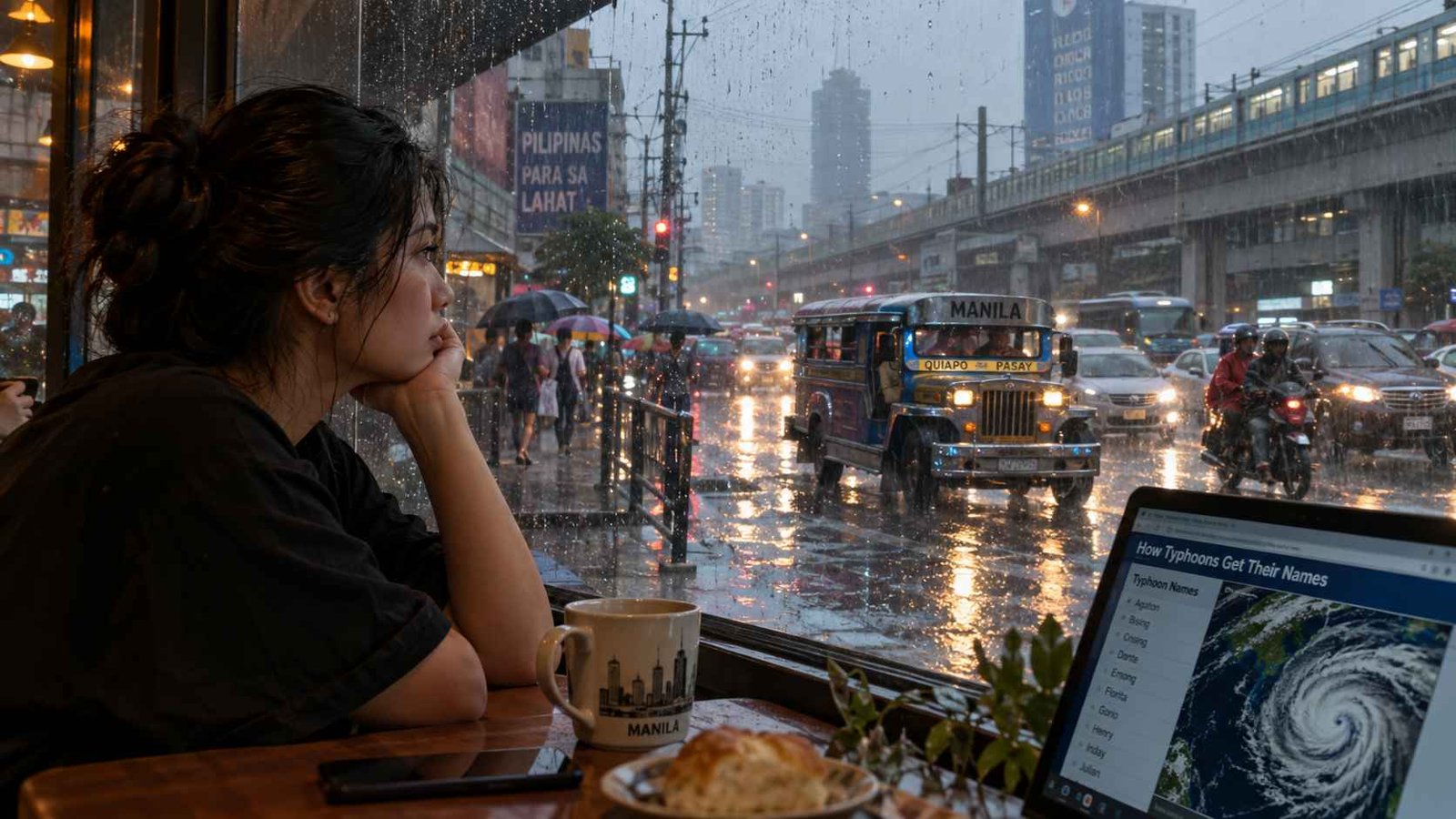
The rain in Manila doesn't ease in politely. One minute the sky over Makati is gray, and the next the windows are streaming and the streets below are turning into small rivers. On one of those afternoons, waiting for the downpour to let up before heading home, I scrolled through the weather updates and noticed something I had always taken for granted: the storm had a name. Actually, it had two.
PAGASA called it by a familiar Filipino name, while international news sites used a completely different one. That simple observation sent me down a research rabbit hole. It turns out there is a carefully planned system behind every storm name, involving more than a dozen countries, rotating lists and rules for retiring names forever.
Key Takeaways
- PAGASA gives a local Filipino name to every tropical cyclone that enters or forms inside the Philippine Area of Responsibility (PAR).
- International names for western North Pacific storms come from a shared list of 140 names contributed by the 14 members of the ESCAP/WMO Typhoon Committee.
- That is why one storm can have two names, like Typhoon Haiyan, known in the Philippines as Yolanda.
- Names linked to severe deaths or damage are retired so they are never used again.
Part 1
Typhoon, Hurricane or Cyclone?
Before getting into names, it helps to know that typhoons, hurricanes and cyclones are the same kind of weather system: a strong, rotating tropical storm that forms over warm ocean water. The word changes depending on where the storm forms.
Typhoon
Western North Pacific, including the Philippines, Japan, China and Vietnam.
Hurricane
North Atlantic, Caribbean and the central and eastern North Pacific.
Cyclone
Indian Ocean and the South Pacific, including Australia.
Scientists use the umbrella term tropical cyclone for all of them. In the Philippines, everyday conversation simply calls them bagyo.
Did you know? In the Northern Hemisphere, tropical cyclones spin counterclockwise because of the Earth's rotation. In the Southern Hemisphere, they spin clockwise.
Part 2
Why Storms Get Names at All
Meteorologists could simply number every storm, but names have proven far more practical, especially when lives are at stake.
🗣️
Easy to remember. A short name sticks in people's minds better than a code or coordinates.
📢
Clearer warnings. Names make news reports, text alerts and radio announcements easier to understand.
🌀
Less confusion. When two or more storms are active at the same time, names help everyone know which one is which.
🤝
Better coordination. Government agencies, rescuers and the media can all refer to the same storm quickly.
Part 3
A Short History of Storm Naming
Storm names have changed a lot over the past century. Here are some of the milestones that shaped today's system.
- Late 1800s
A forecaster with a sense of humor
Australian meteorologist Clement Wragge is often credited as one of the first to give storms personal names. According to popular accounts, he sometimes named them after politicians he disliked.
- 1940s
Military forecasters use women's names
During World War II, U.S. military meteorologists tracking Pacific storms informally used women's names. The practice later became official in several regions.
- 1960s
The Philippines starts its own list
The Philippine weather bureau began using its own local names for storms, a tradition PAGASA continues today.
- Late 1970s
Men's names join the lists
Weather agencies began alternating men's and women's names, ending decades of female-only naming.
- 2000
Asian names for Asian storms
Starting in 2000, western North Pacific storms began receiving names contributed by countries in the region instead of mostly English names.
Part 4
How International Names Are Chosen
For the western North Pacific, the official international names are assigned by the Japan Meteorological Agency (JMA), which serves as the Regional Specialized Meteorological Centre for the area. The names come from a list prepared by the ESCAP/WMO Typhoon Committee.
The committee has 14 members: Cambodia, China, Hong Kong, Japan, Laos, Macau, Malaysia, the Federated States of Micronesia, North Korea, the Philippines, South Korea, Thailand, the United States and Vietnam. Each member contributed 10 names, creating a list of 140 names used one after another. When the list runs out, it starts over from the beginning.
Unlike in the Atlantic, these names are not in alphabetical order and many are not people's names at all. They include animals, plants, foods, places and words from mythology. For example, Haiyan, contributed by China, refers to a petrel, a type of seabird. Hagibis, a name contributed by the Philippines, is a Filipino word meaning "swift."
Fun fact: The JMA only gives a storm an international name once it reaches tropical storm strength. Weaker tropical depressions usually get a number instead.
Part 5
How PAGASA Names Philippine Storms
The Philippine Atmospheric, Geophysical and Astronomical Services Administration, better known as PAGASA, runs its own naming system. Whenever a tropical cyclone enters or forms inside the Philippine Area of Responsibility (PAR), PAGASA gives it a local name, even if it already has an international one.
International (JMA)
Shared regional list
- 140 names from 14 Typhoon Committee members
- Not alphabetical; many are words, not people's names
- Given when a storm reaches tropical storm strength
- Used across the whole western North Pacific
Local (PAGASA)
Filipino names
- Four sets of names, rotated every four years
- Alphabetical, with 25 main names in each set plus 10 extra names
- Given to every cyclone in the PAR, including tropical depressions
- Mostly familiar Filipino names
Because PAGASA reuses each set every four years, the storm names used this year will appear again four years from now, unless some of them are retired. If a very active season uses up all 25 main names, PAGASA switches to the extra names on that year's list.
Why one storm can have two names
A storm that forms far out in the Pacific may already have an international name before it reaches the PAR. Once it enters, PAGASA gives it a local name too. That is how the same storm ends up with two names, as these well-known examples show.
| Year | International name | Philippine name |
|---|---|---|
| 2009 | Ketsana | Ondoy |
| 2011 | Washi | Sendong |
| 2012 | Bopha | Pablo |
| 2013 | Haiyan | Yolanda |
| 2020 | Vamco | Ulysses |
| 2021 | Rai | Odette |
Part 6
Why Some Names Are Retired
Some storms cause so much loss that reusing their names would be painful and confusing. In those cases, the name is permanently removed from the list and replaced with a new one.
PAGASA generally retires a local name when a storm causes at least 300 deaths or at least ₱1 billion in damage. Every Philippine name in the table above has been retired for this reason. Typhoon Yolanda in 2013 remains one of the deadliest storms in modern Philippine history.
The Typhoon Committee follows a similar process for international names. Member countries can request that a name be retired after a destructive storm, and the country that contributed the original name submits a replacement. Haiyan and Hagibis are both examples of retired international names.
Why it matters: Retiring a name is a way of honoring the people affected. It ensures that a future, unrelated storm will never share the name of a tragedy.
Part 7
Storm Categories and Wind Signals
A storm's name tells you which storm it is. Its category and wind signal tell you how dangerous it is. PAGASA classifies tropical cyclones into five categories based on their maximum sustained winds.
| Category | Maximum sustained winds |
|---|---|
| Tropical Depression | Up to 61 km/h |
| Tropical Storm | 62 to 88 km/h |
| Severe Tropical Storm | 89 to 117 km/h |
| Typhoon | 118 to 184 km/h |
| Super Typhoon | 185 km/h or higher |
PAGASA also raises Tropical Cyclone Wind Signals from No. 1 to No. 5 for specific areas, depending on the expected wind strength there. Signal No. 5, the highest level, was added in 2015 after the experience of Typhoon Yolanda showed the need for a warning above Signal No. 4.
On average, about 20 tropical cyclones enter the PAR each year, which is why Filipinos learn to watch the signals from a young age.
Part 8
Staying Safe on Stormy Days
Knowing a storm's name is interesting, but knowing what to do when it arrives matters most. These simple habits can make a real difference.
📡
Follow official updates
Get information from PAGASA, your local government and NDRRMC advisories rather than unverified social media posts.
🎒
Prepare a go bag
Keep water, food, a flashlight, batteries, medicine, important documents and a charged power bank ready.
🌊
Avoid floodwater
Do not walk or drive through floods. Water can be deeper and faster than it looks and may carry diseases such as leptospirosis.
🏠
Evacuate when advised
If authorities call for evacuation, leave early and bring your go bag, family members and pets if possible.
⛈️ Quiz: Beat the Storm
Twelve questions, 20 seconds each, and only three umbrellas. Every wrong answer or timeout costs you an umbrella. Every correct streak raises your storm signal. How dry can you stay?
⏱️ 20 sec per question☂️ 3 umbrellas📶 Streak signal🏅 4 forecaster ranks
Frequently Asked Questions
Who names typhoons in the Philippines?
PAGASA gives local names to tropical cyclones inside the Philippine Area of Responsibility. International names for the western North Pacific are assigned by the Japan Meteorological Agency from a list prepared by the ESCAP/WMO Typhoon Committee.
Why do Philippine typhoons have two names?
A storm may receive an international name before it enters the PAR. Once inside, PAGASA gives it a local name for Filipino audiences, so it ends up with both. For example, Typhoon Haiyan was called Yolanda in the Philippines.
How often are PAGASA's storm names reused?
PAGASA uses four sets of names in rotation, so each set returns every four years. Names that are retired after a destructive storm are replaced with new ones.
When is a typhoon name retired?
PAGASA generally retires a local name when a storm causes at least 300 deaths or at least ₱1 billion in damage. Retired names are never used again.
Can I suggest a new typhoon name?
PAGASA has held public naming contests in the past to replace retired names. Check PAGASA's official channels for announcements of any future calls for suggestions.
Rainy Day? Perfect Quiz Weather.
Stuck indoors? Keep your mind busy with a fresh daily quiz on history, science, geography and current events.
Play Today's Bing Quiz TopicThis article is for educational purposes. During an actual storm, always follow the latest advisories from PAGASA, the NDRRMC and your local government.