
Hot Water Can Sometimes Freeze Faster Than Cold, and Scientists Still Argue Why
Put two identical cups of water in the freezer, one warm and one cool, and common sense says the cool one will turn to ice first. Most of the time, it does. But every so often, the warm cup wins the race. This oddity has a name, the Mpemba effect, and it has been confusing curious people since the days of Aristotle.
What makes it such a good story is not just that it sounds impossible. It is that, more than half a century after a Tanzanian teenager forced modern scientists to take it seriously, researchers still disagree about how often it happens, why it happens, and whether the version in your kitchen freezer is real at all. Meanwhile, physicists have found cousins of the effect in tiny glass beads and even in quantum computers.
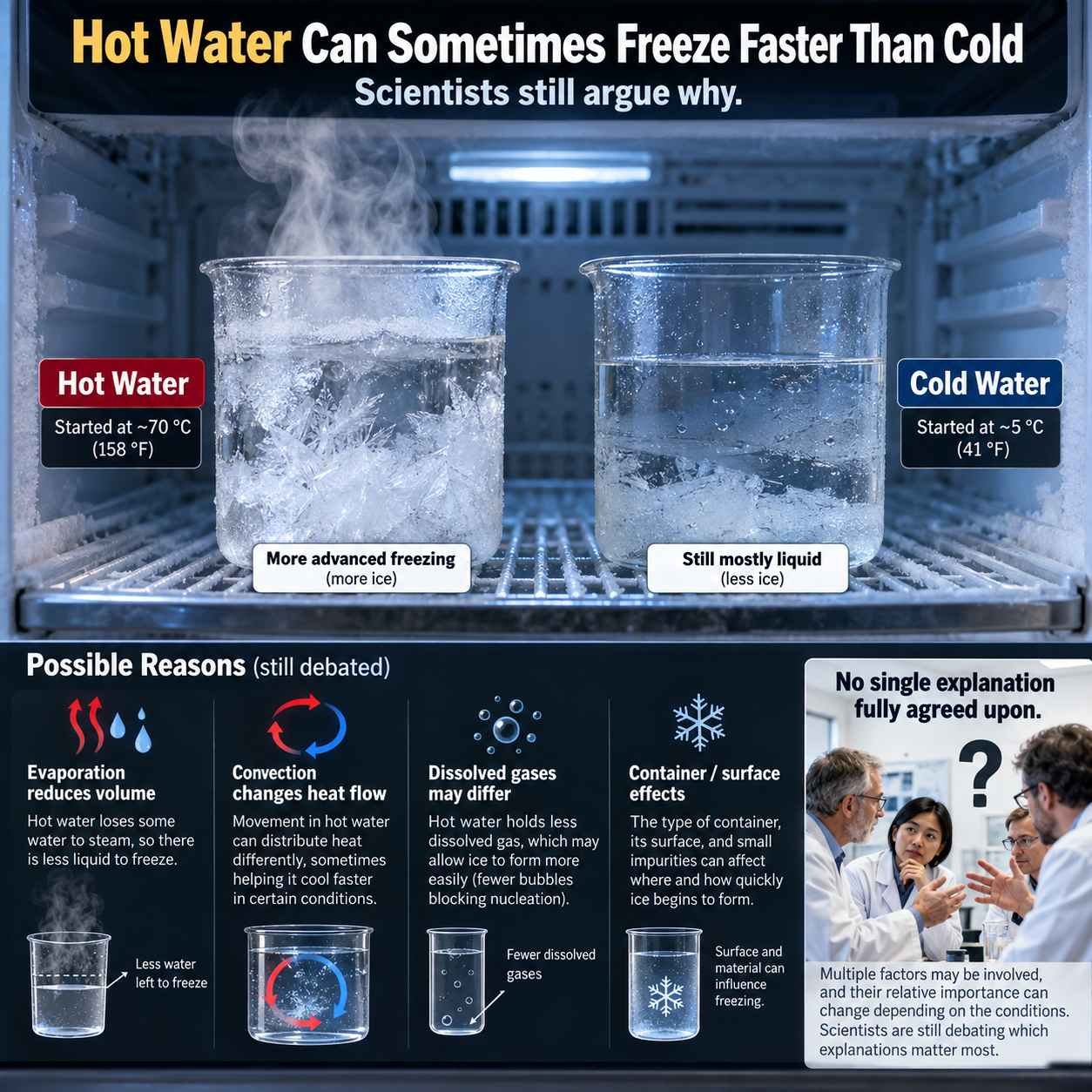
The short answer
Yes, hot water can sometimes freeze faster than cold water, but not always, and not under every setup. The leading explanations involve evaporation, dissolved gases, convection currents, supercooling, and how the container touches the freezer. Some careful studies argue the classic kitchen version is mostly a measurement artifact, while physicists have firmly demonstrated "Mpemba-like" speedups in other systems. The debate is very much alive.
What Is the Mpemba Effect?
The Mpemba effect is the observation that, under some conditions, a sample of water that starts out hotter will begin freezing sooner than an otherwise identical sample that starts out cooler. It is named after Erasto Mpemba, who noticed it as a secondary school student in Tanzania in 1963.
At first glance it seems to break a basic rule. To freeze, hot water has to cool all the way down through the starting temperature of the cold water and then keep going. How could it possibly overtake something that had a head start?
The key is the phrase otherwise identical. Heating water changes more than its temperature. Warm water evaporates faster, holds less dissolved air, swirls differently inside its container, and may even melt a little patch of frost under its cup. By the time the hot sample has cooled to the cold sample's starting point, it is no longer the same water in the same situation. That is where the race can flip.
❄️ Worth knowing
The Mpemba effect does not violate the laws of thermodynamics. Nothing is cooling "backward." The hot sample simply loses heat through extra routes, or the cold sample gets stuck, so the two samples are not on the same path.
An Ancient Puzzle: Aristotle, Bacon and Descartes
Erasto Mpemba did not discover the effect from scratch. He rediscovered something people had been noticing for more than two thousand years.
In the 4th century BCE, Aristotle wrote in his Meteorologica that water which has been warmed beforehand tends to freeze more quickly. He even described people in the Pontus region who, when setting up to fish in winter, poured hot water over their reeds so it would ice up faster. The philosopher did not have a convincing explanation, but he clearly thought the observation was real.
Centuries later, Francis Bacon mentioned in Novum Organum (1620) that slightly warm water freezes more easily than very cold water. René Descartes made a similar remark in his 1637 work on meteorology. In 1775, the Scottish chemist Joseph Black, famous for his work on heat, published experiments on whether boiling water made it freeze more readily.
Then the idea quietly slipped out of mainstream science. For much of the modern era, it was treated as folklore, the kind of thing a physics teacher would politely correct.
The Schoolboy Who Wouldn't Let It Go
In 1963, Erasto Mpemba was a Form 3 student at Magamba Secondary School in what is now the Tanga region of Tanzania. Students there made ice cream by boiling milk, stirring in sugar, and putting the mixture in the freezer once it cooled.
One day, freezer space was running out. Rather than wait and risk losing the last ice tray, Mpemba put his mixture in while it was still hot. To his surprise, it froze into ice cream before a classmate's mixture that had gone in cool.
He asked his physics teacher why. The teacher told him he must have been confused. When he raised it again later, classmates mocked the idea as "Mpemba's physics," and asked whether he had actually understood Newton's law of cooling. His reply, as he later wrote, was simple:
"Theory differs from practical." — Erasto Mpemba, recalling his classmates' teasing, in Physics Education (1969)
His break came when Dr. Denis Osborne, a physics lecturer from University College, Dar es Salaam, visited the school and invited questions. Mpemba asked why hot water would freeze first. Osborne did not dismiss him. Back at the university, he had a technician test it, and the result held up under their conditions. In 1969, the two published a paper together in the journal Physics Education, under the charmingly modest title "Cool?" The first half is Mpemba's own account; the second describes Osborne's follow-up experiments.
The same year, a Canadian scientist named George Kell independently published a paper on the freezing of hot and cold water in the American Journal of Physics. The old puzzle was back, and this time it carried a name. Mpemba went on to a career in wildlife management and conservation in Tanzania, but his schoolboy question outlived almost everyone who laughed at it.
🔥 Why this story matters
Beyond the physics, Mpemba's experience is often used in classrooms as a lesson in scientific humility: an observation should be tested, not waved away because it contradicts what the textbook seems to say, or because of who happened to notice it.
Why Hot Water Might Win: The Leading Explanations
There is no single agreed-upon cause. Most researchers now think several mechanisms can contribute, and which one dominates depends on the container, the freezer, the water, and even how "frozen" is defined. Here are the main candidates.
1. Evaporation
Hot water loses molecules to the air much faster than cold water. That does two things: it removes heat (evaporation is a powerful cooling process), and it leaves less water behind to freeze. Kell's 1969 paper focused on this idea. However, Osborne noted early on that evaporation alone did not seem to account for everything, and some experiments report the effect even in covered containers.
2. Dissolved gases
Cold water holds more dissolved air than hot water, which is why heated water drives out bubbles. Dissolved gases can slightly lower the freezing point and may change how heat moves through the liquid. Water that has been heated, especially boiled, starts its cooling journey with less gas, which could nudge it toward freezing sooner.
3. Convection currents
Warm water develops strong internal currents as hotter water rises and cooler water sinks. This can keep the surface relatively warm, and a warm surface loses heat quickly to the cold freezer air. The result can be faster overall cooling than a simple "average temperature" calculation predicts. The winner of a 2012 Royal Society of Chemistry competition on the topic, Croatian chemist Nikola Bregović, emphasized convection as one of the key players.
4. Supercooling
This is the explanation many physicists find most convincing for when the effect does appear. Pure water can drop well below 0 °C and still stay liquid, a state called supercooling, until something triggers ice crystals to form. In a 1995 study, physicist David Auerbach found that cold water tended to supercool to lower temperatures than hot water, so the hot sample sometimes started forming ice first. Later work by James Brownridge (2011) reached a similar conclusion: hot water tends to win only when the cooler sample supercools further before it finally freezes.
The catch is that supercooling is partly random. The exact temperature at which ice starts can vary from run to run, which helps explain why the effect is notoriously hard to reproduce.
5. The freezer itself
Remember that Mpemba's first observation happened with trays in a real freezer. A hot container can melt the thin layer of frost it sits on, creating better contact with the cold shelf once that meltwater refreezes. A cool container sitting on insulating frost might lose heat more slowly. Details like this have nothing to do with the water's chemistry, yet they can decide the outcome.
6. Hydrogen bonds and molecular structure
Some researchers have proposed deeper explanations based on how water molecules bond with each other. A group led by Chang Q. Sun and Xi Zhang, for example, argued that heating stretches and stores energy in hydrogen bonds in a way that speeds up heat release. Molecular dynamics simulations have also explored how the arrangement of water molecules differs between hot and cold samples. These ideas are interesting but remain contested and are not part of any scientific consensus.
💨 Evaporation
Less water left, extra cooling from vapor loss.
🫧 Dissolved gas
Heated water holds less air, which may change freezing behavior.
🌀 Convection
Stronger currents keep the surface warm and shedding heat.
🧊 Supercooling
Cold water may stay liquid below 0 °C for longer.
The Skeptics Strike Back: Is It Real at All?
Not everyone accepts that the Mpemba effect exists in any meaningful way for water. The most prominent challenge came in 2016, when Henry Burridge and Paul Linden of the University of Cambridge published a paper in Scientific Reports with a blunt title: "Questioning the Mpemba effect: hot water does not cool more quickly than cold."
They reviewed earlier data, including the original 1969 measurements, and ran their own careful experiments. They showed that seemingly small choices, such as exactly where the temperature probe sits inside the container, can change what an experiment appears to show. Under their definition of the effect, they concluded they could find no evidence that it genuinely occurs, and they described it as a scientific fallacy.
That conclusion did not end the argument. In a published reply, chemist Jonathan Katz countered that Burridge and Linden had misread the effect as a statement about cooling rates, when the original claim was about freezing. In other words, the two sides were partly arguing about different things. A 2023 feature in Skeptical Inquirer summed up the view of many skeptics, describing how inconsistent definitions and a lack of reproducible results let the idea persist for decades.
🔬 The fair summary
There is strong agreement that the effect is not universal. There is real disagreement over whether, for ordinary water, it is a genuine physical phenomenon under specific conditions or mostly a product of experimental setup and random supercooling.
Why Scientists Still Can't Agree
The Mpemba effect is a perfect storm for scientific disagreement. It sounds simple, but it hides an enormous number of variables. Consider just a few questions every experimenter has to answer:
- What counts as "frozen"? The first ice crystal? A solid crust? The whole sample turning to ice? Each gives a different winner.
- Where do you measure temperature? Water in a cooling cup is not the same temperature everywhere.
- How hot is "hot" and how cold is "cold"? The effect has been reported only over certain temperature ranges.
- Is the container covered? That changes evaporation dramatically.
- What kind of water? Tap water, distilled water and boiled water all behave differently.
| Variable | How it can help hot water "win" | Why it complicates experiments |
|---|---|---|
| Evaporation | Hot sample loses mass and heat faster | Depends on lids, airflow and humidity |
| Dissolved gases | Heated water holds less air | Varies with water source and how long it was heated |
| Convection | Keeps surface warm, speeding heat loss | Sensitive to container shape and size |
| Supercooling | Cold sample may stay liquid below 0 °C longer | Partly random from one trial to the next |
| Freezer contact | Hot cup may melt frost and sit more snugly | Different in every freezer |
| Probe position | Readings can make one sample look faster | A small shift can change the result |
Small wonder, then, that when the Royal Society of Chemistry offered a £1,000 prize in 2012 for the best explanation, it received about 22,000 entries. The winner, announced in January 2013 with Erasto Mpemba himself in attendance in London, was Nikola Bregović of the University of Zagreb. His entry pointed to supercooling and convection, yet even the prize was widely seen as rewarding a thoughtful analysis rather than a final answer.
The Plot Twist: The Mpemba Effect Beyond Water
Here is where the story gets genuinely exciting. While chemists argued about ice cubes, physicists began asking a broader question: can a system that starts "hotter," or further from its final state, ever settle into that final state faster than one that starts closer? The answer turns out to be yes, and it has been shown convincingly in controlled experiments.
In 2017, theorists Zhiyue Lu and Oren Raz described a general framework for this kind of "anomalous relaxation," now often called the Markovian Mpemba effect. The same year, researchers predicted Mpemba-like behavior in granular fluids, collections of colliding grains that behave a bit like a gas.
The landmark experiment came in 2020. At Simon Fraser University in Canada, physicists Avinash Kumar and John Bechhoefer used a laser to control a single microscopic glass bead suspended in water, placing it in a carefully designed energy landscape. Published in Nature, their results showed that with the right settings, a hotter starting state could cool exponentially faster than a cooler one. Two years later, the same group reported the reverse, an "inverse Mpemba effect," in which a colder system heated up faster.
Then came the quantum world. In July 2024, Physical Review Letters published two experimental papers side by side:
- A team working in Innsbruck, Austria, used a 12-ion quantum simulator and found that a quantum system pushed further from symmetry restored that symmetry more quickly, a quantum version of the effect.
- A group at Israel's Weizmann Institute of Science demonstrated an inverse Mpemba effect on a single trapped strontium-88 ion, showing that it arises from quantum interference.
Since then, research on "quantum Mpemba effects" has grown quickly, with review articles and new experiments on superconducting quantum processors. Researchers have also reported Mpemba-like behavior in polymers, clathrate hydrates, carbon nanotube resonators and spin glasses.
⚡ Why this is useful
If you understand when a system can take a shortcut to equilibrium, you can design faster cooling or heating protocols. That could matter for anything from industrial processes to resetting qubits in quantum computers, where speed and precise control are everything.
Importantly, these experiments do not settle whether your kitchen ice tray shows the effect. They prove the underlying principle is real in some systems: starting further away does not always mean arriving later.
Try It Yourself: A Fair Kitchen Experiment
Want to test the Mpemba effect at home or in class? The trick is to be fair and repeat it several times. One run proves nothing.
- Use identical containers. Same material, size and shape. Heat-safe plastic or metal cups work best; avoid putting very hot glass into a freezer, which can crack from thermal shock.
- Measure equal amounts of water from the same source, for example 100 mL each.
- Set your temperatures. Try warm water around 50–60 °C against cool water around 20 °C. Adults should handle the hot water.
- Place both cups in the freezer at the same time, side by side on the same shelf, with no lids.
- Decide your finish line in advance. Will you record the first visible ice, a solid top layer, or complete freezing?
- Check at regular intervals (every 10 minutes works) and write down what you see.
- Repeat at least five times, swapping shelf positions, and compare the results.
Do not be surprised if the cold water usually wins. That is itself a useful scientific result, and it is exactly why this topic is so hard to pin down.
Myths vs. Facts
| Myth | Fact |
|---|---|
| Hot water always freezes faster than cold. | It does not. Under most everyday conditions, colder water freezes first. |
| Erasto Mpemba was the first to notice it. | Aristotle, Bacon and Descartes described similar observations centuries earlier. Mpemba revived scientific interest. |
| The effect breaks the laws of physics. | No. Heated water changes in ways (mass, gas content, currents) that give it different cooling paths. |
| Scientists solved it in the 2012 competition. | The competition rewarded the best explanation, but no single answer has been universally accepted. |
| It only matters for ice cubes. | Mpemba-like effects have been demonstrated in colloids, granular materials and quantum systems. |
Timeline of the Mpemba Effect
- 4th c. BCE
Aristotle notes that water warmed beforehand tends to freeze more quickly. - 1620
Francis Bacon mentions the idea in Novum Organum. - 1637
René Descartes makes a similar observation. - 1775
Joseph Black publishes experiments on boiled water and freezing. - 1963
Erasto Mpemba notices his hot ice cream mix freezing first in Tanzania. - 1969
Mpemba and Osborne publish "Cool?"; George Kell publishes independently. - 1995
David Auerbach links the effect to supercooling. - 2012–13
Royal Society of Chemistry competition draws about 22,000 entries; Nikola Bregović wins. - 2016
Burridge and Linden publish their skeptical study in Scientific Reports. - 2017
Lu and Raz develop a general theory of Mpemba-like relaxation. - 2020
Kumar and Bechhoefer demonstrate exponentially faster cooling in a colloidal system. - 2024
Two teams report quantum Mpemba effects using trapped ions.
Quick Quiz: Test What You Learned
Tap each question to reveal the answer.
1. What was Erasto Mpemba making when he noticed the effect?
Ice cream. He put a hot mixture of boiled milk and sugar into the freezer, and it froze before a cooler mixture.
2. In which country did Mpemba make his observation?
Tanzania (then Tanganyika), at Magamba Secondary School in 1963.
3. Which ancient Greek philosopher described a similar effect?
Aristotle, in his work Meteorologica.
4. What is it called when water stays liquid below 0 °C?
Supercooling. It is one of the leading explanations for when hot water wins.
5. About how many entries did the 2012 Royal Society of Chemistry competition receive?
About 22,000.
6. What did 2024 quantum Mpemba experiments use?
Trapped ions, including a single strontium-88 ion and a 12-ion quantum simulator.
Frequently Asked Questions
Does hot water really freeze faster than cold water?
Sometimes, under specific conditions. It is not a general rule. In many experiments, cold water freezes first, and some researchers argue the classic effect in water is mostly a measurement artifact.
Why is it called the Mpemba effect?
It is named after Erasto Mpemba, a Tanzanian student who observed it in 1963 and co-authored a 1969 paper on it with physicist Denis Osborne.
What is the most likely explanation?
There is no single agreed cause. Evaporation, dissolved gases, convection, supercooling and freezer contact can all play a role. Many physicists consider supercooling especially important in cases where hot water wins.
Does the Mpemba effect break the laws of thermodynamics?
No. The hot sample does not skip any steps. Heating changes the water's mass, gas content and internal motion, so the two samples follow different cooling paths.
Should I use hot tap water to make ice faster?
It is not a reliable shortcut, and it is not recommended. Hot tap water can pick up more contaminants from pipes, and the U.S. Environmental Protection Agency advises using cold water for drinking and cooking. Hot containers can also warm nearby frozen food.
Is the Mpemba effect real in quantum systems?
Yes, Mpemba-like effects have been demonstrated in quantum systems, including trapped-ion experiments published in 2024. These show the general principle is real, even if the kitchen version remains debated.
Final Thoughts
The Mpemba effect is a small question with a surprisingly big legacy. It began as a curiosity noticed by Aristotle, was dismissed as a myth, then came roaring back because a teenager trusted what he saw and kept asking. Today it sits at the crossroads of kitchen science, careful measurement and cutting-edge physics.
Does hot water freeze faster than cold? The most honest answer is: occasionally, depending on how you do it, and scientists are still arguing about why. That uncertainty is not a failure. It is a reminder that even the most familiar substance on Earth still has a few secrets left, and that good science often starts with someone saying, "Wait, that doesn't seem right."
Enjoyed this deep dive? Put your general knowledge to the test with today's quiz.
Take Today's Bing Quiz →Sources & Further Reading
- Mpemba, E. B., & Osborne, D. G. (1969). "Cool?" Physics Education, 4, 172.
- Burridge, H. C., & Linden, P. F. (2016). Questioning the Mpemba effect: hot water does not cool more quickly than cold. Scientific Reports, 6, 37665.
- Kumar, A., & Bechhoefer, J. (2020). Exponentially faster cooling in a colloidal system. Nature, 584, 64–68.
- Kumar, A., Chétrite, R., & Bechhoefer, J. (2022). Anomalous heating in a colloidal system. PNAS, 119.
- Joshi, L. K., et al. (2024). Observing the quantum Mpemba effect in quantum simulations. Physical Review Letters, 133, 010402.
- Aharony Shapira, S., et al. (2024). Inverse Mpemba effect demonstrated on a single trapped ion qubit. Physical Review Letters, 133, 010403.
- Royal Society of Chemistry. The Mpemba effect: competition, winning entry and original paper.
- Royal Society of Chemistry (2013). Erasto Mpemba announces RSC competition winner.
- Bier, M. (2023). The Rise and Fall of the Mpemba Effect. Skeptical Inquirer.
- Institute of Physics, IOPSpark. The Mpemba effect.
- Auerbach, D. (1995). Supercooling and the Mpemba effect: When hot water freezes quicker than cold. American Journal of Physics, 63, 882.
- Jeng, M. (2006). The Mpemba effect: When can hot water freeze faster than cold? American Journal of Physics, 74, 514.