
The Paper Clip Isn't Floating, It's Lying on a Trampoline Made of Water
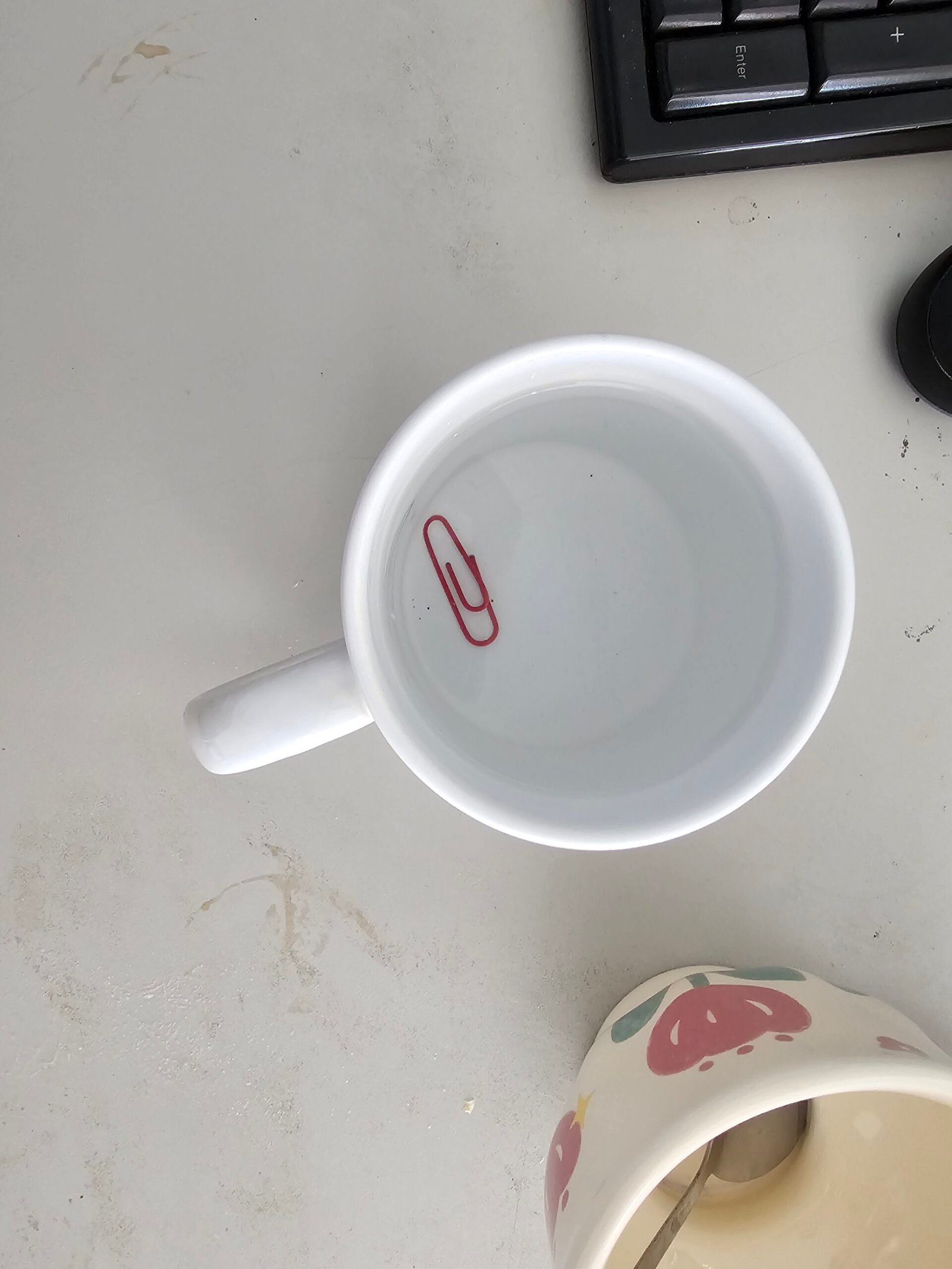
Drop a paper clip into a glass of water and it sinks straight to the bottom, exactly as you'd expect from a piece of steel. Lay the very same clip down on the surface gently enough, and it stays there, resting on top of the water as if the glass had a lid.
It looks like floating, but it isn't. A floating boat is held up by the water it pushes aside. The paper clip is doing something completely different: it's lying on a thin, stretchy layer at the very top of the water, the way you'd lie on a trampoline. Once you see it that way, a whole world of odd little water tricks suddenly makes sense.
Key takeaways
- Steel is roughly eight times denser than water, so a paper clip can't float the way a boat does.
- Water molecules cling tightly to each other, forming a stretchy "skin" called surface tension.
- The clip presses a small dent into that skin, and the skin pulls back up, like a trampoline.
- Break the surface or add a drop of soap, and the clip sinks instantly.
- Water striders, raindrops, soap bubbles, and even your lungs all depend on this same force.
Table of contents
- Why "Floating" Is the Wrong Word
- The Invisible Skin on Every Glass of Water
- How a Tiny Dent Holds Up a Piece of Steel
- Why You Have to Be Gentle
- One Drop of Soap Changes Everything
- Nature's Experts at Standing on Water
- Surface Tension in Your Everyday Life
- Try It Yourself in Two Minutes
- Common Myths, Corrected
- Frequently Asked Questions
- Sources and Further Reading
Why "Floating" Is the Wrong Word
True floating follows a rule described more than 2,000 years ago by Archimedes. An object sinks into water until it has pushed aside its own weight in water. A wooden block floats because wood is lighter than the same volume of water, so it only needs to sink partway before it's supported.
Steel doesn't stand a chance under that rule. It's about eight times denser than water, so a solid piece of steel can never push aside enough water to hold itself up. A steel ship floats only because its hollow shape encloses a huge amount of air. A paper clip has no hollow space at all.
So if the paper clip isn't floating, something else must be holding it up. That something is right at the boundary where the water meets the air.
The Invisible Skin on Every Glass of Water
Water molecules are strongly attracted to one another. Each one tugs on its neighbors through weak links called hydrogen bonds. Deep inside the glass, a molecule is pulled equally in every direction, so all those tugs cancel out.
At the surface, the situation changes. A molecule on top has water beside it and below it, but only air above. With nothing pulling upward, it clings even harder to the molecules next to and beneath it. Multiply that by trillions of molecules and you get a tightly bonded top layer that resists being stretched or broken. That's surface tension.
According to the U.S. Geological Survey, water has the highest surface tension of any common liquid except mercury. That's why water can do tricks that most other liquids can't, like holding up a piece of metal.
How a Tiny Dent Holds Up a Piece of Steel
Picture a trampoline. When you stand in the middle, the fabric sinks into a dip around your feet. The springs around the edge pull the fabric tight, and that pull pushes you back up. You don't fall through because the fabric stretches without tearing.
The water's surface works the same way. When a paper clip rests on it, the clip presses down and makes a shallow dent. If you look at the water from the side, you can actually see it curving downward along the edges of the metal. The surface tension along that curved edge pulls upward, and together with a little help from the water pushed aside by the dent, that upward pull balances the clip's weight.
That same logic explains why surface tension matters most for small things. Shrink an object, and its weight drops much faster than the length of its edges. For a person, surface tension is irrelevant. For an insect, a pollen grain, or a paper clip, it can be the strongest force around.
Why You Have to Be Gentle
A trampoline can hold you when you stand on it, but a sharp object dropped from above can rip straight through. Water's skin behaves similarly. If the paper clip hits the water at an angle or with any speed, one end pokes through the surface layer before the rest of the clip can spread its weight out.
Once any part of the clip breaks through, the trampoline effect is gone. Now the clip is surrounded by water instead of resting on top of it, and the ordinary rules of density take over. Eight times denser than water means straight down.
That's why the clip has to be laid perfectly flat, so its weight is shared evenly along its whole length from the very first moment of contact.
One Drop of Soap Changes Everything
Here's the most satisfying part of the experiment. Once your paper clip is resting on the water, touch the surface a little distance away with a toothpick dipped in dish soap. The clip drops like a stone.
Soap molecules have one end that is attracted to water and one end that avoids it. They crowd onto the surface and wedge themselves between water molecules, weakening the bonds that hold the skin together. The surface tension drops sharply, the trampoline goes slack, and the clip falls through.
Heat has a similar, gentler effect. Warm water has lower surface tension than cold water, which is one reason hot water and detergent work so well together for washing: both help water slip into fabric and grime instead of beading up on top.
Nature's Experts at Standing on Water
The paper clip trick is a party piece for us, but for some animals it's everyday life. The most famous is the water strider, a slender insect that skates across ponds and streams without ever getting wet.
Water striders are light, and their long legs spread that small weight over a large stretch of water surface, each leg pressing its own tiny dent. Their legs are also extremely water-repellent. Researchers Xuefeng Gao and Lei Jiang reported in Nature in 2004 that the legs are covered in countless tiny hairs with microscopic grooves that trap air, keeping water from ever soaking in.
How water striders move was a puzzle for years. Scientists once assumed they pushed themselves along by making ripples, but baby striders move their legs too slowly to make proper ripples, and they get around just fine. In 2003, a team at MIT led by David Hu and John Bush showed in Nature that striders mainly row by shoving little swirls of water backward with their middle legs. To prove it, they built a mechanical water strider, nicknamed Robostrider, that was 9 centimeters long and weighed just 0.35 grams.
Not every water-walker uses surface tension, though. The basilisk lizard, famous for sprinting across ponds, is far too heavy for that. It stays up by slapping the water hard and fast with its feet, a completely different trick.
Surface Tension in Your Everyday Life
Once you know what to look for, the water's skin shows up everywhere:
- Raindrops and bubbles are round because surface tension pulls water into the shape with the smallest possible surface.
- Water beads up on a freshly waxed car because the water clings to itself more than to the wax.
- A tent keeps rain out partly because surface tension lets water bridge the tiny gaps in the fabric. Press your finger against the inside during a storm, and water can start dripping through that spot.
- Your lungs rely on it being lowered. The tiny air sacs in your lungs are lined with a thin film of fluid, and the body produces a natural soap-like substance called surfactant to reduce the surface tension so the sacs can open easily with every breath.
Try It Yourself in Two Minutes
All you need is a glass or bowl of water, a few paper clips, a small square of tissue paper, and a drop of dish soap.
- Start with still water. Fill a clean bowl or glass and let the surface settle completely. Any leftover soap in the container will ruin the trick, so rinse it well first.
- Use the tissue trick. Lay a small piece of tissue paper on the water, then gently place a dry paper clip flat on top of it.
- Wait and watch. Within a minute or so, the tissue soaks up water and sinks, leaving the paper clip resting on the surface.
- Look from the side. Crouch down to eye level and you'll see the water dipping around the clip, the "trampoline" in action.
- Add the soap. Dip a toothpick in dish soap and touch the water near the edge of the bowl. Watch the clip sink.
Common Myths, Corrected
Myth: The paper clip floats because it's light.
Fact: Weight alone isn't the point. Steel is far denser than water, and the clip only stays up because it never breaks through the surface.
Myth: Surface tension is a thin film sitting on top of the water.
Fact: There's no separate layer. It's the water itself, with its top molecules pulling together more tightly than the ones below.
Myth: Any metal object will stay up if you're careful enough.
Fact: Only small, thin objects with lots of edge compared with their weight can do it. A coin or a bolt will sink no matter how gently you place it.
Frequently Asked Questions
Can a needle or pin rest on water too?
Yes. A small sewing needle or pin works the same way as a paper clip, as long as it's laid down flat and gently. Thin, long shapes work best.
Does salt water hold up a paper clip better?
Salt raises water's surface tension very slightly, so it doesn't make a noticeable difference for this trick. Keeping the water clean and still matters much more.
Why does my paper clip keep sinking?
The usual reasons are placing it at an angle, leftover soap in the glass, or a wet or oily clip. Try the tissue method with a clean, dry clip and fresh water.
How long will the paper clip stay on the water?
If nothing disturbs the surface, it can rest there for a long time. A bump to the table, a breeze, or a drop of soap will usually send it down.
Is surface tension the same thing as buoyancy?
No. Buoyancy comes from the water an object pushes aside, and it's what keeps boats and wood afloat. Surface tension comes from water molecules clinging to each other at the surface.
Curious minds never stop learning. Try today's brand-new quiz topic!
Take Today's QuizSources and Further Reading
- U.S. Geological Survey, Water Science School. Surface Tension and Water.
- Georgia State University, HyperPhysics. Surface Tension.
- Hu, D. L., Chan, B., & Bush, J. W. M. (2003). The hydrodynamics of water strider locomotion. Nature, 424, 663–666.
- Gao, X., & Jiang, L. (2004). Water-repellent legs of water striders. Nature, 432, 36.