
The Year Filipinos Lost a Day: Why December 31, 1844 Never Happened in the Philippines
For more than three centuries, the islands ran a full day behind their Asian neighbors. Then one decree erased New Year's Eve from the calendar. Here is how it happened, and why it still matters.
The Philippine calendar went straight from Monday to Wednesday.
The short answer
The Philippines skipped Tuesday, December 31, 1844 because, since the Spanish arrived in the 1500s, the islands had followed the same calendar date as Spanish America. That left them one day behind China, the Dutch East Indies and the rest of Asia. Governor-General Narciso Clavería, with the agreement of the Archbishop of Manila, ordered that Monday, December 30, 1844 be followed directly by Wednesday, January 1, 1845, putting the colony on the same date as its neighbors.
What's in this article
01A night that skipped a whole day
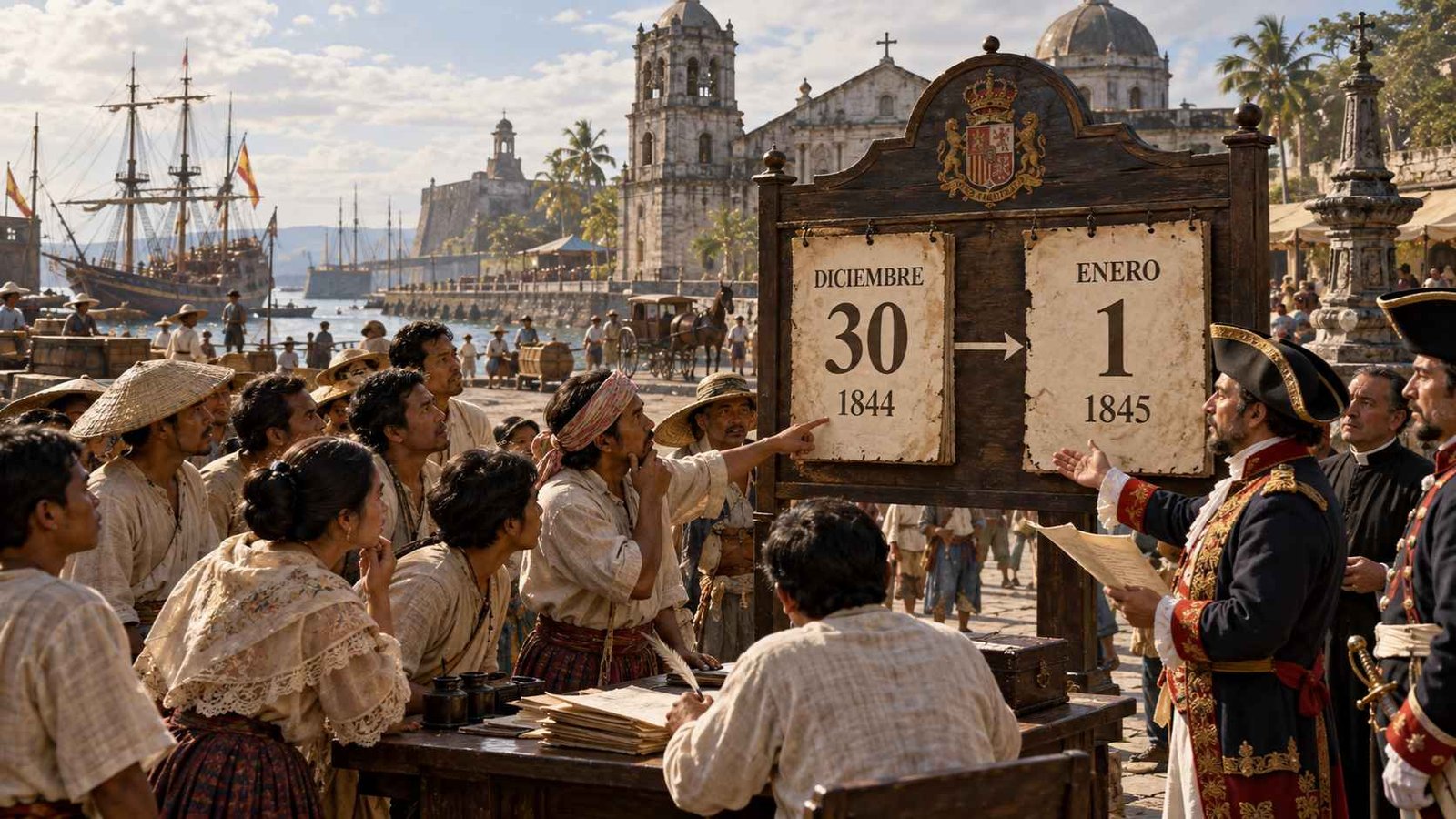
Picture a family in Manila at the end of 1844. They go to bed on the evening of Monday, December 30, expecting the next morning to bring the last day of the year: a Tuesday of cooking, church bells and preparations for New Year. Instead, they wake up on Wednesday, January 1, 1845. Nobody overslept. The day was simply removed by government order.
It sounds like a riddle, but it is one of the most real and well-documented quirks in Philippine history. Because of that decision, there are no Philippine birth certificates, baptisms, weddings or deaths dated December 31, 1844. In the islands, that date has no events at all because it never existed.
To understand why a government would delete a day, we have to go back to the voyages that first connected the Philippines to Spain, and to a simple fact about traveling around a spinning planet.
02How the islands fell a day behind
The Earth turns once every 24 hours, and the Sun appears to move from east to west across the sky. If you travel westward, you are moving in the same direction as the Sun. Each day of your journey becomes a little longer than 24 hours. Sail all the way around the world going west, and you will have seen one sunrise fewer than people who stayed home. Your logbook will be one day behind theirs.
Sailors first proved this the hard way. When the surviving crew of Ferdinand Magellan's expedition stopped at the Cape Verde islands in July 1522, near the end of the first voyage around the world, they discovered that the date in their carefully kept journal was one day off from the date used on land. Their chronicler, Antonio Pigafetta, had not made a mistake. The crew had circled the globe westward and lost a day.
That same westward logic shaped the Philippines. Spain reached the islands by sailing west: across the Atlantic to the Americas, then across the Pacific. Magellan's fleet arrived in 1521, and when Miguel López de Legazpi began permanent Spanish settlement in 1565, the colonists brought the date used in Spain's American territories, especially Mexico (then called New Spain). Nobody added a day for crossing the Pacific.
Meanwhile, the Portuguese, Dutch and British reached Asia by sailing east, around Africa and across the Indian Ocean. They carried a date one day ahead of the one used in Manila. So while the Philippines sat on the Asian side of the world geographically, it kept the calendar of the Americas.
Simplified diagram. Both "Spain" boxes are the same place, shown at either end of a Pacific-centered map. Manila sat on Asia's side of the world but kept the date that came with ships from Mexico.
The result was a strange mismatch. Accounts of the period describe it plainly: when it was Sunday in Manila, it was already Monday in Batavia (today's Jakarta), even though the two cities lie only a few hours apart by today's clocks.
Same moment, two cities. Tap to compare:
One day apart, even though the cities are neighbors in Southeast Asia.
03Why keep the "wrong" date for so long?
From a modern point of view, being a day out of step with your neighbors sounds like a constant headache. For most of the Spanish period, though, the American date was actually the practical choice.
The Philippines' lifeline to the Spanish world was the Manila galleon, the trade route that linked Manila and Acapulco from 1565 to 1815. Silver from the Americas flowed west; silk, porcelain and spices from Asia flowed east. The colony was also governed through New Spain for much of this time, so official mail, orders, money and people all came across the Pacific from Mexico.
Keeping the same date as Mexico meant galleon crews did not have to adjust their journals when they reached port, and church feast days and government records stayed consistent across the Spanish Pacific. As long as Manila's most important partner was Acapulco, sharing Acapulco's calendar made sense.
The Philippines was in Asia on the map, but on the calendar it lived in the Americas.
04What changed by 1844
By the first half of the nineteenth century, the old arrangement was falling apart.
- The galleons stopped. The last voyages of the Manila–Acapulco trade ended in 1815, closing the route that had tied the islands to American time.
- Mexico broke away. Mexico won its independence from Spain in 1821, so the colony's link to the Americas was no longer a Spanish link at all.
- Trade turned toward Asia. Manila was opened more widely to foreign merchants in the 1830s, and commerce with China, the Dutch East Indies and British traders in the region grew. These partners all used the Asian date.
Being a day behind now caused real friction. Contracts, shipping schedules and correspondence with Asian ports had to account for a calendar that didn't match. The practical case for keeping Mexico's date had disappeared, and the case for joining Asia's date grew stronger every year.
05The decree that erased New Year's Eve
The fix came from a new governor-general. Narciso Clavería y Zaldúa, a Spanish army officer, took office in Manila on July 16, 1844. He would go on to be remembered as a reform-minded administrator, and the calendar was one of the first problems he addressed.
On August 16, 1844, Clavería decreed the change after consulting the Archbishop of Manila, José Seguí. Church approval mattered: the Catholic calendar of saints' days, fasts and feasts governed daily life, and the Church kept the parish records of births, marriages and deaths.
The solution was elegant. To jump forward one day and match Asia, the colony would simply skip one date. They chose the last day of the year, so the change would fall cleanly at year's end:
Monday, December 30, 1844 was an ordinary day in Manila.
The next day was declared Wednesday, January 1, 1845. Tuesday, December 31 was removed.
December 31 is traditionally the feast day of Saint Sylvester, so that celebration also went missing in the Philippines that year. Because the switch came at the very end of 1844, it affected only a single date, and the new year began in step with Batavia, Macau and the rest of Asia.
Note what did not happen: no clocks moved and no hours changed. Days still had 24 hours, and the Sun rose over Manila as usual. Only the name of the day changed: the date was moved forward to match the islands' real position on the globe.
06Timeline at a glance
- 1521Magellan's fleet reaches the islandsArriving from the east across the Pacific, Europeans bring a westward-traveling date with them.
- 1522A missing day is noticedExpedition survivors at Cape Verde find their log is one day behind the local date.
- 1565Spanish settlement and the galleon trade beginThe Philippines keeps the date of New Spain (Mexico).
- 1815The Manila galleons endThe trans-Pacific route that tied Manila to Acapulco closes.
- 1821Mexico becomes independentThe colony's American connection weakens further.
- 1844Clavería's decree (Aug 16)With the archbishop's agreement, December 31, 1844 is removed from the calendar.
- 1845A new year, a new dateWednesday, January 1, 1845 follows Monday, December 30. Manila now shares Asia's date.
- 1849Clavería's surname decreeHis government issues the catalog of surnames that shaped many Filipino family names.
07What it meant for ordinary Filipinos
For most people living in the islands in 1844, the change was more of a curiosity than a disruption. Still, it left some interesting marks.
A leap year that wasn't quite
1844 was a leap year, so it should have had 366 days. In the Philippines, it had only 365. February 29 was kept, but December 31 was not.
A blank page in the records
Parish books and government registers in the Philippines contain nothing dated December 31, 1844. Anyone researching Philippine family history will never find an ancestor born, baptized or married on that day.
A puzzle for historians
Because the colony was a day behind before 1845, Philippine dates from the Spanish period don't always line up with dates recorded in nearby Asian ports for the same events. Historians comparing sources across the region need to keep this one-day offset in mind.
Maps that didn't get the memo
The change happened long before there was any international agreement about where the date line should go. Writers on the history of the date line have noted that some mapmakers kept drawing the Philippines on the "American" side for decades afterward, simply because news of Manila's switch hadn't reached them.
The man behind your surname, too
Clavería is often remembered by Filipinos for something even more personal. In 1849, his administration issued a decree and an alphabetical catalog of surnames so that families could adopt fixed, official last names for record-keeping and taxation. Many common Filipino surnames today trace back to that list. The same governor who gave the country its missing day also shaped the names on millions of IDs.
08Other places that skipped a day
The Philippines was one of the earliest places to deliberately change sides of the date divide, but it wasn't the last. Trade and politics have moved this invisible boundary several times:
- Alaska (1867): When Russia transferred Alaska to the United States, the territory moved in the opposite direction, adopting the American date and calendar used across North America.
- Kiribati (1995): The Pacific nation, spread across both sides of the 180th meridian, moved its eastern islands to the Asian side so the whole country would share one date.
- Samoa (2011): To align with its main trading partners, Australia and New Zealand, Samoa skipped Friday, December 30, 2011, jumping from Thursday to Saturday.
The International Date Line still has no single treaty defining it. It is a practical convention that roughly follows the 180° meridian and bends around island nations according to their own choices. Each of these shifts, including Manila's in 1844, was driven by the same thing: being on the same day as the people you trade with.
09Myths vs. facts
Quick quiz: did the day stick?
Three questions. Tap an answer to check yourself.
1. Which day of the week was skipped in the Philippines in 1844?
Tuesday, December 31, 1844 was removed, so Monday the 30th was followed by Wednesday, January 1, 1845.
2. Before 1845, the Philippines shared its calendar date with which place?
Spanish ships reached the islands by sailing west through the Americas, so the colony kept Mexico's date for centuries.
3. Who ordered the change?
Clavería issued the decree on August 16, 1844, after consulting Archbishop José Seguí.
FAQFrequently asked questions
Did December 31, 1844 really not happen in the Philippines?
Yes. By order of Governor-General Narciso Clavería, Monday, December 30, 1844 was followed directly by Wednesday, January 1, 1845. No events in the Philippines carry the date December 31, 1844.
Why was the Philippines a day behind Asia?
Spain reached the islands by sailing west across the Atlantic and Pacific, and colonists kept the date used in Spanish America. Traders who came to Asia by sailing east used a date one day ahead, so Manila ended up a day behind its neighbors.
When was the decree issued?
On August 16, 1844, shortly after Clavería became governor-general in July of that year. The Archbishop of Manila, José Seguí, agreed to the change.
How many days did 1844 have in the Philippines?
Although 1844 was a leap year, the Philippines counted only 365 days that year because December 31 was removed.
Is this the same Clavería who gave Filipinos their surnames?
Yes. In 1849, the same governor-general issued the decree and catalog of surnames that many Filipino families adopted, which is why he appears twice in Philippine history lessons.
Has any other country skipped a day?
Yes. Samoa skipped December 30, 2011 to align with Australia and New Zealand, and Kiribati moved its eastern islands across the date line in 1995. Alaska shifted the other way when it passed from Russia to the United States in 1867.