
Barangay 288 · Zone 27
Why Do Some Philippine Barangays Have Numbers Instead of Names?
Ask someone from Quezon City where they live, and you might hear Commonwealth, Kamuning, or Loyola Heights. Ask someone from parts of Manila, and the answer could be "Barangay 288, Zone 27." Same country, same level of government, but one community has a name and the other has a number.
For many visitors, and even for Filipinos from the provinces, numbered barangays can seem cold or confusing. Yet there's a clear story behind them, one that involves martial law-era decrees, crowded cities, and a law that makes renaming surprisingly difficult.
Most numbered barangays were created in the early 1970s, when the government required a barangay (citizens assembly) in every community. Rural areas already had named barrios that simply became barangays, but dense cities like Manila had no barrios, so they were carved into many small new units. Numbering them was the fastest, most neutral way to label hundreds of new barangays at once, and changing those numbers today requires a lengthy legal process that includes a plebiscite.
01
What a Barangay Is
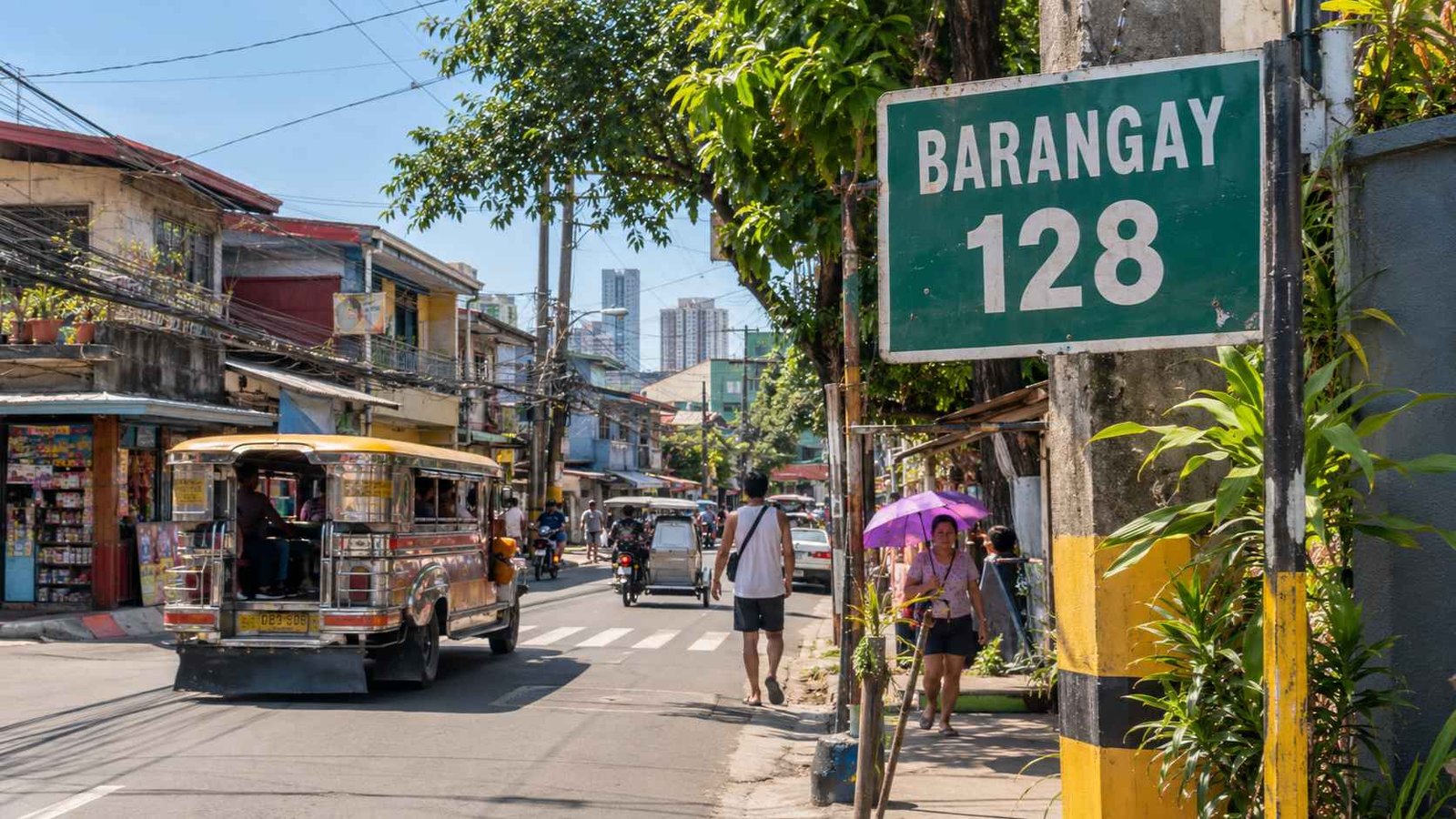
The barangay is the smallest unit of government in the Philippines. Each one has an elected barangay captain (punong barangay) and a council (sangguniang barangay) that handle local matters such as peace and order, minor disputes, clearances, cleanliness, and community programs. There are more than 42,000 barangays nationwide.
The word itself is far older than any government office. It comes from balangay, the plank boats that early Austronesian seafarers used to travel across the islands. Communities formed around those boat crews, and the name stuck to the settlements themselves.
Under Spanish rule, these communities were known as barrios, and the term stayed in use for centuries. It was only in the 1970s that "barangay" returned as the official name, and that same period is when numbered barangays appeared.
02
Where Numbered Barangays Are Found
Numbered barangays are concentrated in a few cities, but they're more widespread than many people realize.
897barangays in the City of Manila, the most of any city in the country
201barangays in Pasay
188barangays in Caloocan
100zones grouping Manila's barangays
In Metro Manila, three cities, Manila, Caloocan, and Pasay, use what's often called a hybrid system: every barangay has a number, but only some also have a name. These cities also group their barangays into zones, which have no elected officials and exist mainly for administration.
Outside Metro Manila, numbers often appear in the poblacion, the old town center. Laoag City in Ilocos Norte, for example, numbers its central barangays while pairing them with saints' names, such as "No. 1, San Lorenzo." Vigan uses Roman numerals with local names, like "Barangay VII, Pagburnayan." Many towns, from Bantay in Ilocos Sur to Baler and Casiguran in Aurora, have a "Barangay 1 (Poblacion)," "Barangay 2," and so on. Tacloban City has 138 barangays, many of them identified by number.
03
How the Numbers Began
The numbering story is tied closely to the early years of martial law under President Ferdinand Marcos.
EARLY 1970s
Manila Mayor Ramon Bagatsing sets up a Barangay Bureau, laying groundwork for the barangay as the city's basic community unit.
DEC 31, 1972
Presidential Decree No. 86 creates a barangay (citizens assembly) in every barrio and in each district of chartered cities. It specifically provides that Manila and other places without barrios will have a citizens assembly for every barangay.
JAN 1973
The new assemblies are used for national referendums, which pushes cities to organize them quickly across every neighborhood.
SEPT 21, 1974
Presidential Decree No. 557 declares all barrios in the country to be barangays.
1975
Manila has 897 barangays, Pasay 201, Caloocan 188, and Quezon City 142, numbers that have barely changed since.
The key difference was between the countryside and the dense urban core. Rural towns already had barrios with long-established names, so those barrios simply became barangays, names and all. As the Wikipedia overview of Metro Manila's barangays notes, most cities merely converted their old barrios.
Manila was different. It had no barrios, only large historic districts like Tondo, Sampaloc, and Santa Ana, each home to tens or hundreds of thousands of people. To create community-sized assemblies, the city had to divide those districts into many small units, sometimes just a few blocks each. With nearly 900 new barangays to label at once, numbers were the obvious choice.
04
Five Reasons Numbers Won
1
Speed
Cities had to set up hundreds of assemblies in a very short time. Assigning numbers in order was far faster than researching, debating, and approving hundreds of names.
2
Sheer volume
Manila's 897 barangays share an area of only about 40 square kilometers. Many cover just a few streets, without any traditional place name of their own to borrow.
3
Avoiding duplicates
Popular names like San Jose, San Roque, or Santo Niño already appear in countless places. Numbers guarantee every unit in a city is unique.
4
Neutrality
A number doesn't honor one politician, family, or saint over another, which avoids local arguments over who or what a community should be named after.
5
Easy administration
Sequential numbers make records, maps, census data, and election lists simple to organize, especially when grouped into zones and districts.
05
Quirks of the Number System
Numbering doesn't mean everything is perfectly tidy. Over the decades, a few oddities have crept in.
The numbers don't match the total
Manila has 897 barangays, yet its numbers run past 900. Barangays in Santa Ana's Zone 100, for example, are numbered 898 to 905. Some numbers have gaps from past changes, and a few barangays carry letter suffixes, such as Barangay 664-A in Paco.
A full address reads like a code
Because numbers alone aren't very descriptive, Manila addresses often combine several layers of location:
123 Sample Street
Barangay 288, Zone 27
City of Manila
Barangay 288, Zone 27
City of Manila
In everyday conversation, most people still identify with the historic district, saying they live in Tondo or Sampaloc, while the barangay number appears on documents and clearances.
Some barangays are extremely small
Because the units were drawn when populations were different, some have since shrunk dramatically. In Caloocan, Barangay 76 was reported to have zero residents in the 2024 census, making it the least populous barangay in Metro Manila. Meanwhile, some named barangays in fast-growing areas now have well over 100,000 residents.
06
Why the Numbers Are Hard to Change
If numbered barangays are confusing, why not just give them names? Because Philippine law deliberately makes changing a local government unit's name, or merging units, a slow and careful process.
What the Local Government Code requires
Under Section 13 of the Local Government Code of 1991 (Republic Act 7160), a city council may rename a barangay upon the recommendation of the barangay council and in consultation with the national historical agency. A name change must have a justifiable reason, can happen no more than once every ten years, and takes effect only after it is ratified in a plebiscite.
Merging barangays is just as demanding. The same law requires a plebiscite for any creation, merger, division, or abolition of a barangay. It also sets minimum population requirements for new barangays, generally 2,000 residents, and 5,000 in Metro Manila and highly urbanized cities.
Several attempts to consolidate numbered barangays have stalled at this stage:
| Year | City | What was proposed | What happened |
|---|---|---|---|
| 1989 | Caloocan | Republic Act 6714 called for merging many numbered barangays into fewer, larger ones, some with new names | The city still has 188 numbered barangays today |
| 1996 | Manila | Ordinance 7907 aimed to cut 897 barangays down to 150 through mergers | Never took effect because no plebiscite was held |
Practical concerns also play a part. Each barangay receives its own share of national funds and has its own set of elected officials. Mergers can mean fewer positions and redrawn budgets, and plebiscites cost time and money to organize.
07
Numbers vs. Names: Pros and Cons
What numbers do well
- Every barangay is unique within its city
- Easy to sort, map, and track in records
- Neutral, with no naming disputes
- Simple to assign when many units are created at once
Where numbers fall short
- Say nothing about local history or identity
- Hard for visitors and delivery riders to remember
- Easy to mix up, especially with neighboring numbers
- Some tiny units now seem out of step with today's populations
Supporters of change argue that names could strengthen community pride and that merging very small barangays could make local services more efficient. Others point out that residents have grown attached to their numbers over five decades, and that "Barangay 143" can carry as much meaning to its people as any saint's name.
08
How to Find Your Barangay Number
If you live in or are moving to a city with numbered barangays, there are a few reliable ways to confirm your barangay:
- Check your documents. Barangay clearances, voter records, and some government IDs list your barangay.
- Visit or call your barangay hall. Staff can confirm boundaries, zone, and district.
- Use the official geographic code list. The Philippine Statistics Authority maintains the Philippine Standard Geographic Code, which lists every barangay in the country.
- Ask your city hall. Many city governments publish lists or maps of barangays by zone and district.
09
Frequently Asked Questions
Which city has the most barangays in the Philippines?
The City of Manila, with 897 barangays, more than half of all barangays in Metro Manila.
Do numbered barangays have the same powers as named ones?
Yes. A numbered barangay is a full local government unit with its own elected captain and council, exactly like a named barangay.
What is a zone in Manila, Caloocan, or Pasay?
A zone is a group of barangays used for administrative and planning purposes. Zones have no elected officials of their own.
Can a numbered barangay get a name?
Yes, but it requires action by the city council, consultation with the national historical agency, a justifiable reason, and approval by voters in a plebiscite.
Why don't all cities use numbers?
Most cities and towns already had named barrios when the barangay system was formalized in the 1970s, so they kept those names. Numbers were mainly used where new units had to be created from scratch.
Curious minds never stop learning. Try today's brand-new quiz topic!
Take Today's Quiz10
Sources
- Official Gazette of the Philippines. Presidential Decree No. 86, s. 1972: Creating Barangays (Citizens Assemblies).
- The LawPhil Project. Presidential Decree No. 557: Declaring All Barrios in the Philippines as Barangays (1974).
- Official Gazette of the Philippines. Republic Act No. 7160: The Local Government Code of 1991.
- Official Gazette of the Philippines. Republic Act No. 6714 (1989).
- Philippine Statistics Authority. Philippine Standard Geographic Code.
- Wikipedia. List of barangays of Metro Manila.