
Your Voice Sounds Richer in the Shower Because the Room Is Singing Along
Step into the shower, start humming your favorite song, and something wonderful happens. Your voice sounds fuller, warmer, and more polished than it ever does in the car or the living room. For a few minutes, you might genuinely believe you missed your calling.
You're not imagining it, but the improvement isn't coming from your vocal cords. It's coming from the room. A tiled shower is one of the most flattering acoustic spaces most people will ever sing in, and every wall around you is quietly adding its own voice to yours.
The short answer
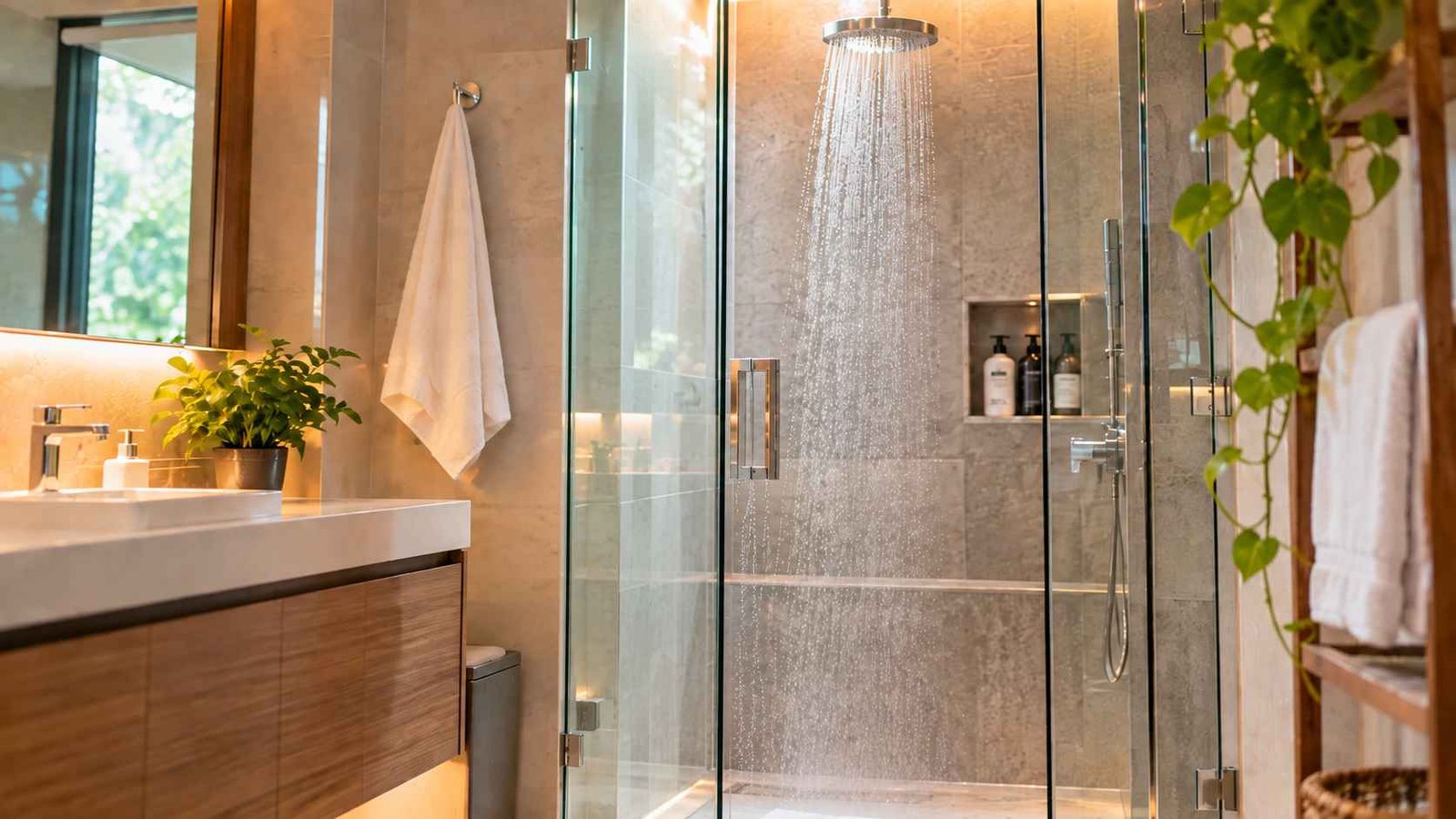
Shower walls are hard and smooth, so they reflect almost all the sound that hits them. Your voice bounces around the small space, lingering longer (reverb), building up at certain pitches (resonance), and arriving back at your ears in thousands of tiny, overlapping reflections. Together, these effects make your voice sound louder, deeper, smoother, and more forgiving of mistakes.
Key takeaways
- Tile and glass absorb very little sound, so your voice keeps bouncing instead of fading.
- Reverb makes notes linger and blend, smoothing over small slips in pitch.
- A shower's small size boosts certain low and middle pitches, adding warmth and depth.
- Reflections arrive so fast that your brain hears them as a fuller voice, not as echoes.
- Steam, running water, and a relaxed mood add to the effect.
Table of contents
- Hard Walls Give Your Voice Nowhere to Hide
- Reverb Gives Every Note a Tail
- Resonance: The Room Hums Along
- Reflections Too Fast to Hear as Echoes
- Steam, Running Water, and a Relaxed Mind
- The Scientist Who Measured Echoes With Seat Cushions
- Recording Studios Have Been Copying Your Shower for Decades
- Try It Yourself: Three Shower Sound Tests
- Will Singing in the Shower Make You a Better Singer?
- Frequently Asked Questions
- Sources and Further Reading
Hard Walls Give Your Voice Nowhere to Hide
Every time you sing, your voice sends out waves of vibrating air in all directions. What happens next depends on what those waves hit.
Soft, porous materials like sofas, curtains, carpets, and pillows act like sponges for sound. The air vibrations get trapped in their tiny fibers and gaps and fade away as a tiny amount of heat. That's why a bedroom full of furniture sounds "dead" and quiet.
Glazed tile, stone, glass, and smooth acrylic are the opposite. They're hard, dense, and sealed, so sound waves can't sink into them. Instead, nearly all of the sound bounces right back into the room. In a shower, that means almost nothing is soaking up your voice, except you.
Reverb Gives Every Note a Tail
Because the walls keep throwing your voice back, each sound lingers for a moment after you've stopped making it. This lingering is called reverberation, or reverb. Clap once in a tiled bathroom and you'll hear a short "shhh" tail after the clap. Clap in your bedroom and the sound stops almost instantly.
Reverb flatters singing in two big ways.
It blends notes together
When each note hangs in the air briefly, it overlaps with the next one. The jumps between notes sound smoother and more connected, a bit like the difference between dotting a line with a pen and drawing it in one stroke.
It hides small mistakes
If you're slightly off pitch or your voice wobbles, the reverb surrounds that moment with a wash of sound from the notes around it. The slip becomes harder to pick out. It's a gentle, natural version of the polishing effects used in music production.
Resonance: The Room Hums Along
Here's where the "room is singing along" part becomes almost literal.
When sound bounces back and forth between two parallel walls, certain pitches fit the space perfectly. Their reflected waves line up with the new waves coming in, reinforcing each other instead of canceling out. These favored pitches are called the room's resonant frequencies, or room modes. When you sing near one of them, the room seems to amplify you.
The lowest resonant pitch between two walls can be estimated with a simple formula:
Because showers are small, their resonant pitches land right in the range of the human voice:
| Distance between surfaces | Lowest resonant pitch | Where it falls |
|---|---|---|
| 0.9 m (narrow shower stall) | About 190 Hz | Within many women's and some men's speaking range |
| 1.2 m (wider shower) | About 143 Hz | Within many men's speaking range |
| 2.4 m (floor to ceiling) | About 71 Hz | Below most voices, adds a deep low-end boost |
Adult speaking voices typically center somewhere around 85 to 255 Hz, with men usually lower and women usually higher. That overlap means a shower naturally boosts the lower, warmer parts of most voices, which is why you sound deeper and fuller in there. Each room also has higher resonances at multiples of these pitches, so the effect continues up the scale.
Reflections Too Fast to Hear as Echoes
If your voice is bouncing all over the shower, why don't you hear an echo like you would shouting across a canyon?
The answer is speed and distance. Sound travels about 34 centimeters every thousandth of a second. In a shower, the wall might be only half a meter away, so the reflection makes a one-meter round trip and returns in roughly three milliseconds.
Your brain can't separate sounds that arrive that close together. Instead of hearing "voice, then echo," it merges them into one combined sound. The result feels like your own voice is simply bigger, louder, and closer, as if you're surrounded by it. A canyon echo, by contrast, can take a second or more to return, which is plenty of time to hear it as a separate sound.
Steam, Running Water, and a Relaxed Mind
Acoustics do most of the work, but the shower experience adds a few more helpers.
Singing in the bath is nothing new. The Wikipedia entry on bathroom singing notes that the 14th-century scholar Ibn Khaldun described how the warmth of a hot bath lifted people's spirits so much that they often burst into song.
The Scientist Who Measured Echoes With Seat Cushions
Much of what we know about how rooms shape sound began with a frustrated professor and a pile of seat cushions.
In 1895, Harvard University opened a new lecture hall in its Fogg Art Museum, and it had terrible acoustics. A young physics professor named Wallace Clement Sabine was asked to fix it. According to the American Physical Society, Sabine found that a spoken word in the hall stayed audible for about 5.5 seconds, far too long for listeners to follow a lecture.
To study the problem, Sabine and his assistants borrowed hundreds of seat cushions from a nearby theater, carrying them in and out at night and measuring how each change affected the lingering sound. From these experiments, he worked out the relationship between a room's size, the materials inside it, and how long sound takes to fade, now known as reverberation time.
His work launched the science of architectural acoustics. As Britannica notes, Boston's Symphony Hall, which opened in 1900, was the first building designed using his principles, and it's still praised for its sound today. The unit of sound absorption, the sabin, is named after him. Your shower follows exactly the rules he discovered: a small room with almost no absorbing material keeps sound alive.
Recording Studios Have Been Copying Your Shower for Decades
Professional singers usually record in vocal booths lined with soft, absorbing panels, which capture a clean, "dry" voice with almost no reverb. Then engineers add reverb back afterward, giving the voice the same glow your shower provides for free.
Before digital effects, studios built physical spaces for this. Capitol Studios in Hollywood famously built underground echo chambers in the 1950s, concrete rooms where recorded sound was played through a speaker and picked up again with the reflections included. Some musicians have gone even more directly. Jon Anderson of the band Yes reportedly had tiles installed in a studio to recreate the sound of singing in a bathroom.
Today, nearly every recorded vocal you hear on the radio includes some artificial reverb. In a sense, almost every pop song is sung in a shower.
Try It Yourself: Three Shower Sound Tests
- The clap test. Clap once, sharply, in your bathroom, then do the same in your bedroom. Listen to how long the sound lingers in each room. That tail is reverb.
- The resonance hunt. In the shower, hum softly and slide your voice slowly from low to high, like a siren. At certain pitches, the sound will suddenly swell and seem to fill the room. You've found one of your shower's resonant frequencies.
- The recording test. Record yourself singing the same short line on your phone, once in the bathroom and once in a furnished room. Play both back. The bathroom version will usually sound fuller and smoother, while the other reveals your "dry" voice.
Will Singing in the Shower Make You a Better Singer?
It can help, just not in the way you might think. The shower doesn't change your actual voice; it changes what you hear. Step out into a furnished room or onto a karaoke stage, and the flattering reverb and resonance disappear.
Still, shower singing has real benefits. It's a relaxed, private place to warm up, explore your range, and build confidence. The key is to also practice in "drier" spaces now and then, or record yourself in an ordinary room, so you get honest feedback about pitch and tone. Think of the shower as a fun warm-up stage, not your final judge.
Frequently Asked Questions
Why does my voice sound deeper in the shower?
A shower's small dimensions create resonances in the low and middle pitch range of the human voice. Those frequencies get boosted, so your voice sounds warmer and deeper than usual.
Do bigger bathrooms sound better?
Not necessarily. Larger rooms have lower resonant pitches and longer reverb, while towels, rugs, and shower curtains absorb sound. A small, fully tiled shower with a glass door often sounds the most dramatic.
Does a shower curtain change the sound?
Yes, a little. Fabric curtains absorb some sound, especially higher pitches, while glass doors reflect it. A glass-enclosed shower usually has more noticeable reverb.
Why don't I hear a real echo in the shower?
The reflections return in just a few thousandths of a second. That's too fast for your brain to hear them separately, so they blend into a fuller version of your voice.
Is singing in the shower good for you?
Singing is a fun way to relax and lift your mood, and the shower is a private, low-pressure place to do it. Just keep your voice comfortable and avoid straining.
Curious minds never stop learning. Try today's brand-new quiz topic!
Take Today's QuizSources and Further Reading
- American Physical Society, APS News. January 10, 1919: Death of Wallace Sabine, pioneer of architectural acoustics.
- Encyclopaedia Britannica. Wallace Clement Sabine.
- Linda Hall Library. Scientist of the Day: Wallace Clement Sabine.
- Wikipedia. Bathroom singing.
- Wikipedia. Reverberation.