The Everyday Scholar: Finding Lessons in Ordinary Moments
Learning does not always arrive with a textbook, a lecture, or a quiet desk. Sometimes it shows up while you are waiting in line, fixing a small mistake, reading a message twice, comparing prices at a store, answering a quiz question, or listening to someone explain their point of view.
Many useful lessons are hidden in ordinary moments. The problem is not that life teaches too little. The problem is that we often move too quickly to notice what it is teaching.
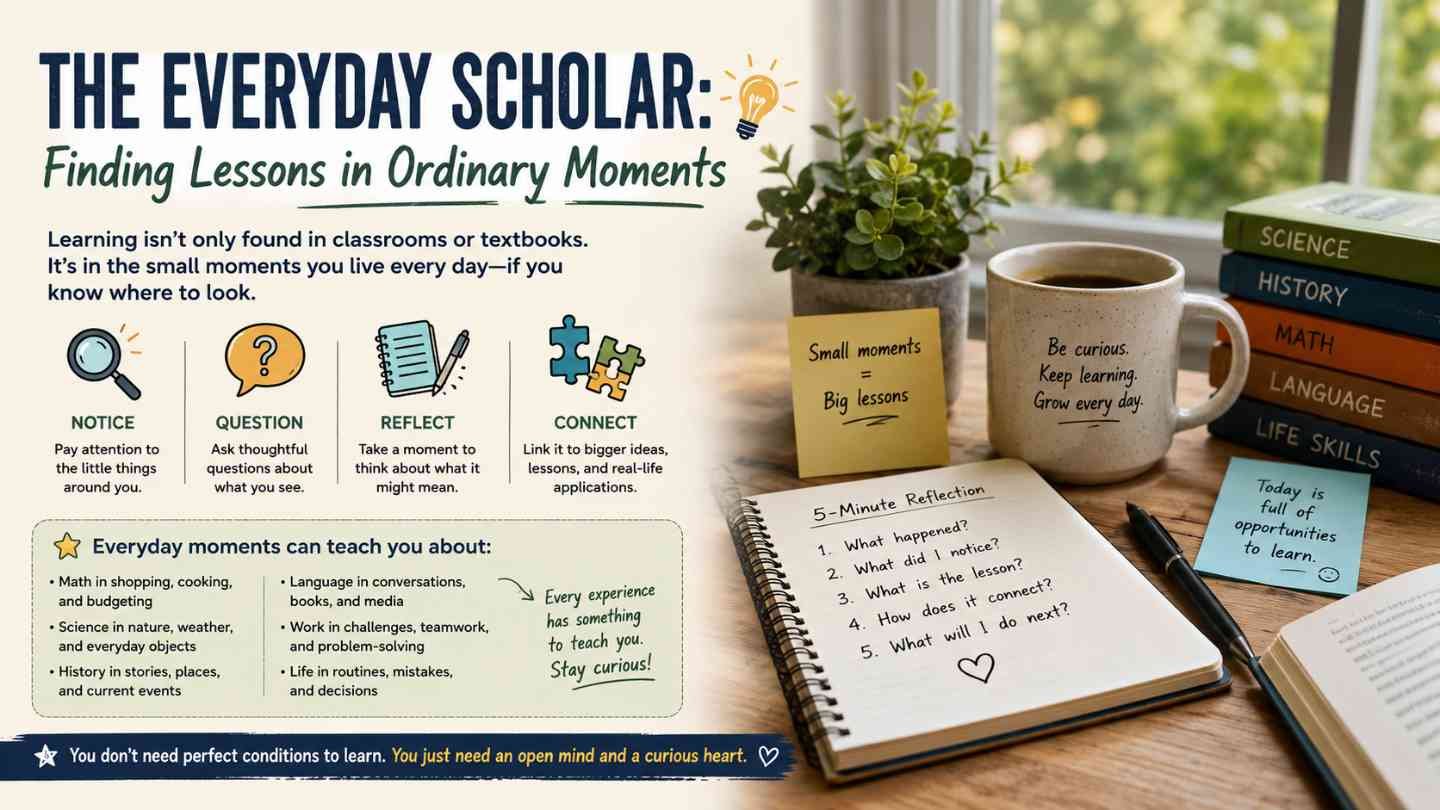
Being an everyday scholar means learning from the world you already live in. It means paying attention to small details, asking better questions, and turning simple experiences into understanding. You do not need a perfect study routine to grow smarter. You need the habit of noticing.
What Does It Mean to Be an Everyday Scholar?
An everyday scholar is someone who treats daily life as a quiet classroom. This does not mean overthinking every little thing. It means staying curious enough to ask, “What can this moment teach me?” A conversation, a delay, a mistake, a routine task, or a surprising fact can become the beginning of deeper learning.
An everyday scholar does not only study when a lesson is assigned. They learn while cooking, commuting, working, reading, practicing a language, solving a small problem, or taking an online quiz.
✨ The main idea
The goal is not to make life feel like homework. The goal is to notice that real understanding often starts with ordinary experience.
Why Daily Experiences Can Teach More Than We Expect
Daily life gives learning something that textbooks sometimes cannot: context. A math formula may feel abstract until you use it to compare discounts. A science idea may seem distant until you notice condensation on a cold glass. A history lesson may become clearer when you hear a debate about leadership, power, or public memory.
Ordinary moments make learning easier to remember because they attach ideas to real situations.
💡 Experience gives facts a place to land
Facts are easier to understand when they connect to something familiar. Reading about supply and demand may feel dry, but when you notice prices rising before a holiday, the concept becomes visible. You are no longer memorizing an idea. You are seeing it work.
Small Observations Build Better Thinking
A small observation can open a bigger idea. You might notice that you remember a story better than a list of facts. That observation can lead you to study memory, storytelling, or reading strategies. You might notice that you misunderstand someone when you reply too quickly. That can lead to lessons about listening, communication, and patience.
Everyday scholarship begins when you stop treating small moments as meaningless.
How to Notice Small Lessons in Routine Situations
The easiest way to learn from daily life is to pause briefly and ask one useful question. You do not need a notebook every second. You do not need to turn every event into a deep reflection. A few seconds of attention can be enough.
🔎 Ask: “What is really happening here?”
If you get a quiz answer wrong, do not only check the correct option. Ask what confused you. Was it a word, a date, a concept, or careless reading?
🔗 Ask: “What does this remind me of?”
Connections make learning stronger. A science idea may connect to cooking, a history topic may connect to current events, and a new word may connect to a phrase you already know.
🛠️ Ask: “Where else can I use this?”
If you learn a new word, use it in a sentence. If you understand a math pattern, look for it in a receipt, schedule, or budget.
Practical Examples of Everyday Learning
Everyday scholarship works across school subjects, online learning, work, home life, and self-study. The key is to look for the lesson inside the moment.
🎯 Learning from quizzes
Quizzes are not only tests. They are mirrors. When you answer correctly, ask why the answer made sense. When you answer incorrectly, ask what clue you missed. A good quiz can show gaps in memory, weak connections, and topics worth reviewing.
For example, if a trivia question asks about a historical event and you guess wrong, you can use that mistake as a starting point. What period was it from? Who was involved? What happened before and after it? That one missed question can become a doorway into a larger subject. You can also sharpen your daily knowledge with resources like Play Today’s Bing Quiz Trivia Questions.
Learning From School Subjects
School subjects become easier when you connect them to real life. Math, science, history, and language are not trapped inside classrooms. They appear quietly inside everyday decisions, conversations, problems, and routines.
➗ Math
Math appears in budgets, recipes, discounts, travel time, sports scores, and measurements. A shirt that is 30% off is not just shopping; it is percentage practice.
🔬 Science
Science shows up in weather, cooking, exercise, electricity, health habits, plants, and machines. A foggy mirror can teach condensation, while a wilting plant can introduce water, sunlight, and soil conditions.
🏛️ History
History is not only dates and names. A public holiday can open a lesson about national identity, while a news debate can connect to older struggles over rights, power, and responsibility.
🗣️ Language Learning
A new phrase, confusing idiom, mispronounced word, or message that sounds too formal can become a learning moment. Daily conversations show how words actually work.
Learning From Reading
Reading becomes deeper when you notice more than the words. Ask why an opening sentence catches your attention. Notice how an author explains a difficult idea. Pay attention to examples, comparisons, and transitions.
If a paragraph confuses you, slow down. Look for the main idea. Ask which word or concept is blocking your understanding. Sometimes the lesson is not only in the content, but in how the content is written. This helps learners become better readers and better thinkers.
Learning From Online Learning
Online learning can feel fast and scattered. Videos, articles, quizzes, and short lessons often move quickly from one idea to another. An everyday scholar slows the process down.
After watching or reading a lesson, ask:
- What is one idea I can explain without looking?
- What example helped me understand it?
- What question do I still have?
- Where can I apply this today?
Online learning becomes stronger when you do not only consume information. You pause, test, apply, and connect it.
Learning From Work
Work is full of hidden lessons. A missed deadline can teach planning. A confusing email can teach clearer communication. A repeated mistake can reveal a broken process. A successful meeting can show the value of preparation.
Instead of asking only, “Did I finish the task?” ask, “What did this task teach me about how I work?”
🛠️ Work problems as learning signals
If you keep forgetting a step, you may need a checklist. If people misunderstand your instructions, you may need clearer wording. If a task takes too long, you may need a better system. Work becomes a classroom when you study your process, not just your output.
Learning From Home Life
Home life offers practical lessons every day. Cooking teaches timing, measurement, patience, and cause and effect. Cleaning teaches systems and maintenance. Budgeting teaches priorities. Repairing something teaches problem-solving. Caring for others teaches communication and responsibility.
Even a messy room can become a lesson in organization. Why did the mess build up? What system failed? What small habit could prevent it next time? Ordinary home routines can teach structure, attention, and self-management.
Learning From Conversations
Conversations are one of the most underrated learning tools. A casual talk can reveal how people think, what they value, and how ideas sound outside your own head. You can learn from agreement, disagreement, confusion, humor, and silence.
👂 Listen for the hidden lesson
When someone explains something differently from you, ask what shaped their view. When you disagree, ask what evidence or experience they are using. When you feel defensive, ask what part of the conversation challenged you. This does not mean accepting every opinion. It means learning how to listen carefully before deciding what you think.
Learning From Mistakes
Mistakes are not pleasant, but they are often precise teachers. A mistake shows where attention slipped, where understanding was incomplete, or where a better habit is needed. The key is to review mistakes without turning them into personal attacks.
A better question after a mistake
Instead of saying, “I am bad at this,” ask, “What exactly went wrong?” That question protects confidence while improving skill.
Learning From Decisions
Everyday decisions can teach judgment. Choosing how to spend money, when to rest, what to prioritize, or how to respond to someone all involves thinking. Some decisions work well. Others reveal weak assumptions.
A useful question after any decision is: “What did I know, what did I miss, and what would I do differently next time?” This kind of reflection builds practical wisdom.
A Five-Minute Ordinary Moment Reflection Exercise
This simple exercise helps you turn daily experience into learning without making it complicated.
⏱️ Try this five-minute method:
- Minute 1: Choose one ordinary moment. Pick a conversation, quiz question, mistake, task, article, shopping decision, cooking problem, or small observation from your day.
- Minute 2: Describe what happened. Do not judge it yet. Just describe it in plain words.
- Minute 3: Ask one thoughtful question. Try: What did I miss? What pattern do I notice? What does this remind me of? Why did this happen?
- Minute 4: Connect it to a bigger lesson. Link the moment to a subject, skill, habit, or idea.
- Minute 5: Choose one small action. Reread questions, look up one concept, practice a word, make a checklist, or ask a better follow-up question.
Learning grows when reflection leads to action.
Common Mistakes to Avoid
Trying to Turn Everything Into a Lesson
Not every moment needs analysis. Sometimes rest is rest. The goal is awareness, not mental exhaustion.
Collecting Observations Without Reflection
Noticing is only the first step. A short reflection helps turn experience into understanding.
Being Too Hard on Yourself
If you make a mistake, study the mistake, not your worth. A calm review teaches more than shame.
Staying Too Surface-Level
“I failed the quiz” is an event. “I confused two similar terms” is a lesson. Go one layer deeper.
Never Applying the Lesson
Reflection matters, but action completes the cycle. Try a new habit, ask a clearer question, or change the routine.
How to Build the Everyday Scholar Habit
The habit starts small. Choose one moment each day and ask what it can teach you. Do not wait for a dramatic event. Use what is already around you: a sentence, a question, a mistake, a task, a decision, or a conversation.
Over time, your attention improves. You begin to see patterns faster. You connect ideas more naturally. You become less dependent on perfect study conditions because learning becomes part of how you move through the day.
🌱 The quiet strength of the everyday scholar
You learn not because life becomes easier, but because you become more awake to what life is already showing you.
FAQ About Everyday Learning
What is an everyday scholar?
An everyday scholar is someone who learns from ordinary experiences, not only from formal lessons. They pay attention, ask thoughtful questions, reflect briefly, and connect daily moments to bigger ideas.
Can ordinary moments really help with school learning?
Yes. Ordinary moments can make school subjects easier to understand because they give abstract ideas real examples. Math, science, history, language, and reading all become clearer when connected to daily life.
How much time should I spend reflecting each day?
Five minutes is enough to start. Choose one moment, ask one useful question, connect it to a bigger idea, and decide on one small action.
Is learning from daily life the same as overthinking?
No. Overthinking creates stress without direction. Everyday learning is brief, focused, and practical. It looks for one useful lesson, then moves on.
What is the best question to ask after an ordinary moment?
A strong question is: “What can this teach me?” You can also ask, “What did I miss?” “What does this connect to?” or “Where else can I use this?”
Final Thoughts
Being an everyday scholar does not require a perfect schedule, a fancy notebook, or hours of study time. It begins with the habit of noticing what ordinary moments are already teaching.
A quiz mistake, a conversation, a decision, a household task, a paragraph, a work problem, or a daily routine can become a small classroom. The lesson may be about math, science, language, communication, patience, planning, or self-awareness.
The more you practice noticing, questioning, reflecting, and applying, the more daily life becomes a source of useful understanding. Learning is not only something you do at a desk. Sometimes, it is what happens when you slow down enough to see the lesson hiding in plain sight.