The First-Clue Method: How One Hint Can Open an Entire Subject
A confusing topic often feels like a locked room. You know there is something inside worth learning, but the door looks too heavy, the terms look unfamiliar, and the whole subject seems bigger than your brain wants to handle at once.
Then one small clue appears. Maybe it is a keyword in a quiz question, a photo in a textbook, a strange fact in a video, a phrase your teacher repeats, or one example that suddenly feels easier than the rest. That clue may look small, but it can give your mind a starting point.
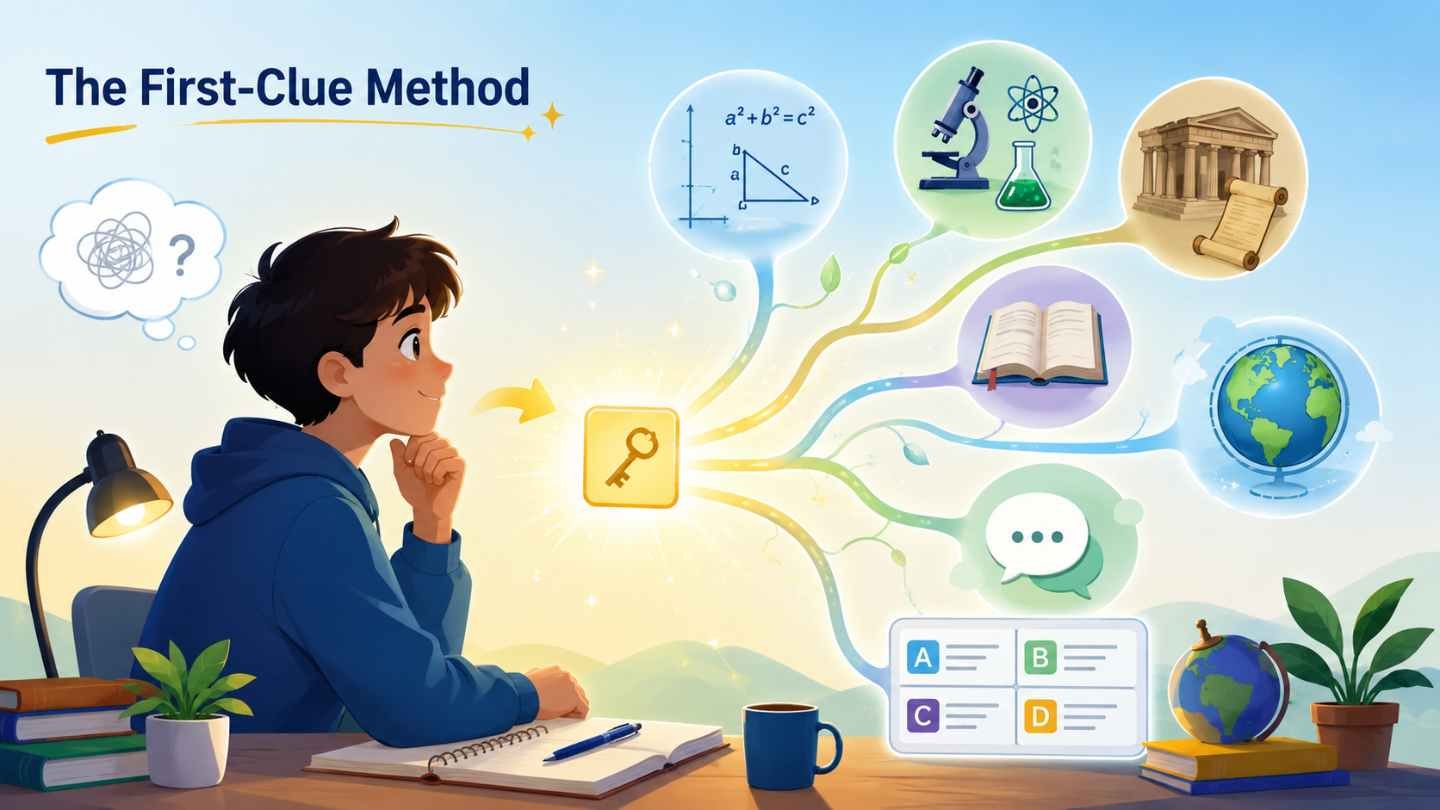
That is the power of the First-Clue Method. Instead of trying to understand everything at once, you begin with one hint and let it lead you into the larger idea.
What Is the First-Clue Method?
The First-Clue Method is a simple way to learn by starting with one small piece of information. Instead of trying to take in an entire topic at once, you begin with one clue and use it as a doorway into the bigger subject.
✨ A first clue can be:
- A keyword
- A picture
- A question
- A short example
- A surprising fact
- A name, date, place, or formula
- A detail that feels interesting or confusing
Instead of ignoring the clue or rushing past it, you pause and ask, “What can this lead me to?” The clue gives your learning direction before you try to understand the whole topic.
Why a Small Clue Makes a Big Topic Less Scary
Big subjects can feel overwhelming because they contain too many parts at once. Science has terms, diagrams, laws, and experiments. History has dates, people, places, causes, and effects. Math has formulas, steps, symbols, and patterns.
A first clue narrows the field. Instead of thinking, “I need to understand the entire lesson,” you think, “Let me follow this one hint first.” That small shift makes learning feel possible.
💡 The simple shift
A difficult topic becomes easier when you stop staring at the whole mountain and start with one visible trail marker.
Why One Hint Can Lead to Deeper Understanding
One clue is useful because the brain often learns through connection. A single detail can point toward a bigger pattern, and that pattern can lead to stronger understanding.
For example, the word “migration” in a history lesson can lead to questions about movement, survival, jobs, war, climate, trade, and culture. One word opens many doors. A clue works because it gives your mind something concrete to hold.
🧭 Clues Create Direction
When you are lost in a topic, you do not always need more information right away. Sometimes you need a starting point. A clue gives you that.
🔥 Clues Build Curiosity
A student may not care about ancient Egypt at first, but a picture of the pyramids can spark a question about engineering, labor, religion, geography, and leadership.
🧠 Clues Help Memory
A strong image, phrase, example, or story can become a memory hook. It gives learners something easier to remember than a full page of notes.
A strong clue is like a handle. It helps you pick up the bigger idea.
How to Use the First-Clue Method Without Getting Lost
The First-Clue Method is not about chasing every random detail. That can turn learning into a messy internet spiral. The goal is to follow one clue carefully, connect it to the main topic, and return with better understanding.
Step 1: Notice the clue
Start by identifying the detail that stands out. Ask yourself what word keeps appearing, what example makes the topic clearer, what image catches your attention, what part feels surprising, or what question you naturally want to ask.
The clue does not have to be impressive. It only has to give you a place to begin.
Step 2: Ask one focused question
- Why is this word important?
- What does this image show?
- How does this example connect to the lesson?
- What happened before this event?
- What does this formula help solve?
Step 3: Connect the clue to the bigger topic
The clue should lead back to the subject, not away from it. If your clue is “photosynthesis,” connect it to plants, sunlight, energy, oxygen, carbon dioxide, and food chains. A good clue expands the topic while still staying connected.
Step 4: Write one simple explanation
After following the clue, explain what you learned in your own words. Keep it short and clear.
Example: “Photosynthesis is how plants use sunlight to make food, and it matters because it supports oxygen and food chains.”
Practical Examples of the First-Clue Method
The method works across many subjects because every topic has clues hiding inside it.
🎯 In Quizzes
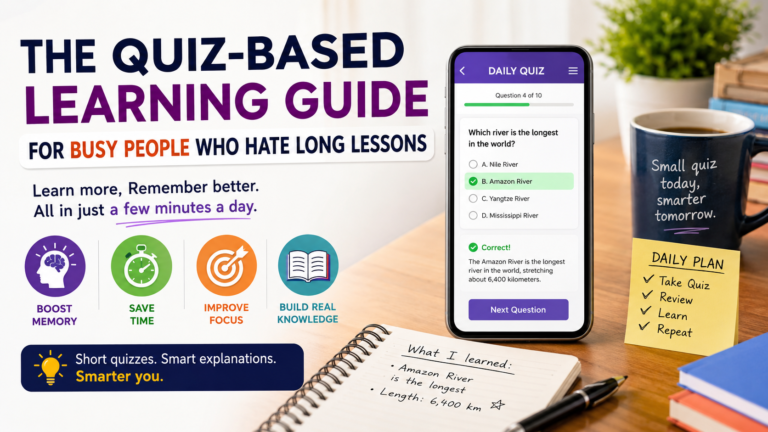
A quiz question may contain one word that unlocks the answer. If a question asks about “the water cycle” and includes “evaporation,” that clue points to water changing from liquid to vapor.
A current events question in a bing news quiz might introduce one country, leader, issue, or event that leads to a larger news story.
🎬 In Entertainment and Pop Culture
A clue can come from movies, music, shows, celebrities, or games. A question in a bing entertainment quiz might mention a director, award, actor, or song title that leads to learning about storytelling, culture, media trends, or language.
🔬 In Science
One diagram of a cell can lead to organelles, life processes, disease, medicine, and genetics. A leaf turning toward sunlight can lead to plant behavior and energy.
🏛️ In History
One date, artifact, speech, law, painting, or map can reveal how people lived, what they valued, what they feared, and what they wanted to change.
📖 In Reading
A repeated word, phrase, symbol, or heading can become a clue. If a passage repeats “pressure,” the main idea may involve stress, force, expectations, or conflict.
➗ In Math
Words like “total,” “difference,” “each,” “per,” “remaining,” or “rate” can hint at the operation needed. The wording of a problem often holds the first clue.
More Places to Find First Clues
🌍 In geography
One map symbol can lead to mountains, rivers, climate, trade routes, and population patterns. Maps are full of clues about how people live and move.
🗣️ In language learning
A new word can open an entire language pattern. If you learn the Spanish word “familia,” you may notice its connection to “family” in English. That clue can lead to cognates, pronunciation patterns, sentence building, and cultural vocabulary.
🏠 In everyday life
A receipt can teach budgeting. A food label can teach nutrition. A bus route can teach maps and planning. A news headline can teach politics, geography, or economics. A broken appliance can teach problem-solving.
📚 In self-study
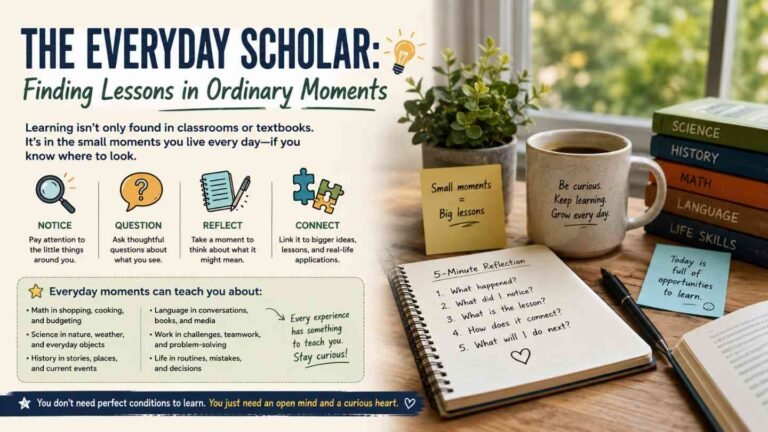
Start with one term, question, image, or example. Look it up. Write a simple explanation. Connect it to two related ideas. Then stop and review what you learned. This keeps self-study focused instead of overwhelming.
A Simple Five-Minute First-Clue Exercise
You can use this exercise with any topic. It works for lessons, quiz questions, articles, videos, notes, and everyday observations.
⏱️ Try this five-minute method:
- Minute 1: Choose one clue. Pick one small detail from your lesson, quiz, article, video, or notes. It could be a word, image, formula, name, date, example, or question.
- Minute 2: Ask one question. Turn the clue into a clear question, such as “Why does this matter?” or “What does this connect to?”
- Minute 3: Find one connection. Connect the clue to one bigger idea. If your clue is “gravity,” connect it to falling objects, planets, weight, or motion.
- Minute 4: Write a tiny explanation. Write two or three sentences explaining what the clue helped you understand. Try to sound clear, not perfect.
- Minute 5: Add one more clue. Find one related clue that could continue the learning. For gravity, your next clue might be “orbit.”
This final step keeps curiosity moving without making the task too large.
Common Mistakes to Avoid When Learning From Hints
The First-Clue Method works best when you use clues with focus. Here are a few mistakes that can weaken it.
Chasing Too Many Clues at Once
One clue can lead to another, but too many clues can create confusion. Start with one, follow it, explain it, then move to the next.
Treating the Clue as the Whole Lesson
A clue is a doorway, not the entire house. It starts the learning, but it should not replace deeper thinking.
Following Unrelated Details
Some details are interesting but not useful for your current goal. Curiosity is good, but direction matters.
Copying Without Understanding
Looking up a clue is helpful, but copying a definition is not enough. Use your own words and connect it to something you already know.
Ignoring Visual Clues
Maps, charts, diagrams, photos, timelines, and graphs often show relationships faster than paragraphs can. Pause and study them.
Why the First-Clue Method Makes Learning Feel More Natural
The First-Clue Method works because it matches how curiosity often begins. We rarely become interested in a subject by seeing the whole thing at once. We usually enter through one small detail.
A dinosaur footprint can lead to paleontology. A song lyric can lead to poetry. A news headline can lead to economics. A recipe can lead to chemistry. A math mistake can lead to a better understanding of problem-solving.
🌱 The natural learning path
Learning becomes less about forcing information into your mind and more about following a trail. That trail begins with one clue.
FAQ About the First-Clue Method
What is the First-Clue Method?
The First-Clue Method is a learning strategy where you begin with one small clue, such as a keyword, image, example, or question, and use it as a starting point to understand a larger topic.
Why does starting with one clue help learners?
One clue makes a big topic feel smaller and easier to approach. It gives learners direction, sparks curiosity, and helps them connect new information to ideas they already know.
Can this method work for difficult subjects?
Yes. It is especially useful for difficult subjects because it reduces overwhelm. Instead of trying to understand everything at once, learners focus on one useful hint and build from there.
Is the First-Clue Method only for students?
No. Anyone can use it. It works for school, work, reading, online learning, everyday problem-solving, language learning, and self-study.
How do I know if a clue is useful?
A useful clue helps you ask a better question, understand a key idea, or connect to the main topic. If it leads you away from your learning goal, it may be interesting but not useful for the moment.
Can quiz questions be used as first clues?
Yes. Quiz questions often contain keywords, examples, names, dates, or choices that can lead to deeper learning. Even a wrong answer can become a clue if you review why it was incorrect.
Final Thoughts
The First-Clue Method reminds us that understanding does not always begin with a full explanation. Sometimes it begins with one small hint that makes us pause.
A keyword, image, example, question, or surprising detail can make a difficult subject feel reachable. It gives you a starting point, builds curiosity, supports memory, and helps you connect one idea to another.
The next time a topic feels too big, do not try to swallow the whole lesson at once. Find the first clue. Follow it carefully. Let it open the subject one step at a time.