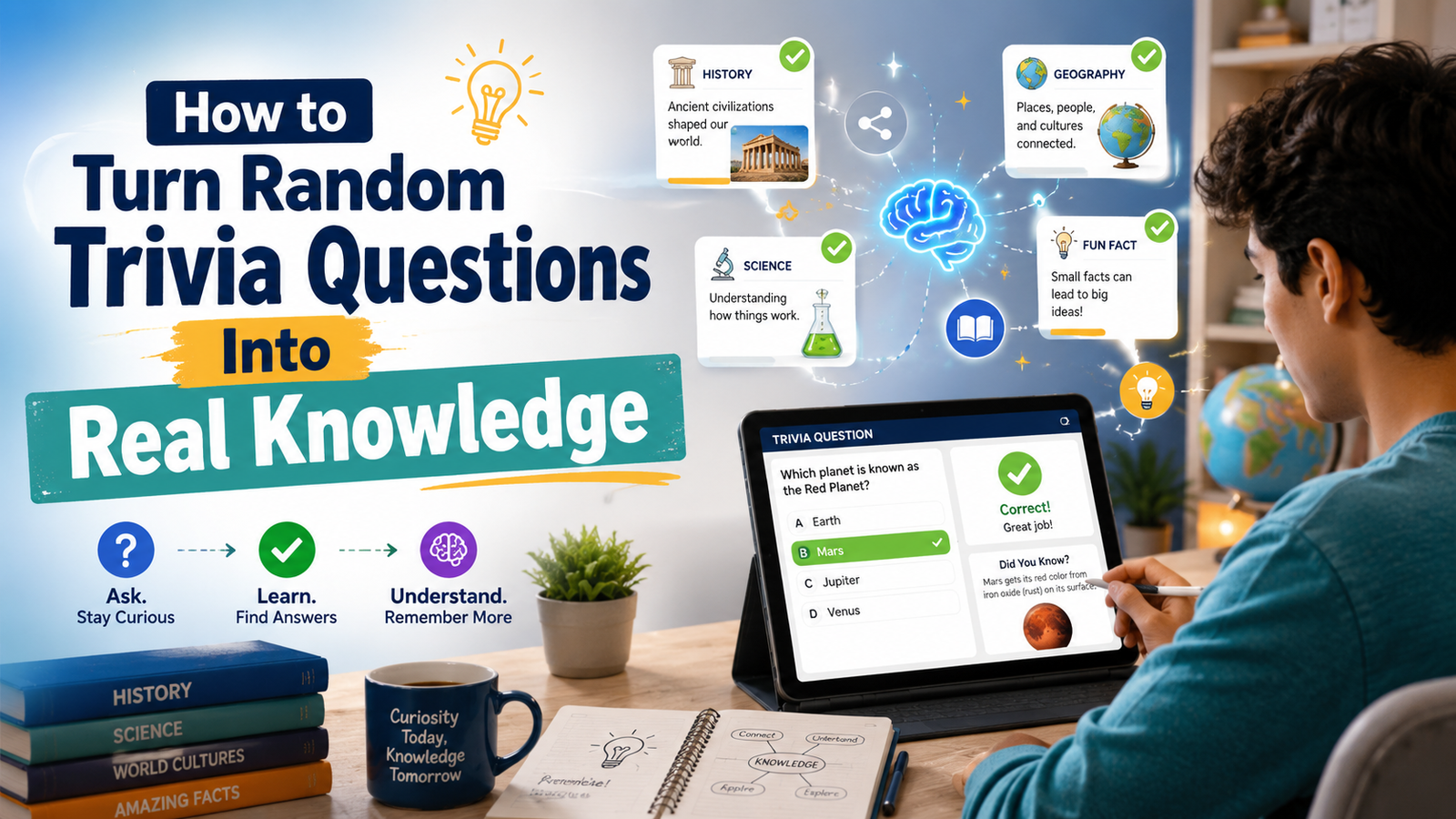
How to Turn Random Trivia Questions Into Real Knowledge
Random trivia questions look simple.
One question. Four choices. A quick guess. Maybe you get it right. Maybe you don’t. Then you move on.
But here’s the part many people miss:
Trivia is not just entertainment. When used the right way, it can become a powerful tool for building real knowledge.
A random question about planets can lead you into astronomy. A question about an old king can open the door to history. A question about the human body can suddenly make science feel less boring.
Trivia works because it starts small. It simply says, “Do you know this?” And once your curiosity wakes up, learning becomes much easier.
Question
A small prompt catches your attention.
Curiosity
You wonder why the answer is right or why your guess missed.
Connection
One fact links to a bigger idea.
Knowledge
The random trivia question becomes something useful.
Why Random Trivia Questions Are Better Than They Look
Random trivia questions may seem scattered, but that is actually part of their strength.
A normal lesson usually follows one subject at a time. That is useful, of course. But life does not test your knowledge in neat little boxes. One day you hear something about space. The next day it is politics, food, geography, sports, inventions, animals, or famous people.
Space
A planet question can lead into astronomy.
History
A king, empire, or invention can open a bigger story.
Science
A body or nature question can make science easier to enjoy.
Trivia trains your brain to jump between topics. That helps you build flexible general knowledge. You are not just memorizing facts. You are learning how different pieces of information connect.
Example: You answer a question about the Amazon River. Then you learn it is in South America. That connects to geography. Then you discover it affects climate, wildlife, and local communities. Suddenly, one trivia question has turned into a small lesson about the world.
That is quiz learning at its best.
The Difference Between Trivia and Real Knowledge
Trivia becomes real knowledge when you understand the “why” behind the answer.
Which planet is known as the Red Planet?
The answer is Mars.
Mars looks red because of iron oxide, or “rust,” on its surface.
Now you are not just remembering a nickname. You understand the reason behind it.
The goal is not to know every random fact on earth. Nobody does. The goal is to turn small facts into useful understanding.
Use the “One Question, Three Layers” Method
Here is a simple method you can use every time you answer random trivia questions.
The Answer Layer
First, know the correct answer. This is the basic quiz part. You either got it right or wrong. No drama. No shame. A wrong answer is not failure. It is just a bright little sign pointing to something you can learn.
The Reason Layer
Next, ask: Why is that the answer? If the answer is “the Nile,” ask why it matters. If the answer is “Marie Curie,” ask what she discovered. Do not stop at the answer. Chase the explanation.
The Connection Layer
Finally, connect the fact to something else you already know. This helps with memory improvement because your brain remembers connected ideas better than isolated facts.
Connection Example
Trivia fact: The Great Wall of China is very long.
Connection: It was built for defense.
Bigger idea: Countries often build structures to protect borders.
Modern link: Today, countries use technology, surveillance, and diplomacy instead of only walls.
One question. One answer. Several connections. That is how trivia grows roots.
Why Daily Quizzes Help Memory
Daily quizzes work because they create repetition without making learning feel heavy. Reading a long chapter once may not stick. But answering a few educational quizzes every day gives your brain repeated contact with facts, ideas, and patterns.
This is especially helpful for memory improvement. Your brain likes repeated signals. When you see a topic again and again, it starts to feel familiar. Familiar things are easier to remember.
A daily quiz can help you:
Even five to ten questions a day can make a difference over time.
Don’t Just Guess and Leave
Guessing is fine. Everyone guesses sometimes. But the mistake is guessing and then immediately moving on.
When you answer a random trivia question, spend a few seconds with it. That tiny pause can change everything.
Ask yourself:
This turns a simple quiz into active learning. And yes, it takes a little more effort. But not much. You are not writing a research paper. You are just giving your brain a better chance to keep the information.
Wrong Answers Are Often the Best Teachers
Getting a question wrong feels annoying for about two seconds. Then it becomes useful.
A wrong answer shows you exactly where your knowledge is fuzzy. Maybe you mixed up two countries. Maybe you confused two inventors. Maybe you remembered the right topic but picked the wrong detail.
If you thought Thomas Edison invented the telephone, but the correct answer was Alexander Graham Bell, you now have a chance to separate two commonly confused names.
Light bulb and phonograph
Telephone
One wrong answer helped you clean up two facts. That is a win, honestly.
Turn Random Facts Into Mini Stories
Facts are easier to remember when they feel like stories. A dry fact disappears quickly. A small story sticks.
“Mount Vesuvius erupted in AD 79.”
“A Roman city called Pompeii was buried when Mount Vesuvius erupted in AD 79, preserving buildings, streets, and even daily objects under volcanic ash.”
Now the fact has a place, a scene, and a reason to matter. When you answer educational quizzes, try to add one small story to the facts you want to remember.
Make a “Curiosity List”
This is one of the easiest ways to turn random trivia questions into real knowledge. Whenever a question catches your attention, write it down. Not every question. Just the ones that make you think:
Your curiosity list might include topics like why flamingos turn pink, what caused the fall of the Roman Empire, how Wi-Fi works, why the ocean is salty, or who invented the first computer.
Later, pick one topic and read a short article, watch an educational video, or take another quiz about it. That is how random trivia becomes self-directed learning.
Group Similar Questions Together
Random trivia questions are fun, but patterns make them stronger. After taking a quiz, look for categories.
Ask yourself:
This helps you understand your learning map. If you keep missing country capitals, focus on geography quizzes. If you struggle with dates, try timeline-based history questions. If science terms confuse you, start with basic explanations. If you love movie trivia, use it as a bridge into culture and history.
Explain the Answer in Your Own Words
This is a powerful trick. After answering a quiz question, explain the correct answer as if you were teaching a younger student. Keep it simple.
Question: What gas do plants absorb from the air?
Answer: Carbon dioxide.
Simple explanation: Plants take in carbon dioxide and use sunlight to make food. This process is called photosynthesis.
When you can explain something simply, you understand it better. If you cannot explain it, that is not a problem. It just means you found a gap. Now you know what to learn next.
Use Trivia as a Warm-Up for Learning
Random trivia questions are not always the full lesson. Sometimes they are the doorway. Before reading about a topic, try answering a short quiz first. This wakes up your brain and shows you what you already know.
Before World War II
Answer five history questions.
Before Solar System Study
Take a short space quiz.
Before Nutrition Reading
Answer food and health questions.
This makes learning more active. Instead of passively reading, your brain is already searching for answers. That little mental spark matters.
Keep It Fun, Not Stressful
Trivia should not feel like a punishment. You do not need to turn every quiz into a serious study session. Some questions can simply be fun. Some can make you laugh. Some can surprise you and then vanish forever, like that one fact about octopuses having three hearts.
Still a great fact, by the way.
The key is balance. Enjoy the game, but keep your eyes open for learning moments.
A good quiz website should not only test what you know. It should make you want to know more.
Practical Tips for Better Quiz Learning
Small habits make trivia more useful. You do not need a complicated system. You just need a better way to pay attention.
Example: Turning One Trivia Question Into Real Knowledge
Answer: The skin.
Now that one question is no longer just a fact. It has meaning.
Why General Knowledge Still Matters
Some people think general knowledge is just for game shows. Not true.
General knowledge helps you understand conversations, news, books, documentaries, school lessons, and even everyday decisions. It gives you more context for the world around you.
When you know a little about many things, you can learn new things faster.
That is because new information needs somewhere to land. General knowledge gives your brain more hooks. Random trivia questions build those hooks one at a time.
FAQs About Random Trivia Questions and Learning
1. Can random trivia questions really improve knowledge?
Yes, especially when you review the answers and understand the explanation behind them. Trivia becomes real knowledge when you connect facts to reasons, stories, and related ideas.
2. Are daily quizzes good for memory improvement?
Daily quizzes can help because they use recall and repetition. When you answer questions regularly, your brain practices bringing information back, which can make memory stronger over time.
3. What should I do when I get a trivia question wrong?
Do not just move on. Look at the correct answer, ask why it is correct, and compare it with your wrong choice. This helps you fix confusion and remember better next time.
4. Are educational quizzes better than reading?
They are different tools. Reading gives depth, while quizzes test recall and spark curiosity. The best approach is to use both: take quizzes to find gaps, then read or study to fill them.
Final Thoughts
Random trivia questions may look small, but they can lead to real knowledge when you treat them with curiosity.
The secret is simple: do not stop at the answer.
Ask why. Make a connection. Review what you missed. Turn interesting facts into short stories. Use daily quizzes to keep your brain active.
Over time, those little questions add up. One day, a random quiz answer becomes something you remember in a conversation, understand in an article, or connect to a bigger idea.
That is when trivia stops being just a game. That is when it becomes learning.