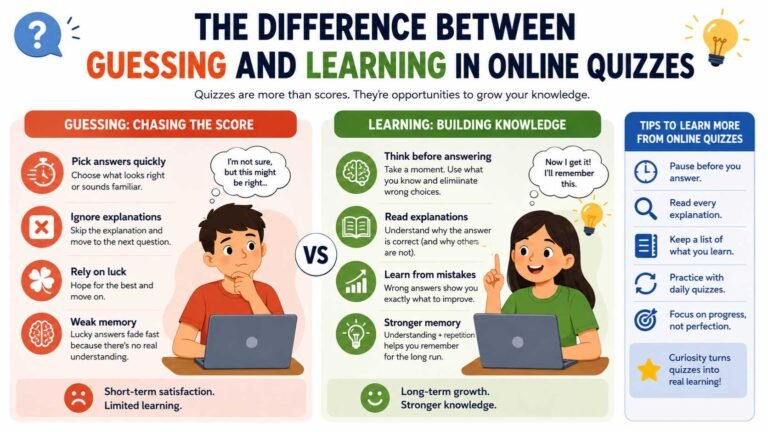
Why Quiz Explanations Matter More Than the Score
Most people look at a quiz score first.
But here is the funny thing: the score is usually the least useful part of a quiz.
The real learning happens after the answer is revealed. That small explanation under the question can do more for your memory, curiosity, and general knowledge than the number at the end of the quiz.
A score tells you what happened.
A good explanation tells you why.
And that “why” is where the learning begins.
Scores Measure
They show the result, but not always the reason behind it.
Explanations Teach
They connect answers to meaning, examples, and memory.
Mistakes Grow
A wrong answer becomes useful when you understand why.
Fresh Angle: A Quiz Score Is a Receipt, Not the Lesson
Think of your quiz score like a receipt after shopping. It shows what you got, what you missed, and the final total. Useful? Sure. But it does not teach you much by itself.
Quiz explanations are different. They are more like a tiny teacher sitting beside each question, gently pointing out what matters:
That is why quiz explanations matter so much. They turn a quick quiz into real quiz learning.
What Are Quiz Explanations?
Quiz explanations are short notes that explain the correct answer after a question. They do not need to be long, complicated, or textbook-heavy. Their job is simple: help the learner understand the answer.
Which planet is known as the Red Planet?
Answer: Mars
Explanation: Mars is called the Red Planet because iron-rich dust on its surface gives it a reddish color.
Without the explanation, you only know the answer. With the explanation, you understand the reason behind it. That reason is what helps the fact stay in your mind longer.
Why the Score Can Be Misleading
A high score feels good, but it does not always mean deep understanding. Maybe you guessed correctly. Maybe the choices were too obvious. Maybe you remembered the answer for a moment but would forget it tomorrow.
A low score can also be misleading. It might look bad, but it can actually be a great learning moment if the quiz gives clear answer explanations.
In educational quizzes, the score is just the surface. The explanation is the part that helps you grow.
Quiz Explanations Help You Remember Better
Memory loves meaning. Random facts are easy to forget when they float around alone. But when a fact connects to a reason, story, example, or pattern, your brain has something to hold onto.
Weak Quiz
Correct answer: Carbon dioxide.
The learner knows the answer, but not the reason.
Useful Quiz
Plants absorb carbon dioxide during photosynthesis and release oxygen as a byproduct.
Now the answer connects to a process, not just a word.
That is memory improvement in action. Not magic. Just better learning.
Answer Explanations Turn Mistakes Into Clues
Wrong answers are not useless. In fact, they can be the best part of a quiz. When you choose the wrong answer, your brain becomes alert. It wants to know what happened. That moment is perfect for learning.
A good explanation helps you see the gap:
Once you understand the mistake, you are less likely to repeat it. That is why answer explanations matter more than just seeing “Correct” or “Incorrect.”
They Make General Knowledge Feel Connected
General knowledge can feel random sometimes. One question is about planets. The next is about history. Then suddenly you are answering something about animals, music, or geography. It can feel like mental popcorn.
Quiz explanations help connect those scattered facts. A question about the Nile River can lead to geography, ancient Egypt, agriculture, and world history. A question about lightning can open the door to weather, electricity, and safety.
The explanation gives each fact a place to belong.
That is how daily quizzes become more than entertainment. They slowly build a stronger web of knowledge.
Why Curiosity Needs More Than a Correct Answer
A correct answer can end curiosity too quickly. You see the answer. You nod. You move on. But a good explanation keeps the door open.
It may add a surprising detail, correct a common myth, or give a simple reason that makes you want to learn more.
Do sharks really smell one drop of blood from miles away?
Answer: Not exactly.
Explanation: Sharks have an excellent sense of smell, but the “miles away” idea is often exaggerated. Water currents, distance, and the type of scent all matter.
That kind of explanation does more than answer the question. It makes the topic interesting. And curiosity is one of the strongest engines for learning.
Short Explanations Are Often Better
Quiz explanations do not need to be long. Actually, the best ones are usually short, clear, and useful.
A strong explanation should:
For a quiz website, this matters a lot. Readers often want quick learning, not a full lecture. A good explanation respects their time while still giving them something valuable.
Practical Example: Score-Only vs. Explanation-Based Quiz
Here is the difference.
Score-Only Quiz
What is the capital of Canada?
A. Toronto
B. Ottawa
C. Vancouver
D. Montreal
Correct Answer: Ottawa
That is fine. But it is thin.
Explanation-Based Quiz
Correct Answer: Ottawa
Explanation: Ottawa is Canada’s capital. Toronto is the largest city, which is why many people guess it, but the national government is based in Ottawa.
Now the learner understands the common trap.
How Quiz Explanations Improve Daily Quiz Learning
Daily quizzes work best when they build small habits. You answer a few questions. You learn one or two new things. You come back tomorrow. Simple.
But if a daily quiz only gives a score, the learning fades quickly. You may enjoy the game, but the facts do not always stick.
When daily quizzes include explanations, each session becomes more useful.
You are not just testing what you know. You are training your brain to notice, compare, remember, and connect ideas.
That is the difference between playing a quiz and learning from a quiz.
Tips for Getting More Value From Quiz Explanations
1. Read the Explanation Even When You Got It Right
Many people skip explanations after correct answers. Don’t. Sometimes you guessed correctly. Sometimes you knew the answer but not the reason. The explanation can still add depth.
2. Notice Why the Wrong Choices Were Tempting
Wrong choices are often designed around common confusion. If you picked Toronto instead of Ottawa, maybe you mixed up “largest city” with “capital city.” That small correction helps your memory.
3. Turn One Explanation Into One Sentence
After reading an explanation, try saying it in your own words. Example: “Ottawa is the capital, but Toronto is often guessed because it is Canada’s largest city.”
4. Save Questions That Surprise You
If an explanation teaches you something unexpected, write it down or bookmark it. Surprise is great for memory improvement because your brain pays attention when something breaks your expectation.
5. Use Explanations as Mini Study Notes
You do not need a giant notebook. A few short notes from educational quizzes can become a simple general knowledge review list.
Mini study note examples:
Small notes. Big payoff over time.
What Makes a Good Quiz Explanation?
Not all explanations are equal. A good quiz explanation should be clear, accurate, and easy to remember. It should not just repeat the answer.
Weak Explanation
“Ottawa is correct because Ottawa is the capital.”
It repeats the answer but adds almost nothing.
Better Explanation
“Ottawa is Canada’s capital. Toronto is larger, but Ottawa is where the federal government is based.”
It teaches something and explains the common trap.
The second one teaches something. It also explains why someone might choose the wrong answer. That is what makes it useful.
Why Quiz Websites Should Care About Explanations
For quiz websites, explanations are not just nice extras. They can improve the whole experience. Readers stay longer because they are learning, not just clicking. They trust the quiz more because the answers feel supported. They may also return more often because each quiz gives them something useful to take away.
Scores create quick reactions.
Explanations create value.
And value is what makes people come back.
Quiz Explanations Build Confidence
A bad quiz can make someone feel dumb. A good quiz makes someone think, “Oh, now I get it.” That difference matters.
When explanations are friendly and clear, learners feel encouraged instead of embarrassed. They understand that wrong answers are part of the process.
Confidence grows when people understand their mistakes.
This is especially important for students, casual learners, and anyone trying to build general knowledge little by little.
FAQs About Quiz Explanations
1. Why are quiz explanations important?
Quiz explanations are important because they show why an answer is correct. They help readers understand the topic, remember facts better, and learn from mistakes instead of only seeing a score.
2. Do quiz explanations help with memory improvement?
Yes. Explanations connect facts to meaning, examples, and reasons. This makes information easier to remember than simple answer memorization.
3. Should I read explanations even if I answer correctly?
Yes. A correct answer does not always mean full understanding. Reading the explanation can add helpful details and strengthen your knowledge.
4. Are educational quizzes better with answer explanations?
Definitely. Educational quizzes become more useful when they include answer explanations because they teach as well as test. The learner gets more value from each question.
Final Thoughts
A quiz score is quick. It gives you a result. But quiz explanations give you something better: understanding.
They help you see why an answer is right, why another answer is wrong, and how a small fact connects to a bigger idea. That is where real quiz learning happens.
So the next time you finish a quiz, don’t rush past the explanations. Read them. Think about them. Let them do their quiet little job.
The score may tell you how you did today.
The explanation helps you do better tomorrow.