The Quiz-Based Learning Guide for Busy People Who Hate Long Lessons
Some people love long lessons.
They enjoy sitting with a notebook, watching a 45-minute video, reading chapter after chapter, and slowly building knowledge piece by piece.
Then there are the rest of us.
You want to learn. You really do. But long lessons feel heavy. Your attention wanders. Your schedule is already packed. And sometimes, even a simple topic feels like one more thing asking for your time.
✨ That is where quiz-based learning becomes useful.
Instead of forcing yourself through long explanations, you can use short quizzes to test what you know, notice what you missed, and learn in small pieces that actually fit into real life.
This guide is for busy learners who want something practical, simple, and definitely not boring.
Fast to Start
A few questions can turn spare minutes into learning moments.
Easy to Focus
One question gives your brain one clear target.
Built for Growth
Mistakes become clues, not dead ends.
Why Quiz-Based Learning Works for Busy People
Quiz-based learning works because it turns learning into action. Instead of only reading or watching, you answer. You guess. You remember. You compare your answer with the correct one. That small mental effort makes your brain work harder than passive reading.
And that is a good thing.
When you try to recall an answer, your brain is not just receiving information. It is searching for it. That search helps strengthen memory.
For busy people, this matters because you may not have one hour to study. But you may have five minutes during lunch, while waiting in line, or before sleeping. A short quiz can turn dead time into learning time.
The Fresh Angle: Learn by “Catching Your Brain in the Act”
Most people think quizzes are only for checking scores. But a better way to use quizzes is to treat them like a mirror. A quiz shows you how your brain thinks.
A quiz reveals:
That is powerful. A wrong answer is not just a mistake. It is a clue. It tells you where your understanding is weak. A correct guess may also be a clue, because it shows you need stronger confidence, not just luck.
This is why quiz learning can be more useful than simply reading a long lesson. It makes your brain show its work.
What Makes Quiz-Based Learning Different from Long Lessons?
📖 Long Lessons
Usually give you information first. You may feel productive because you finished reading or watching, but finishing does not always mean remembering.
🧩 Quizzes
Ask you to think first. You see results right away and quickly learn which ideas stuck and which ones slipped away.
For example, reading about world capitals for 30 minutes may feel useful. But answering 10 general knowledge questions about countries, cities, and geography will quickly show what you actually remember. That feedback is what makes quiz-based learning so helpful.
How Short Quizzes Help Memory Improvement
Memory gets stronger when you use it. This is why short quizzes can help with memory improvement. They make you pull information out of your mind instead of only putting more information in.
Think of it like exercise: reading is like watching someone lift weights. Quizzing is like lifting the weight yourself.
Even a quick daily quiz can train your memory because it gives your brain repeated practice.
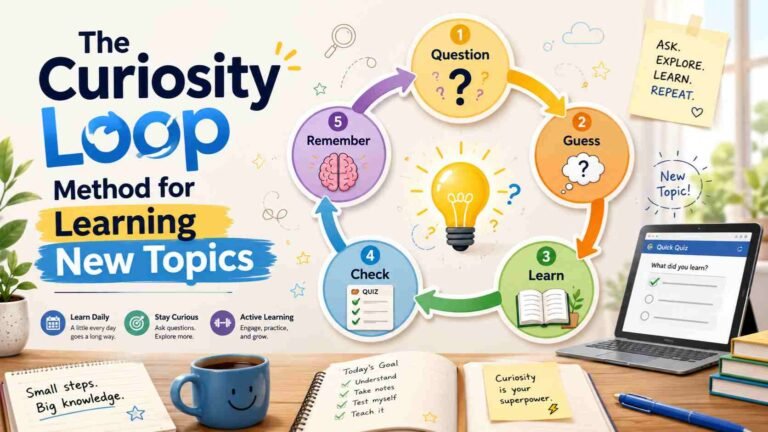
The Simple Memory Loop
This loop does not need to take long. Even 10 minutes a day can build real knowledge over time.
Why Busy Learners Should Use Short Lessons
Short lessons are not lazy learning. They are realistic learning.
Many people fail to study because they set the bar too high. They think they need a perfect desk, a quiet room, a long notebook, and a big block of free time. But busy learners need something lighter.
A five-question quiz may not look impressive. But if you do it every day, that becomes 35 questions a week. Over a month, that is around 150 questions. Over a year, it becomes thousands of small learning moments.
Tiny steps can become serious knowledge.
How to Use Daily Quizzes Without Feeling Overwhelmed
Daily quizzes are useful, but only when they feel manageable. Do not treat them like school punishment. Treat them like a small mental warm-up.
You can use daily quizzes for:
The key is to keep it short. A quiz that takes 5 to 10 minutes is easier to build into your routine than a long lesson that demands your whole evening.
The 10-Minute Quiz-Based Learning Routine
Here is a simple routine busy learners can use.
Step 1: Take a Short Quiz
Start with 5 to 10 questions. Do not worry about getting a perfect score. The goal is not to look smart. The goal is to discover what your brain remembers.
Step 2: Mark the Questions You Missed
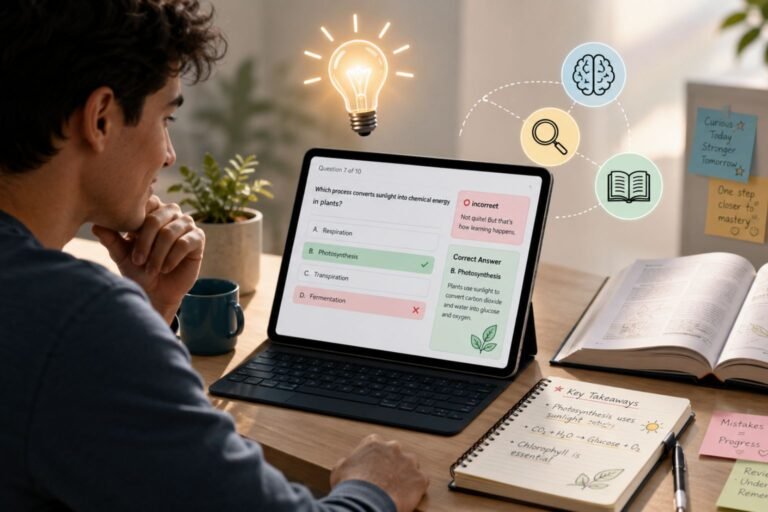
Wrong answers are the most useful part. Instead of ignoring them, pause for a moment and ask, “Why did I choose that answer?” Maybe you guessed. Maybe two choices looked similar. Maybe you misunderstood the question.
Step 3: Read the Explanation
A good quiz explanation matters more than the score. The explanation turns a missed question into a mini-lesson. Do not just look at the correct letter. Read why it is correct.
Step 4: Say the Answer in Your Own Words
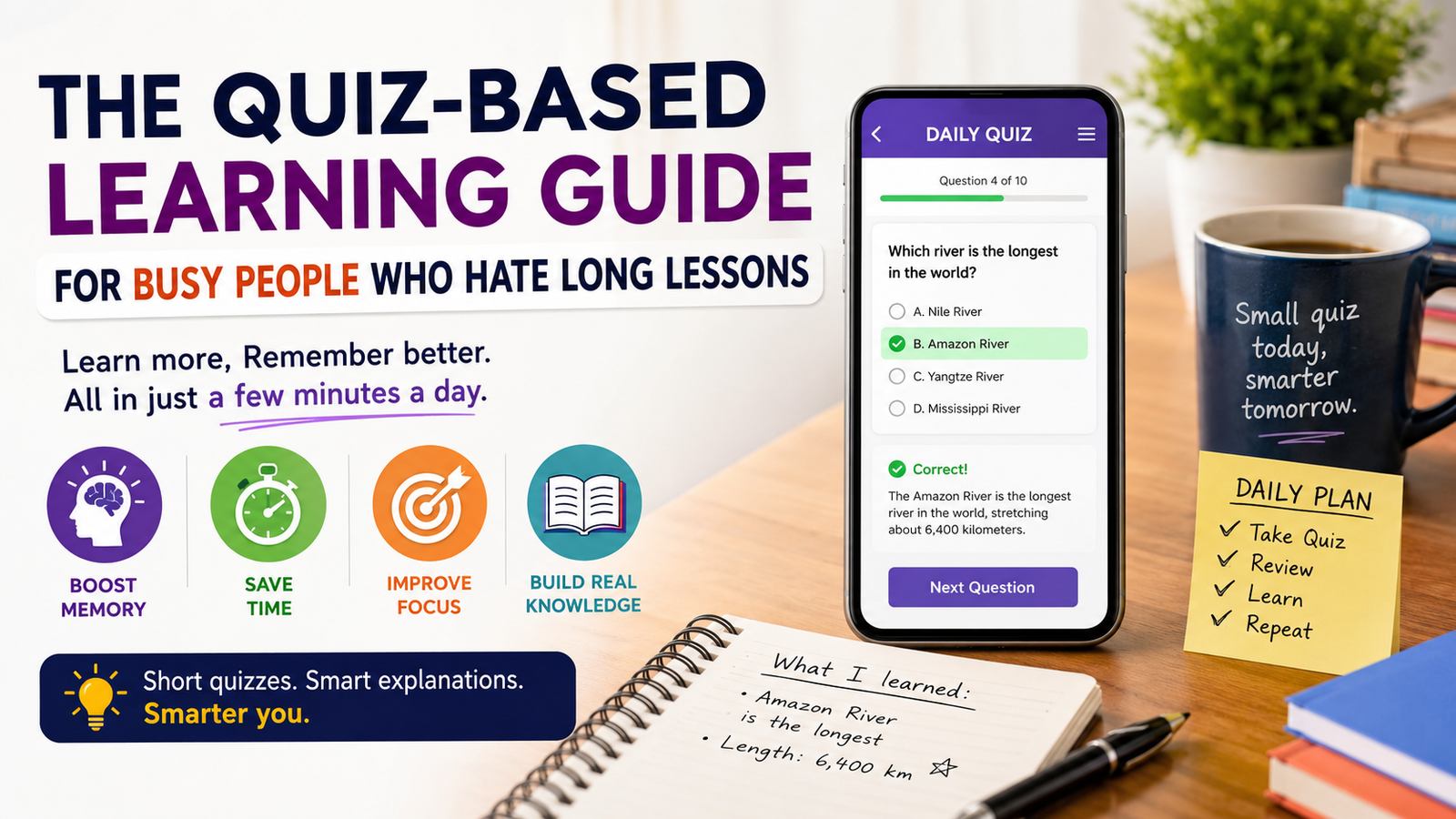
After reading the explanation, explain the answer to yourself in one sentence. For example: “The Amazon River is important because it carries more water than any other river in the world.” That sentence helps move the fact from short-term memory into deeper understanding.
Step 5: Review One Missed Question Tomorrow
You do not need to review everything. Just review one or two missed questions the next day. This keeps learning light and helps with memory improvement.
How Quiz Learning Builds Focus
Focus is not only about trying harder. Sometimes, focus improves when the task becomes smaller.
Long lessons can feel endless. A quiz gives your brain a clear target: one question, one answer, one result. That structure helps you stay engaged.
Quizzes also add a little challenge, and challenge wakes up attention. You want to know if you got it right. You want to see the next question. You want to beat your previous score.
That small spark of curiosity can pull your mind back when it starts drifting.
The Best Types of Educational Quizzes for Busy Learners
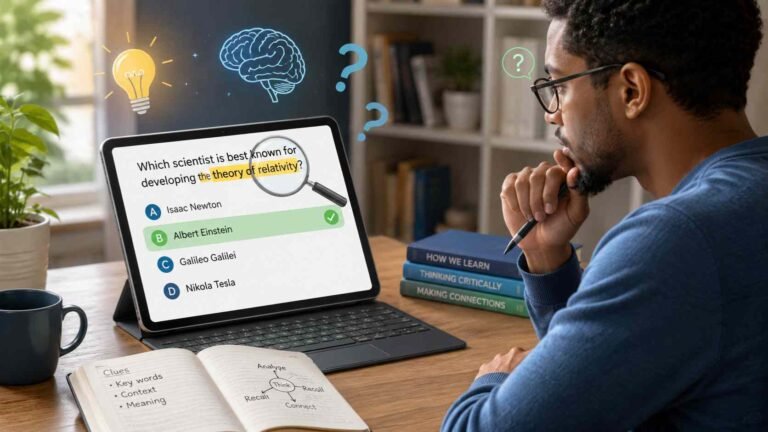
Not every quiz is equally helpful. Some quizzes are just random entertainment. That can be fun, but if your goal is learning, choose quizzes that give you something useful after each answer.
Quizzes with Explanations
A quiz without explanations can test you, but a quiz with explanations can teach you.
Mixed General Knowledge
Variety keeps the brain alert by moving across science, history, geography, and more.
Daily Quizzes
Daily quizzes help you build consistency without needing to study all day.
Review Quizzes
Review helps memory become stronger. Without it, even interesting facts fade quickly.
Practical Tips to Learn More from Every Quiz
Use Wrong Answers as Study Signals
Do not feel bad about wrong answers. A wrong answer is your brain saying, “This part needs attention.” That is not failure. That is direction.
Keep a Tiny Mistake List
Write down only the questions you missed. Not every question. Not every fact. Just the ones that fooled you. This list becomes your personal study guide.
Do Not Chase Perfect Scores Too Soon
Perfect scores feel nice, but they are not the main goal. The main goal is improvement. If you scored 5 out of 10 today and 7 out of 10 next week, that is progress.
Mix Easy and Hard Questions
Easy questions build confidence. Hard questions build growth. A good quiz should have both.
Repeat Topics After a Few Days
If you took a history quiz today, try another one later in the week. Repetition helps memory, especially when there is a little time between sessions.
A Simple Weekly Plan for Busy Learners
You do not need a complicated study system. Try this simple rhythm:
This keeps learning fresh without making it feel like a heavy assignment.
Common Mistakes to Avoid
Mistake 1: Only Caring About the Score
The score is feedback, not your identity. A low score can still be useful if you learn from it.
Mistake 2: Skipping Explanations
If you only check whether you were right or wrong, you miss the best part of the quiz.
Mistake 3: Taking Too Many Quizzes
More is not always better. One thoughtful quiz can teach more than five rushed ones.
Mistake 4: Never Reviewing Mistakes
Review turns weak memory into stronger memory. Even a quick review can help.
Why Curiosity Matters in Quiz-Based Learning
Curiosity makes learning feel less forced. A good quiz question can make you wonder, “Wait, is that really true?” That moment matters.
Questions wake up the mind.
You do not need to begin with a big lecture. You can begin with a question.
Curiosity opens the door for learning. It makes your brain want the answer. And when your brain wants the answer, the information becomes easier to remember.
Who Should Try Quiz-Based Learning?
Quiz-based learning is useful for many kinds of learners, especially:
It is not about replacing deep study forever. Some topics still need reading, practice, and longer explanations. But quizzes can help you start, review, and stay consistent. For many busy learners, that is the hardest part.
FAQs About Quiz-Based Learning
1. What is quiz-based learning?
Quiz-based learning is a study method that uses questions, answers, and feedback to help you learn. Instead of only reading or watching lessons, you test your memory and understanding through quizzes.
2. Can short quizzes really help with memory improvement?
Yes. Short quizzes can help because they make you recall information. This recall practice strengthens memory over time, especially when you review missed questions later.
3. How many quiz questions should I answer per day?
For busy learners, 5 to 10 questions a day is a good starting point. The goal is consistency, not exhaustion. A short daily quiz is better than a long study plan you never follow.
4. Are educational quizzes better than long lessons?
They are different. Long lessons can explain topics deeply, while educational quizzes help you test, review, and remember. For many people, the best approach is to use quizzes first, then read short explanations for the questions they missed.
Final Thoughts
Quiz-based learning is not about rushing through random questions. It is about learning in a way that fits real life.
If you hate long lessons, you do not have to force yourself into a study routine that feels heavy. Start with a short quiz. Notice what you know. Learn from what you miss. Read the explanation. Try again tomorrow.
Small quizzes can build big knowledge when you use them with purpose.
And for busy learners, that may be the best kind of learning: simple, repeatable, and easy to begin.