How to Build a Personal Knowledge Map From Daily Trivia
Daily trivia is fun because it feels quick. One question, one answer, one tiny spark of curiosity.
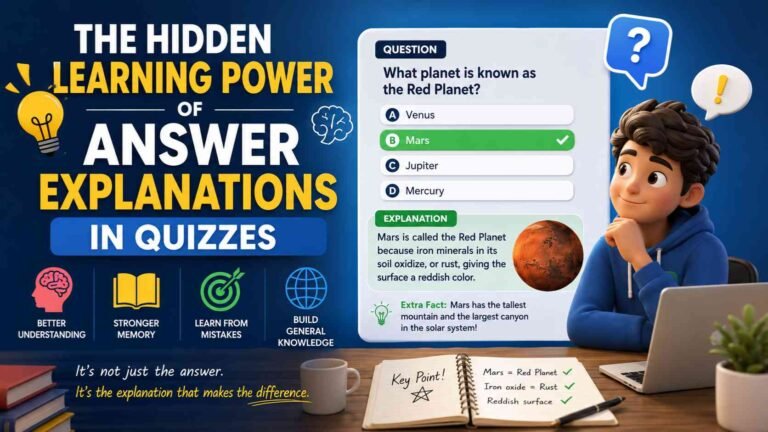
But here is the problem: if you answer a quiz question today and forget it tomorrow, the learning disappears too fast.
That is where a personal knowledge map can help.
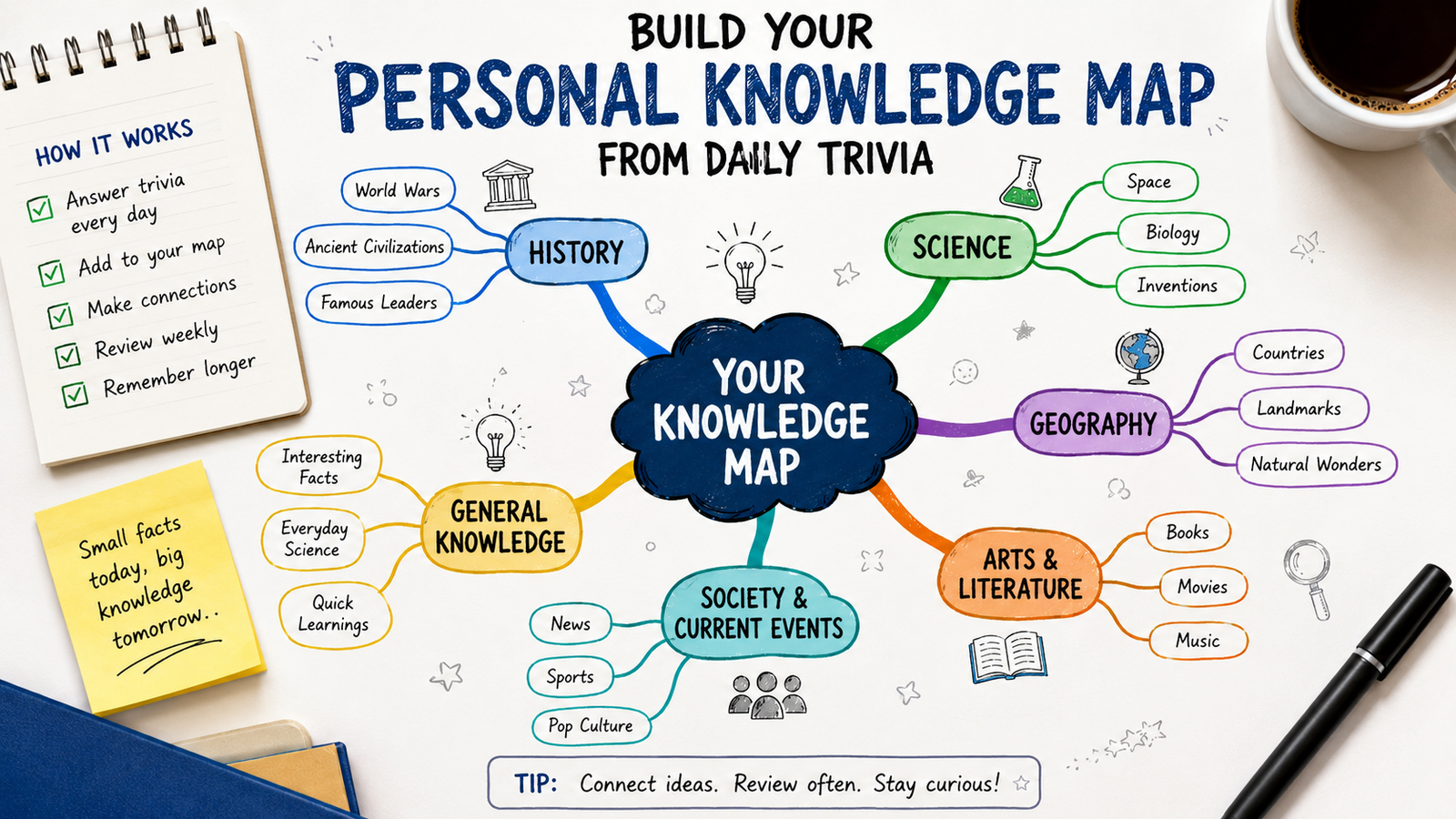
A personal knowledge map is a simple way to organize what you learn from daily trivia. Instead of treating every question like a random fact, you connect it to bigger ideas. Over time, your quiz answers become a web of useful knowledge.
Think of it like turning scattered puzzle pieces into a picture.
🗺️ What Is a Personal Knowledge Map?
A personal knowledge map is a visual or written system that shows what you know, what you are learning, and how different facts connect.
It does not need to be fancy. You can build one with a notebook, spreadsheet, notes app, whiteboard, mind-mapping tool, or even index cards.
The goal is simple: when you learn something from daily trivia, you place it somewhere meaningful.
Question: Which planet has the strongest winds in the solar system?
Answer: Neptune
Instead of writing only “Neptune = strongest winds,” connect it to astronomy, planets, weather systems, gas giants, space facts, and science quiz mistakes.
Now that one answer has a place in your memory.
✨ Why Daily Trivia Is Perfect for Building a Knowledge Map
Daily trivia works well because it gives your brain small, manageable pieces of information.
Long lessons can feel heavy. Trivia feels light. That is why quiz learning is useful for busy people.
You do not need one hour of study. You can start with five minutes and still build real knowledge if you organize what you learn.
This variety makes trivia a great starting point for a personal knowledge map. You are not just memorizing facts. You are discovering patterns.
🍞 The Fresh Angle: Treat Trivia Like Breadcrumbs, Not Final Answers
Most people treat trivia questions as complete lessons. They answer, check the score, and move on.
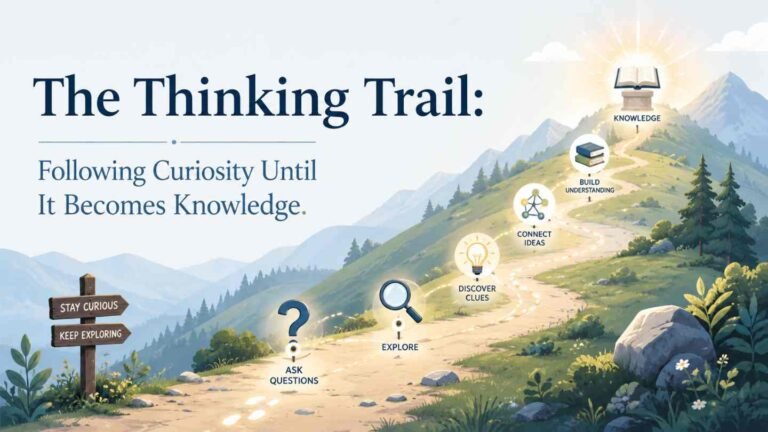
But a better method is to treat every trivia question like a breadcrumb. It points you toward a bigger trail.
That is the secret. The trivia answer is not the destination. It is the doorway.
🧭 Step 1: Choose Your Main Knowledge Categories
Start with broad categories. Do not overthink this. For a quiz website or daily trivia habit, these categories work well:
1. History
People, wars, empires, inventions, ancient civilizations, timelines, and major events.
2. Science
Biology, chemistry, physics, astronomy, medicine, animals, earth science, and technology.
3. Geography
Countries, capitals, landmarks, oceans, mountains, rivers, climate, and cultures.
4. Arts and Literature
Books, authors, paintings, music, films, language, and famous creative works.
5. Society and Current Knowledge
Government, economics, world news, sports, pop culture, and modern life.
These categories become the “big roads” of your personal knowledge map.
🧾 Step 2: Add Every Trivia Question as a Small Knowledge Card
After answering a daily trivia question, write down four things:
Question: What is the largest desert in the world?
Answer: Antarctica
Category: Geography
Connection: Deserts are defined by low precipitation, not heat.
That one connection makes the fact much stronger. You are not only remembering “Antarctica.” You are also learning what a desert actually means.
🔗 Step 3: Connect New Facts to Old Facts
This is where your personal knowledge map becomes powerful.
Every time you add a new trivia fact, ask: “What does this remind me of?”
Fact: The Nile River is often called the longest river in the world.
You can connect it to Ancient Egypt, agriculture, river civilizations, Africa, geography quizzes, and the Amazon River debate.
Memory loves connections. A lonely fact is easy to forget. A connected fact is easier to find again.
📍 Step 4: Mark Your Wrong Answers
Wrong answers are not failures. They are map markers.
When you miss a trivia question, place a small symbol beside it.
❌ Question: Which country invented paper?
Correct Answer: China
My Guess: Egypt
Connection: Ancient China also gave the world printing, gunpowder, and the compass.
This turns a mistake into a stronger memory. In fact, wrong answers can be more useful than correct ones because they show exactly where your knowledge map has gaps.
🌌 Step 5: Create Topic Clusters
A topic cluster is a small group of related facts. Let’s say you keep getting questions about space. Your map might grow like this:
Space Cluster
🌬️ Neptune has very strong winds.
🔥 Venus is the hottest planet.
🪐 Jupiter is the largest planet.
🌊 The Moon affects ocean tides.
🌋 Mars has the tallest known volcano in the solar system.
Now you are no longer holding five random facts. You are building a science cluster. This is how educational quizzes can slowly create deeper understanding.
🔁 Step 6: Review Your Map Once a Week
A personal knowledge map only works if you return to it. You do not need a long review session. Ten minutes is enough.
Once a week, look at your map and ask:
This helps you turn daily trivia into long-term learning. That awareness is useful because it shows you where to go next.
🎨 Step 7: Use Color or Labels to Make the Map Easier to Read
Your map should be easy to scan. Try simple labels like HIS for History, SCI for Science, GEO for Geography, ART for Arts, and GEN for General Knowledge.
A clean map makes review easier. And when review feels easy, you are more likely to keep doing it.
💡 Step 8: Add “Why It Matters” Notes
This is one of the best ways to make trivia useful. After each fact, add one short note explaining why it matters.
Fact: The printing press was developed by Johannes Gutenberg.
Why it matters: It helped spread books, ideas, and education across Europe.
Fact: The Amazon Rainforest produces a huge amount of oxygen and stores carbon.
Why it matters: It plays an important role in Earth’s climate system.
Fact: Marie Curie won Nobel Prizes in two different scientific fields.
Why it matters: Her work changed science and opened doors for future researchers.
This habit keeps your personal knowledge map from becoming a boring list.
🏆 Step 9: Turn Your Map Into Better Quiz Performance
The funny thing is this: when you stop obsessing over your score, your score often improves.
Why? Because you are learning connections, not just answers.
A question about rivers may help you remember ancient civilizations.
A question about planets may help you understand weather patterns.
A question about famous authors may connect to history, culture, and language.
That is the advantage of using a personal knowledge map. You begin to see how knowledge fits together.
🚀 Step 10: Use Daily Quiz Sites as Your Starting Point
You do not need to invent new questions every day. A good quiz habit can begin with existing daily trivia and general knowledge questions.
You can explore different quiz topics from sites like daily quiz challenges and use the questions as starting points for your own map.
The quiz gives you the spark. Your map turns that spark into lasting knowledge.
📋 Simple Personal Knowledge Map Template
Here is an easy format you can copy:
Trivia Knowledge Entry
Date:
Question:
Correct Answer:
My Answer:
Category:
Connection:
Why It Matters:
Review Status:
Example
Date: May 19, 2026
Question: Which gas do plants absorb during photosynthesis?
Correct Answer: Carbon dioxide
My Answer: Oxygen
Category: Science
Connection: Plants release oxygen as a result of photosynthesis.
Why It Matters: Photosynthesis supports life by helping produce oxygen and food energy.
Review Status: 🔁 Review again
This takes less than two minutes per question.
🛠️ Practical Tips for Building Your Knowledge Map
Keep It Small at First
Do not try to map 50 trivia questions on your first day. Start with three to five questions. A small habit you keep is better than a big system you abandon.
Focus on Connections, Not Decoration
A beautiful map is nice, but a useful map is better. The real value is in connecting ideas.
Review Wrong Answers First
Wrong answers show your weakest links. Before reviewing everything, scan your missed questions and ask why you missed them.
Add One Curiosity Question
After each trivia answer, write one follow-up question. For example: “Why does Antarctica receive so little precipitation?”
Use Your Map to Choose Future Quizzes
If your map shows weak spots in geography, take more geography quizzes. If your science cluster is growing, try harder science questions.
🧠 How a Personal Knowledge Map Improves Memory
Memory works better when information is repeated, organized, and connected.
Daily Trivia
Gives you repetition.
Your Map
Gives you organization.
Connections
Give your brain more ways to remember.
Instead of forcing your mind to memorize isolated facts, you are building a structure. Each new fact has a place to land.
⚠️ Common Mistakes to Avoid
Mistake 1: Saving Only the Correct Answer
The answer matters, but it is not enough. Always add a connection or a short explanation.
Mistake 2: Making Too Many Categories
If your system has 30 categories, you may stop using it. Start broad. Add smaller subtopics later.
Mistake 3: Never Reviewing
A map you never review becomes storage, not learning. Set a weekly review day.
Mistake 4: Ignoring Easy Questions
Easy questions can still connect to bigger ideas. Even a simple capital city question can lead to geography, history, language, and culture.
❓ FAQs About Building a Personal Knowledge Map
1. What is the best tool for creating a personal knowledge map?
The best tool is the one you will actually use. A notebook, Google Docs, spreadsheet, notes app, or mind-mapping tool can all work. Start simple before trying advanced systems.
2. How many daily trivia questions should I add to my map?
Start with three to five questions a day. That is enough to build momentum without feeling like homework. You can add more later if the habit feels easy.
3. Can trivia really improve general knowledge?
Yes, especially when you review the answers and connect them to bigger topics. Trivia alone may be random, but organized trivia can help build stronger general knowledge over time.
4. Should I include wrong answers in my knowledge map?
Yes. Wrong answers are very useful because they show what you need to review. Mark them clearly and add a note explaining the correct answer.
🌈 Final Thoughts
A personal knowledge map turns daily trivia into something deeper than a quick score.
It helps you see what you know, what you missed, and how facts connect. More importantly, it makes learning feel lighter. You do not need long lessons or complicated study plans. You only need a few questions, a simple system, and a little curiosity.
Daily quizzes can entertain you for a moment. But when you map what you learn, those small trivia moments can grow into real knowledge.
One quiz question can spark curiosity.
A knowledge map can turn that spark into understanding.