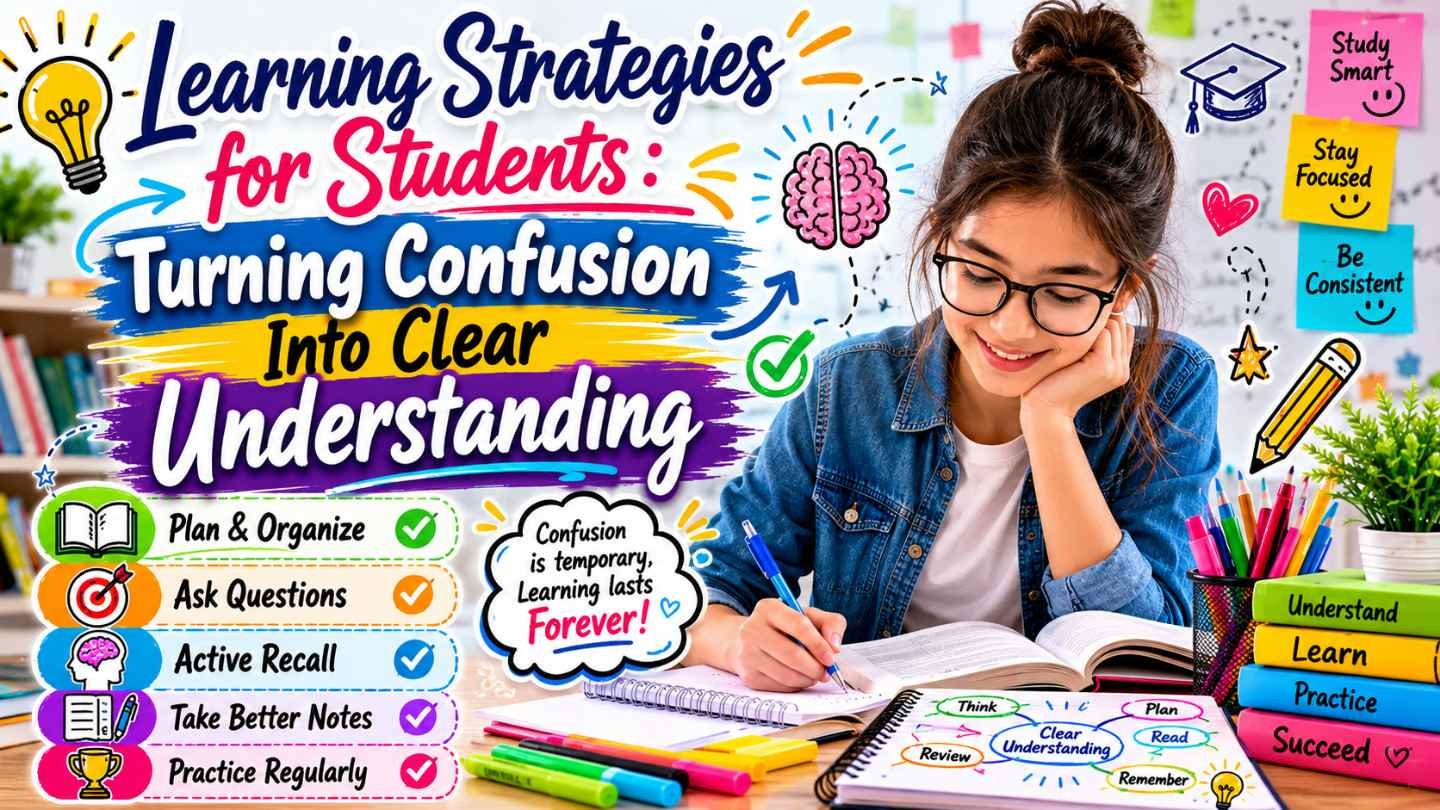
Learning Strategies for Students: Turning Confusion Into Clear Understanding
Every student feels confused sometimes. A math problem looks impossible. A science lesson feels too technical. A history chapter has too many dates. An essay question sounds unclear. When this happens, it is easy to think, “I’m just not good at this.”
But confusion does not mean you are failing. In many cases, confusion is the first sign that your brain is trying to connect new information with what you already know. The real goal is not to avoid confusion completely. The goal is to learn how to move through it with patience, strategy, and confidence.
With the right learning strategies for students, difficult lessons can become easier to understand. You can improve your focus while studying, build stronger memory retention, develop critical thinking skills, and create study habits that support better grades over time.
✨ Learning reminder: Confusion is not the end of understanding. It is usually the doorway into it.
This guide will show you simple, practical, and student-friendly ways to turn confusing lessons into clear understanding.
Why Confusion Is a Normal Part of Learning
Confusion is not the enemy of learning. It is part of the process.
When you learn something new, your brain is trying to organize unfamiliar ideas. At first, the topic may feel messy because the pieces are not connected yet. This can happen when you are learning a new formula, reading a difficult paragraph, solving a new type of problem, or studying a concept you have never seen before.
Confusion becomes a problem only when you ignore it or give up too early. A confused student may say, “I don’t get it.” A stronger learning response is, “Which part do I not understand yet?”
That small change matters. It turns confusion into a problem you can solve instead of a wall you cannot climb.
Identify What Part of the Lesson Is Confusing
One of the most effective study techniques is learning how to locate the exact point of confusion. Many students feel overwhelmed because they treat the whole lesson as one big problem. Instead of saying, “I don’t understand science,” try to narrow it down.
Ask Yourself What Is Unclear
For example, if you are studying fractions, maybe you understand adding fractions with the same denominator but get confused when the denominators are different. That means the problem is not “fractions.” The problem is finding common denominators. That is much easier to fix.
Use the Traffic Light Method
You understand it well.
You partly understand it but need more practice.
You do not understand it yet.
This note-taking strategy helps you stop wasting time reviewing everything equally. Spend more time on the yellow and red areas, where the real learning work is waiting.
Break Hard Topics Into Smaller Pieces
Big topics feel scary when you try to learn them all at once. The better approach is to break them into smaller parts. This is one of the best student learning tips because it makes difficult subjects less overwhelming.
Turn One Big Lesson Into Mini-Lessons
Instead of studying “photosynthesis” as one large topic, divide it into smaller pieces:
🌱 What photosynthesis means
☀️ What plants need for photosynthesis
🍃 What chlorophyll does
💡 How sunlight is used
🧪 What glucose and oxygen are
🌍 Why photosynthesis matters
Now the lesson becomes easier to manage. You are not trying to understand everything at the same time. You are building one step at a time.
Learn in Layers
Do not try to master a difficult topic in one reading. Learn it in layers.
This method works because understanding grows through repeated contact with the material.
Use Questions to Build Understanding
Questions are powerful because they force your brain to think actively. They help you move from memorizing words to understanding ideas. If you want to know how to understand difficult lessons, start asking better questions.
Ask “Why,” “How,” and “What If?”
Why does this happen?
How does this process work?
What if one part changes?
Why is this step needed?
How is this idea connected to the previous lesson?
For example, in math, do not only memorize that area equals length times width. Ask why multiplying length and width gives the number of square units inside a rectangle. That question builds real understanding.
Turn Headings Into Questions
Before reading a textbook section, turn the heading into a question. If the heading says “Causes of World War I,” ask, “What were the main causes of World War I?”
Now your brain has a purpose while reading. You are searching for an answer, not just moving your eyes across the page. This simple habit improves focus while studying and makes reading more active.
Use Active Recall and Self-Testing
Active recall means trying to remember information without looking at your notes first. It is one of the most effective study techniques for memory retention.
Many students only reread their notes and think they are studying. But rereading can feel easy even when you do not truly know the material. Self-testing shows what you actually remember.
Try the Look-Cover-Explain Method
📖 Read a small section of your notes.
🙈 Cover the page.
🗣️ Explain the idea out loud or write it from memory.
✅ Check your notes.
🔁 Fix what you missed.
This method is simple, but powerful. It trains your brain to retrieve information, which helps you remember it longer.
Make Your Own Practice Questions
After studying a lesson, create questions such as: What is the main idea? What are the three most important details? How would I explain this to a younger student? What example proves this idea? What mistake should I avoid?
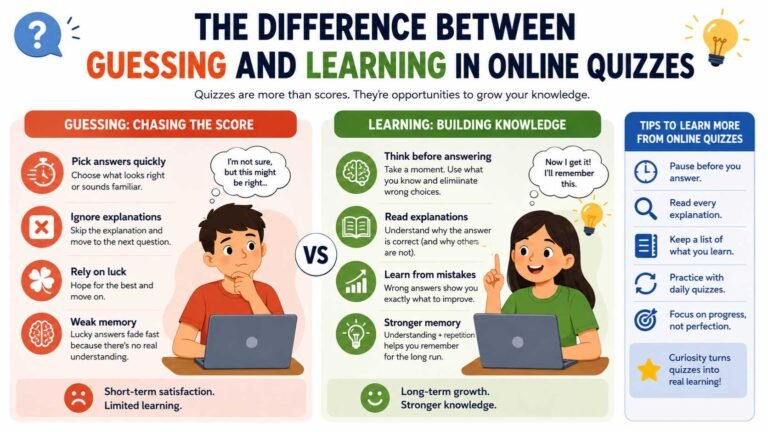
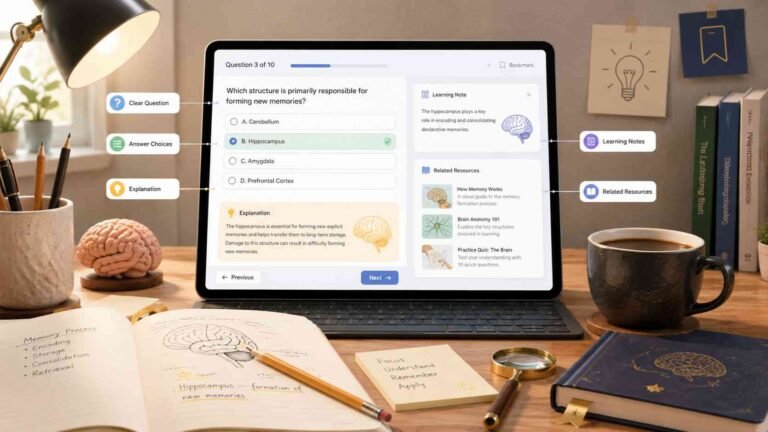
You can also use educational games and quizzes to practice thinking quickly. For example, a site like bing trivia can help students enjoy quick question-based learning while building curiosity.
Improve Notes With Summaries and Visual Organizers
Good notes are not just copied words. Good notes help you think. Strong note-taking strategies make lessons easier to review and understand later.
Write Short Summaries After Each Lesson
After class or study time, write a short summary using your own words. Use this format:
Today I learned that…
The most important idea was…
One example is…
One thing I still need to review is…
This helps you process the lesson instead of just storing information.
Use Visual Organizers
Some lessons are easier to understand when you can see the structure. Try using mind maps for connected ideas, timelines for history events, flowcharts for processes, tables for comparing concepts, and diagrams for science lessons.
For example, if you are learning about the water cycle, a diagram may help more than a long paragraph. If you are comparing plant and animal cells, a table can make the differences clearer. Visual organizers turn scattered information into something easier to remember.
Improve Focus and Avoid Distractions
Even the best study habits will not work well if your attention is constantly interrupted. Focus while studying is not about forcing yourself to study for hours. It is about creating a setup that helps your brain stay with the task.
Use Short Study Sessions
Try studying for 25 minutes, then taking a 5-minute break. This keeps your mind fresh and makes long study periods feel less stressful. During the study session, focus on one task only.
Do not study math while checking messages.
Do not read science while watching videos.
Do not write an essay while scrolling social media.
Multitasking makes learning slower because your attention keeps switching from one thing to another.
Prepare Your Study Space
Before studying, remove small distractions. Put your phone away or turn on focus mode. Keep only the materials you need. Use a clean table if possible. Write your study goal before starting.
A simple goal could be: “I will solve five practice problems,” “I will summarize one chapter section,” or “I will memorize ten vocabulary words.” Clear goals make studying feel more manageable.
Practical Examples for Different School Subjects
Math
If a math lesson feels confusing, do not only memorize the formula. Study one example step by step. Ask what is being asked, what information is given, which method applies, and why each step comes next.
Science
For science lessons, focus on processes and cause-and-effect relationships. Use diagrams, flowcharts, and short summaries to connect each step clearly.
English or Literature
If you are reading a story or poem, confusion may come from vocabulary, symbolism, or theme. Summarize each scene, look for repeated ideas, and explain the main message in one sentence.
History
History can feel confusing because of many names, dates, and events. Use timelines to organize what happened first, next, and last. Then ask why each event mattered.
Language Learning
When learning a new language, practice in small chunks. Learn useful words, say them out loud, write short examples, and test yourself later.
Common Mistakes Students Make When They Feel Confused
Mistake 1: Rereading Without Thinking
Rereading is not always bad, but it is weak when used alone. If you read the same page five times without asking questions or testing yourself, you may still not understand it. Add active recall, summaries, or practice problems.
Mistake 2: Waiting Too Long to Ask for Help
Some students stay stuck because they feel embarrassed. But asking for help is not weakness. It is a smart learning strategy. Be specific. Instead of saying, “I don’t get it,” say, “I understand the first step, but I get confused when the equation changes.”
Mistake 3: Studying Everything the Same Way
Different subjects need different methods. Math needs practice. Science needs diagrams and processes. History needs timelines and cause-and-effect thinking. English needs reading, interpretation, and writing.
Mistake 4: Cramming the Night Before
Cramming may help you remember something for a short time, but it is not good for long-term understanding. Study a little each day. Short, repeated sessions are better than one stressful night.
Mistake 5: Thinking Confusion Means You Are Not Smart
This is the most harmful mistake. Confusion does not mean you are not smart. It means you have found the next thing to learn.
FAQ: Learning Strategies for Students
What are the best learning strategies for students?
The best learning strategies include breaking lessons into smaller parts, asking questions, using active recall, making summaries, practicing with self-tests, and using visual organizers like charts, diagrams, and mind maps.
How can I understand difficult lessons faster?
Start by identifying the exact part that confuses you. Then review that part slowly, look at examples, ask questions, and explain the idea in your own words. Do not try to learn the whole topic at once.
Is active recall better than rereading?
Yes. Active recall is usually more effective because it makes your brain retrieve information. Rereading can feel easier, but self-testing shows whether you truly remember and understand the lesson.
How do I stay focused while studying?
Use short study sessions, remove distractions, set a clear goal, and study one task at a time. A quiet space and a simple checklist can also help improve focus.
What should I do when I still feel confused after studying?
Write down exactly what you do not understand. Then ask for help, watch another explanation, try a simpler example, or review the previous lesson that connects to the topic.
Stay Consistent, Curious, and Patient
Clear understanding does not always happen immediately. Sometimes it comes after asking one better question, trying one more example, or reviewing the lesson in a different way.
The most successful students are not the ones who never feel confused. They are the ones who know what to do when confusion appears.
Use simple study habits. Break hard topics into smaller pieces. Practice active recall. Improve your notes. Protect your focus. Ask questions. Stay curious.
Final thought: Learning is not about understanding everything right away. It is about staying consistent long enough for the pieces to connect.