The Quiz Lover’s Guide to Understanding Countries, Capitals, and Continents
Geography can feel huge at first.
There are countries to remember, capitals to match, continents to understand, oceans to locate, borders to notice, and names that sound almost alike. Then a quiz asks, “What is the capital of Kazakhstan?” and suddenly your brain opens twelve tabs at once.
But here is the good news: world geography becomes much easier when you stop treating it like a giant list.
Countries, capitals, and continents are connected. They are not random facts floating around. A country has a place. A capital has a purpose. A continent gives you the bigger picture. Once you begin seeing those links, geography quizzes become less intimidating and much more enjoyable.
Whether you are playing a geography quiz for fun, studying for school, building your general knowledge, or simply trying not to confuse Austria with Australia, this guide will help you understand the world in a clearer way.
For more quiz practice across different topics, you can also explore these fun online quizzes for general knowledge.
Why Countries, Capitals, and Continents Matter in Geography
Countries, capitals, and continents are three basic building blocks of world geography.
A country is a political area with its own government, borders, people, culture, and identity. Examples include Japan, Brazil, Egypt, Canada, and the Philippines.
A capital is usually the main city where the government is based. Some capitals are also the biggest and most famous cities in the country. Others are not. That is where many quiz takers get surprised.
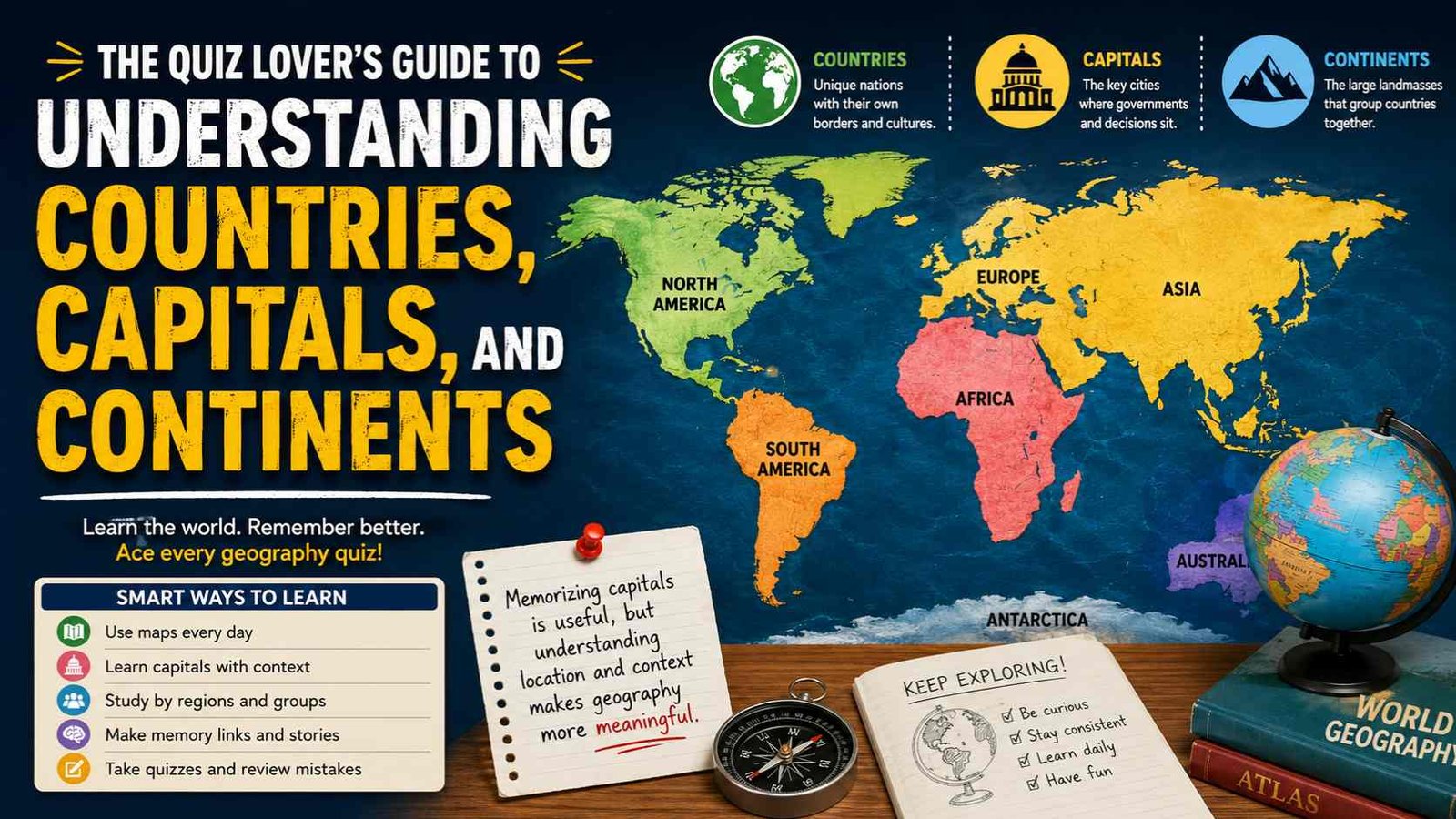
A continent is a large land area that groups many countries together. The most commonly taught continents are Asia, Africa, North America, South America, Antarctica, Europe, and Australia/Oceania.
Country: Japan
Capital: Tokyo
Continent: Asia
Country: Brazil
Capital: Brasília
Continent: South America
Country: Egypt
Capital: Cairo
Continent: Africa
That simple pattern already gives your brain a map, not just a memory test.
The Big Mistake: Memorizing Without Location
Many people try to learn geography by memorizing country-capital pairs only.
Italy — Rome
Kenya — Nairobi
Thailand — Bangkok
That works for easy questions, but it gets shaky fast. If a quiz asks which continent Kenya is in, where Thailand is located, or which capital belongs to a landlocked country, plain memorization may not be enough.
A capital is easier to remember when you know where the country sits, what region it belongs to, what countries are nearby, and what makes the place familiar.
- Where is this country on the map?
- Which continent is it part of?
- What countries are near it?
- Is it an island, coastal, or landlocked country?
- Is the capital famous for history, government, culture, or location?
How Countries, Capitals, and Continents Connect
Think of world geography like a set of zoom levels. Continents give you the big view, countries give you the main identity, and capitals give you the specific detail.
🗺️ Continents Give You the Big View
Continents help you organize the world into large regions. If you know that Vietnam is in Asia, Peru is in South America, and Ghana is in Africa, you already have a better chance of answering related quiz questions.
A continent-level understanding gives you a mental “folder” for each country.
🏳️ Countries Give You the Main Identity
Countries have flags, capitals, languages, landmarks, borders, currencies, climates, and histories. When you learn a country, attach one or two useful clues to it.
Example: Chile — South America, Santiago, long narrow shape along the Pacific coast.
🏛️ Capitals Give You the Specific Detail
Capitals are quiz-friendly because they are direct and easy to ask. But they can be tricky because the most famous city is not always the capital.
Examples: Canberra, not Sydney. Ottawa, not Toronto. Brasília, not Rio de Janeiro.
Practical Tips for Remembering Capitals
1. Learn by Continent First
Start with one continent at a time. Spend a week on Asia, then move to Europe, then Africa. This gives your brain a cleaner structure.
2. Group Countries by Region
Regions make capitals easier to remember. Southeast Asia, East Africa, Scandinavia, and Central America all give your brain helpful neighborhoods.
3. Use Map Practice
When you learn a capital, point to the country on a map. Notice whether it is coastal, inland, near mountains, or close to another country.
4. Make Tiny Memory Links
Memory links do not need to be perfect. They just need to help you recall the answer. Personal, visual clues work best.
5. Review the Ones You Miss
If you miss “What is the capital of Mongolia?” attach it to something: Mongolia — Ulaanbaatar — Asia — between Russia and China.
How to Locate Countries More Easily
📍 Start With Large Anchor Countries
Anchor countries are easy-to-spot places that help you locate smaller or nearby countries.
China can help you locate Mongolia, Nepal, Vietnam, and North Korea.
Brazil can help you locate Argentina, Bolivia, Peru, and Uruguay.
Egypt can help you locate Libya, Sudan, and the Middle East nearby.
Germany can help you locate Poland, Austria, France, and the Netherlands.
🌊 Notice Shapes and Coastlines
Some countries have memorable shapes. Italy looks like a boot. Chile is long and narrow. Japan is an island chain. The Philippines is an archipelago. Madagascar is a large island off Africa’s southeast coast.
🤝 Pay Attention to Neighbors
Neighboring countries often appear together in geography quizzes. If you know Portugal is next to Spain, and Spain is in Europe, you already have a helpful clue.
Understanding Continents Without Confusion
Continents sound simple until you notice that people sometimes use different terms. Some sources say Australia, while others say Oceania. Some teach North America and South America as separate continents, while others group them as the Americas.
For most educational quizzes, the seven-continent model is commonly used:
Asia
Asia is the largest continent by land area and population. It includes China, India, Japan, South Korea, Indonesia, Saudi Arabia, Thailand, and the Philippines.
Africa
Africa includes countries with rich histories, languages, cultures, and landscapes, such as Egypt, Nigeria, Kenya, South Africa, Morocco, Ghana, and Ethiopia.
Europe
Europe has many smaller countries close together, making it popular in geography quizzes. Examples include France, Germany, Italy, Spain, Norway, Greece, and Poland.
North America
North America includes Canada, the United States, Mexico, Guatemala, Cuba, Jamaica, and many countries in Central America and the Caribbean.
South America
South America includes Brazil, Argentina, Chile, Peru, Colombia, Venezuela, Bolivia, Ecuador, Paraguay, Uruguay, Guyana, and Suriname.
Australia/Oceania
This region includes Australia, New Zealand, Papua New Guinea, and many Pacific island nations. Quiz makers may use either “Australia” or “Oceania.”
How Geography Quizzes Help You Learn Faster
A geography quiz is not just a test. Used well, it becomes a learning tool.
Quizzes help because they force your brain to retrieve information. Retrieval is stronger than simply rereading a list. When you try to remember “What is the capital of Vietnam?” your brain works harder than when you only look at “Vietnam — Hanoi.”
Question: What is the capital of Canada?
Answer: Ottawa.
Explanation: Ottawa is Canada’s capital, while Toronto is its largest city and a major business center.
A Simple Daily Geography Quiz Routine
You do not need a long study session. Ten minutes can help if you use it well.
- Pick one continent or region.
- Answer 10 geography quiz questions.
- Write down the questions you missed.
- Look at those countries on a map.
- Add one memory clue for each missed answer.
- Review the same questions the next day.
This small habit builds general knowledge without feeling like homework.
Better Ways to Study Countries and Capitals
Use “Country + Capital + Continent”
Do not study only country and capital. Add the continent every time.
Use: Argentina — Buenos Aires — South America
Add One Map Fact
Attach one simple location clue: Argentina — Buenos Aires — South America — near Chile and Uruguay.
Mix Easy and Hard Questions
A good geography quiz should mix easy, medium, and harder questions. That mix keeps your brain awake.
Watch Out for Famous City Traps
Some quiz questions are tricky because the most famous city is not always the capital.
United States — Washington, D.C., not New York City
United Arab Emirates — Abu Dhabi, not Dubai
Switzerland — Bern, not Zurich or Geneva
How Quiz Website Owners Can Make Geography Pages More Helpful
If you run a quiz website, a countries, capitals, and continents quiz can be more than a list of questions. Make it more educational by adding:
For example, after a user answers a question about Peru, you can include: “Peru is in South America, and its capital is Lima. The country is known for the Andes Mountains and Machu Picchu.”
Why Context Makes Geography More Meaningful
Memorizing capitals can help you win quizzes. That is useful. But context helps you understand the world.
When you know where a country is, who its neighbors are, what continent it belongs to, and why its capital matters, geography becomes more than trivia. It becomes a way to understand news, travel, history, culture, weather, sports, food, languages, and global events.
A person who knows only “Japan — Tokyo” knows one fact. A person who knows Japan is an island country in East Asia, near Korea, China, and Russia, with Tokyo as one of the world’s major cities, understands much more.
That is the difference between memorizing and learning.
Common Geography Quiz Mistakes to Avoid
Guessing by famous cities only.
Ignoring continents.
Studying too many countries at once.
Never looking at a map.
Forgetting to review wrong answers.
FAQs About Countries, Capitals, and Continents
1. What is the easiest way to learn countries, capitals, and continents?
Study by continent or region. Learn a small group of countries, match each one with its capital, then locate them on a map.
2. Are geography quizzes good for learning?
Yes. A geography quiz helps you practice recall, which strengthens memory. It becomes even better when each answer includes a short explanation or map clue.
3. Should I memorize capitals first or countries first?
Start with countries and continents, then add capitals. It is easier to remember a capital when you already know where the country is located.
4. Why do I forget capitals so quickly?
You may be memorizing them without context. Connect each capital to its country, continent, region, nearby countries, or a simple visual clue.
Summary
Countries, capitals, and continents are easier to understand when you treat them as connected parts of world geography.
A country tells you the place. A capital gives you the government center. A continent shows you the bigger region.
Memorizing capitals is useful, especially for quizzes. But geography becomes more meaningful when you also understand location, neighbors, maps, regions, and context.
The best way to improve is simple: take geography quizzes, look at maps, review missed answers, and learn one region at a time. Over time, the world stops feeling like a confusing list of names and starts feeling like a map you can actually read.