The Difference Between a Quiz Page and a Learning Page
Quiz Page vs Learning Page
What makes online quizzes fun, useful, memorable, and genuinely educational?
A good quiz page is like a quick challenge. It asks, “Do you know this?”
A good learning page goes one step further. It says, “Here is why the answer matters.”
That small difference can change the whole experience for your visitors. A quiz page can be fun, fast, and engaging. But a learning page helps people walk away with something they can remember later.
For quiz websites, this matters a lot. Visitors may come for entertainment, but they often stay longer when they feel they are learning something useful.
What Is a Quiz Page?
A quiz page is a page where visitors answer questions and usually receive a score at the end.
It may include multiple-choice questions, true-or-false items, picture clues, timed challenges, or general knowledge questions.
Which planet is known as the Red Planet?
A. Venus
B. Mars
C. Jupiter
D. Saturn
The visitor chooses an answer, moves to the next question, and later sees the score. That is the basic job of a quiz page. It tests what the visitor already knows.
What Is a Learning Page?
A learning page is a page that teaches, explains, or expands on a topic.
Instead of only testing knowledge, it helps the visitor understand the answer.
Correct answer: Mars
Mars is called the Red Planet because iron minerals in its soil oxidize, or rust, giving the surface a reddish color.
Now the visitor is not just told the answer. They are given a reason to remember it. That is the heart of a learning page.
Quiz Page vs Learning Page: The Clear Difference
1. A Quiz Page Tests Recall
A quiz page asks visitors to pull information from memory. That is powerful because recall practice can make facts easier to remember later.
Example: What is the capital of Japan?
If someone answers “Tokyo,” they have practiced remembering that fact. If they answer incorrectly, they now know there is a gap.
2. A Learning Page Explains the Answer
A learning page gives context. It may explain why Tokyo became important, where it is located, or how it compares with other major cities in Japan.
That extra information gives the brain more “hooks” to hold onto.
3. A Quiz Page Is Usually Faster
Quiz pages are often designed for speed. People like quick challenges. They want to answer 10 questions, see their score, and maybe share the result.
A fast quiz can be perfect for daily quizzes, trivia challenges, general knowledge games, homepage quiz features, and social media traffic.
4. A Learning Page Takes More Time
A learning page asks the visitor to slow down. It may include answer explanations, related facts, examples, or review notes.
This is better when the goal is deeper understanding.
Why Quiz Pages and Learning Pages Should Work Together
The best quiz websites do not treat quizzes and learning as enemies. They use both. A quiz page gets attention. A learning page builds value.
For example, a visitor may land on a quiz titled:
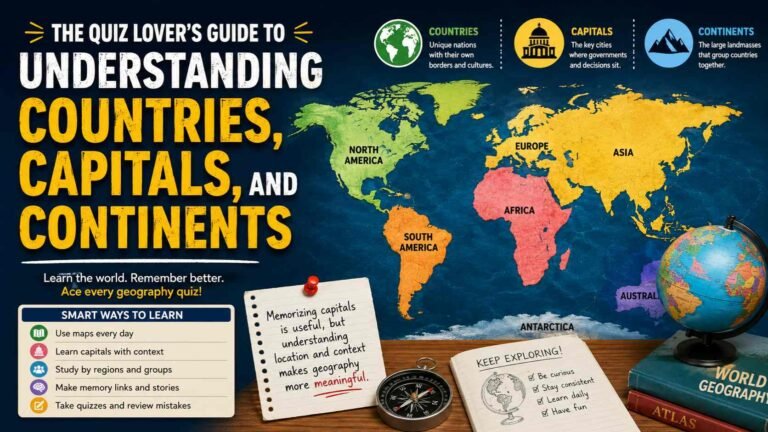
Can You Pass This 10-Question World Geography Quiz?
That title is fun and clickable. But after the quiz, the page can offer:
- Correct answers
- Short explanations
- Map-related facts
- Related topics
- A review section
- A link to another quiz
Now the visitor has more than a score. They have a learning path.
How a Quiz Page Can Become More Educational
A quiz page does not need to become a textbook. You can make it more educational with small, useful additions.
📝 Add Short Answer Explanations
After each question, add a simple explanation.
Question: Which gas do plants absorb from the air?
Answer: Carbon dioxide
Explanation: Plants use carbon dioxide during photosynthesis to help make food.
🔍 Explain Wrong Answers
This is one of the best ways to improve quiz learning.
The heart pumps blood through the body. The lungs help with breathing, the brain controls body functions, and the liver helps process nutrients and filter toxins.
✨ Add a “Did You Know?” Fact
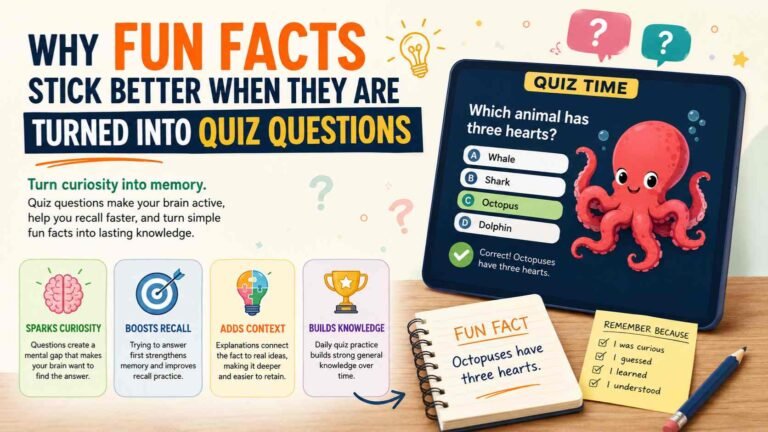
Fun facts help make online quizzes more memorable.
Did you know? An adult human heart beats about 100,000 times a day.
🧭 Include Related Topics
At the end of a quiz, suggest related topics so visitors can continue learning naturally.
After an animal quiz, suggest wildlife quizzes, animal habitats, or a short guide about mammals, reptiles, and birds.
Practical Example: Basic Quiz Page vs Better Learning Page
Basic Quiz Page
Question: Who painted the Mona Lisa?
A. Vincent van Gogh
B. Leonardo da Vinci
C. Pablo Picasso
D. Michelangelo
Correct answer: Leonardo da Vinci
That works. It tests knowledge. But it does not teach much.
More Educational Version
Question: Who painted the Mona Lisa?
A. Vincent van Gogh
B. Leonardo da Vinci
C. Pablo Picasso
D. Michelangelo
Correct answer: Leonardo da Vinci
Explanation: Leonardo da Vinci painted the Mona Lisa during the Italian Renaissance. The painting is famous for its mysterious smile and careful use of light and shadow.
Quick fact: The Mona Lisa is displayed at the Louvre Museum in Paris.
Why This Helps Memory and Curiosity
🧠 Better Memory
Memory improves when facts are connected. A quiz page asks the brain to retrieve information. A learning page gives the brain more meaning, context, and examples.
A visitor may forget a bare answer like “Leonardo da Vinci.” But they are more likely to remember it when they connect it to the Mona Lisa, the Renaissance, the mysterious smile, and the Louvre Museum.
🔥 Stronger Curiosity
A quiz page can spark curiosity very quickly. A person gets a question wrong and thinks, “Wait, really?” That moment matters.
A learning page should catch that curiosity before it disappears. Surprise is one of the best tools a quiz website can use.
Tips for Website Owners
1. Keep the Quiz Easy to Use
Do not bury the questions under too much text. Let visitors answer first, then give explanations after each question or at the end.
2. Use Simple Language
Write explanations ordinary people can understand. Avoid turning a fun quiz into a lecture.
3. Add Context, Not Clutter
Add why the answer is correct, what makes it interesting, how it connects to daily life, and what topic to review next.
4. Build Around Common Mistakes
If many people get a question wrong, that is a clue. The topic may need a better explanation.
5. End With a Next Step
Invite visitors to review missed answers, try another quiz, read a short guide, or challenge themselves again tomorrow.
Tips for Teachers, Students, and Casual Quiz Takers
👩🏫 For Teachers and Students
Teachers can use quiz pages to check understanding. Students can use them for quick study practice. But both should look beyond the score.
A low score is not always bad. Sometimes it shows exactly what needs attention. The best question after a quiz is not only, “How many did I get right?” It is also, “What did I misunderstand?”
🎮 For Casual Quiz Takers
Not every quiz has to be serious. Sometimes you just want to test your general knowledge, relax, or beat your previous score.
But when you miss a question, take a few seconds to read the explanation. Those tiny moments add up.
A Balanced Note: Quiz Pages Are Already Useful
A quiz page does not need to become a full lesson to have value. Quizzes are useful because they are active. They make visitors think, choose, guess, remember, and compare answers.
The score gives feedback. The explanation gives meaning. Together, they create a better experience.
FAQs
1. What is the main difference between a quiz page and a learning page?
A quiz page mainly tests what someone knows. A learning page helps explain the topic so the visitor understands and remembers it better.
2. Can a quiz page also be a learning page?
Yes. A quiz page can become more educational by adding answer explanations, quick facts, examples, review notes, and related topics.
3. Are quiz pages good for memory improvement?
Yes. Quiz pages can help with memory because they use recall practice. When visitors try to remember an answer, they strengthen the connection to that information.
4. What should I add to my quiz page to make it more helpful?
Start with short explanations after each answer. Then add helpful facts, related quiz links, review sections, and simple notes about why wrong answers are incorrect.
Fun First, Learning Close Behind
A quiz page tests knowledge. A learning page builds knowledge.
A quiz page is great for practice, engagement, and quick recall. A learning page is better for explanations, context, memory, and deeper understanding.
The strongest quiz websites often use both. They let visitors enjoy the challenge, then help them learn from the results.
Try More Quiz Challenges →Final Thoughts
The difference between a quiz page and a learning page is not complicated. A quiz page asks the question. A learning page helps the answer stick.
For a quiz website, the best goal is not to remove the fun. Keep the challenge. Keep the score. Keep the quick questions. Just add enough explanation to make the visitor feel a little smarter when they leave.