The Curiosity Loop Method for Learning New Topics
Learning a new topic can feel difficult when you start with a long article, a thick textbook, or a list of facts you do not yet care about.
That is where the curiosity loop method can help.
Instead of forcing your brain to memorize information right away, this method begins with something much smaller: a question. A question creates a little gap in your mind. You want to know what comes next. You start paying attention. You begin looking for the answer.
That small gap is the “loop.” When you use it well, learning becomes less like stuffing facts into your head and more like solving a mini mystery. This is why the curiosity loop method works so naturally with quiz learning, educational quizzes, general knowledge practice, and daily quizzes.
What Is the Curiosity Loop Method?
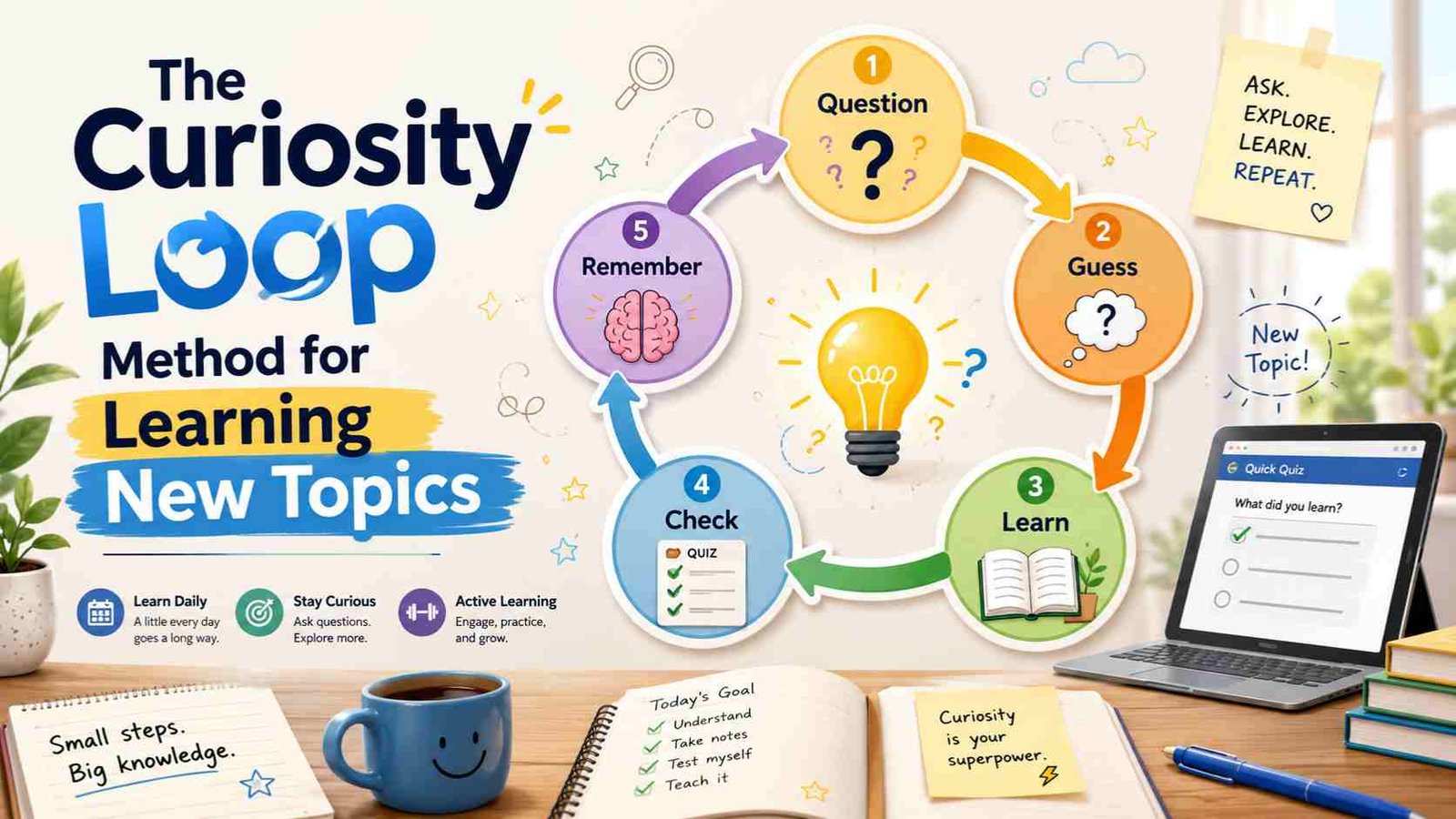
The curiosity loop method is a simple way to learn new topics by moving through five memorable steps:
It works because your brain becomes more interested in information when it first feels a need to know it.
Compare these two learning starts:
Plain fact: “Mount Everest is 8,849 meters tall.”
Curiosity loop: “What is the tallest mountain in the world, and why is its height still discussed by scientists?”
The second version pulls you in. It gives your brain a reason to continue. That is the power of a curiosity loop.
How Curiosity Loops Work
A curiosity loop follows a simple pattern. It begins with interest, creates a little tension, then helps your brain close the gap through learning and review.
1. Question
Every curiosity loop starts with a question. It does not need to be complicated. In fact, simple questions often work best.
“What causes thunder?”
“Why do some countries have more than one capital?”
“Who invented the first computer?”
“Why does the moon look bigger near the horizon?”
A question gives your brain a target. Instead of reading passively, you now have something to look for.
2. Guess
Before checking the answer, make a guess. This step matters more than people think. Guessing wakes up your memory, even when your answer is wrong.
Question: “Which planet has the shortest day?”
Your guess: “Maybe Mercury, because it is closest to the sun.”
Actual answer: “Jupiter.”
Now the answer becomes more memorable because your brain noticed the difference. That small surprise helps memory improvement.
3. Learn
Next, read or listen to the explanation. This is where real learning begins. The goal is not just to find the answer but to understand why the answer makes sense.
If the answer is “Jupiter has the shortest day,” you also want to know that Jupiter rotates very quickly, completing one day in about 10 hours. That extra explanation gives the fact a place to live in your mind.
4. Check
After learning, check yourself. This is where quizzes become useful. A quiz forces you to pull the answer from memory instead of simply recognizing it on the page.
“What was the answer again?”
“Why was that answer correct?”
“Can I explain this in one sentence?”
This step turns curiosity into active learning.
5. Remember
The final step is review. A fact you learn once can fade quickly. But if you return to it later, even for a few seconds, your brain gets a stronger signal that the information matters.
This is why daily quizzes work well. They bring back old ideas, mix them with new ones, and help your brain keep useful knowledge available.
Why This Method Works So Well for Learning New Topics
The curiosity loop method works because it matches how people naturally explore the world. We rarely become interested in a topic because someone hands us a list of facts. We become interested because something makes us wonder.
That little spark gives the brain energy. When you use curiosity before learning, you improve focus. When you guess before checking, you create mental contrast. When you quiz yourself afterward, you strengthen memory.
Put together, the method becomes a simple but powerful learning habit.
How to Use Curiosity Before Reading
Before reading about a new topic, do not begin with the first paragraph right away. Start with one or two questions.
🌋 Before Reading About Volcanoes
“What makes a volcano erupt?”
“Are all volcanoes dangerous?”
“Can extinct volcanoes become active again?”
🏛 Before Reading About World History
“What caused this event?”
“Who benefited from it?”
“What changed afterward?”
🌍 Before Reading About Geography
“Where is this country located?”
“What is its capital?”
“What makes it different from nearby countries?”
These questions prepare your mind. You are no longer just reading words. You are hunting for answers.
How to Use the Curiosity Loop During Quizzes
Quizzes are one of the easiest ways to use curiosity loops because each question naturally opens a loop. But here is the trick: do not rush straight to the answer.
When you see a quiz question, pause for a moment and ask yourself:
“What do I already know?”
“What answer feels most likely?”
“Why might this choice be correct?”
“Which option is trying to trick me?”
Then answer. After that, read the explanation if one is available. This is where quiz learning becomes more educational. A score tells you how many you got right, but an explanation tells you what to remember next time.
You can also try a new topic quiz when you want to practice this method with fresh questions and different subjects.
How to Use Curiosity After Learning Something New
After you learn something, do not close the loop too quickly. Take one extra step. Ask:
“What surprised me?”
“How would I explain this to a friend?”
“What question do I still have?”
“Where else does this idea appear?”
This keeps the learning alive. It also helps you connect one topic to another.
For example, if you learn that bees communicate through movement, that may lead to questions about animal behavior, ecosystems, food supply, and even farming. One curiosity loop can open another.
That is how daily learning grows.
Practical Tips for Using the Curiosity Loop Method
1. Start With Small Questions
Do not begin with a huge question like, “How does the universe work?” Start smaller: “What is a black hole?” “Why do stars shine?” “What is gravity?” Small questions are easier to answer, and they build confidence.
2. Make a Guess Before Checking
Even a wrong guess is useful. Wrong guesses show your brain what needs correcting. That correction often makes the real answer easier to remember.
3. Look for the “Why,” Not Just the Answer
A quick answer can close the loop too early. If you ask, “What is the capital of Canada?” the answer is Ottawa. But if you ask, “Why is Ottawa the capital instead of Toronto?” now you are learning history, geography, and politics together.
4. Use Short Quizzes for Review
A daily quiz can act like a memory workout. A few good questions can remind you what you know, reveal what you forgot, and give you new things to explore.
5. Keep a Curiosity List
Write down questions that pop into your mind during the day: “Why do cats purr?” “What makes coffee bitter?” “How do airplanes stay in the air?” Later, turn those questions into mini learning sessions.
6. Explain One Answer in Your Own Words
After learning something, explain it simply. If you cannot explain it yet, that does not mean you failed. It only means the loop is not fully closed. Go back, read a little more, then try again.
Curiosity Starts Learning, But Reflection Makes It Stick
Curiosity is powerful, but it is only the beginning.
A question can make you interested. A quiz can make you alert. A surprising answer can make you smile. But real learning needs more than that.
So the best use of the curiosity loop method is not just to chase random facts. It is to use curiosity as the doorway, then walk through it with careful learning.
Why Quiz Websites Are Perfect for Curiosity Loops
Quiz websites are built around questions, which makes them a natural home for this method.
A good educational quiz does more than ask, “Do you know this?” It also helps you think:
“Why did I choose that answer?”
“What did I misunderstand?”
“What new fact did I discover?”
“What should I remember next time?”
This is what makes educational quizzes valuable. They turn curiosity into action. They give your brain a reason to focus, a way to check memory, and a path toward learning new topics one question at a time.
FAQs About the Curiosity Loop Method
1. What is the curiosity loop method?
The curiosity loop method is a learning approach that starts with a question, encourages you to guess, helps you learn the answer, checks your understanding, and uses review to help you remember.
2. How does the curiosity loop method help with memory improvement?
It helps because your brain pays more attention when it wants to know an answer. Guessing, checking, and reviewing also make the information easier to recall later.
3. Can curiosity loops be used with daily quizzes?
Yes. Daily quizzes are a great way to use curiosity loops because every question creates a small learning gap. When you answer, read the explanation, and review later, the information becomes more memorable.
4. Is guessing before learning really helpful?
Yes. Guessing prepares your brain to compare your idea with the correct answer. Even when your guess is wrong, the correction can help the real answer stick better.
5. Does this method work for serious learning?
Yes, but it works best when curiosity is followed by clear explanations, deeper reading, practice, and reflection. Curiosity opens the door, but effort keeps the learning strong.
6. What topics can I learn with this method?
You can use it for general knowledge, science, history, geography, language learning, current events, Bible study, technology, and many other subjects. Any topic can begin with a good question.
Final Thoughts
The curiosity loop method makes learning new topics feel less heavy and more natural.
You begin with a question. You make a guess. You learn the answer. You check yourself. Then you review it so the idea has a better chance of staying in your memory.
That simple loop can turn ordinary reading into active learning. It can make quizzes more useful. It can help you focus, remember, and enjoy the process of discovery.
Curiosity gets your attention. Explanation gives the answer meaning. Reflection helps it stay.