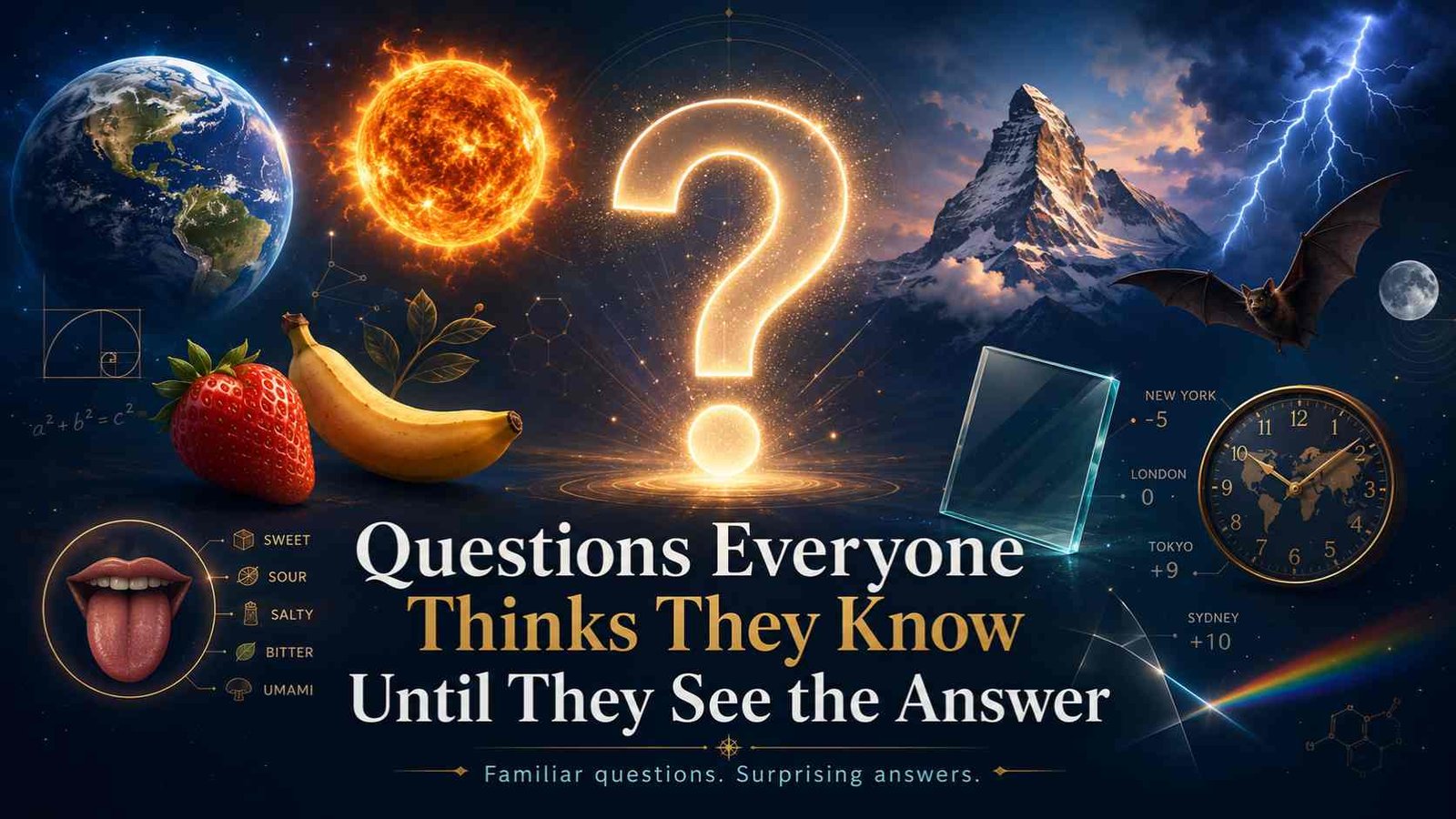
Questions Everyone Thinks They Know Until They See the Answer
Some questions feel easy because we have heard their answers so many times that examining them no longer seems necessary. School diagrams, casual sayings, films, advertising, and half-remembered facts can turn an incomplete explanation into something that sounds unquestionably true. The trap is not always ignorance. Often, it is familiarity.
The questions below are not riddles built on sneaky wording. Each one shows how definitions, evidence, measurement methods, or historical context can change an answer that initially appears obvious. Some familiar answers are completely wrong. Others are correct only when a particular definition or reference point is used.
Pause before each answer and make a genuine guess. Remembering a fact is useful, but understanding why it is true is where lasting knowledge begins.
For another daily opportunity to test your assumptions, try the quiz for the day.
Every question begins with an answer many people confidently assume is correct.
Each answer includes the scientific, historical, or linguistic context behind it.
Every section ends with one concise idea worth remembering.
What is the largest desert on Earth?
The Sahara.
Antarctica.
A desert is defined mainly by how little precipitation it receives, not by heat, sand, or the plants and animals living there. Antarctica qualifies because much of its interior receives extremely little snowfall or rain. Covering roughly 14 million square kilometers, the continent is substantially larger than the Sahara, which remains the world’s largest hot desert. This is a good example of an everyday image competing with a scientific definition: people often picture deserts as scorching landscapes, while climatology also recognizes polar deserts. The United States Antarctic Program describes Antarctica as the driest continent.
Which country has the most time zones?
Russia or the United States.
France, when its overseas territories are included.
Metropolitan France follows a single civil time at any given moment, switching seasonally between Central European Time and Central European Summer Time. The answer becomes less surprising once France’s far-flung overseas territories are included. French-administered lands extend across the Caribbean, South America, the Indian Ocean, and the Pacific. France spans 12 standard time zones, and some counts rise to 13 during parts of the year when daylight-saving arrangements are considered. Russia and the United States each span 11 in commonly cited counts. The result therefore depends on including overseas territories as part of the country, a qualification noted by Guinness World Records.
What color is the Sun?
Yellow.
Its combined visible light appears essentially white.
The Sun emits light across the visible spectrum, and those wavelengths combine to appear white to human eyes. From Earth, the atmosphere scatters shorter wavelengths of light, which can make the solar disk look yellow, orange, or red, particularly when it is low on the horizon. Textbooks and drawings also reinforce the yellow image because a white Sun is difficult to show on white paper. Although the Sun is commonly called a “yellow dwarf,” that informal label refers to its type of star rather than its literal visible color. Its more precise spectral classification is G2V. NASA explains that sunlight contains the colors of the visible spectrum.
Do humans have only five senses?
Yes: sight, hearing, smell, taste, and touch.
No. Five is a useful traditional list, not a complete scientific count.
Humans also detect balance, body position, movement, temperature, pain, and internal conditions such as hunger or a racing heartbeat. Proprioception allows you to know where your limbs are without looking at them, while the vestibular system helps detect head movement and maintain balance. Scientists do not use one universally agreed total because sensory abilities can be divided or grouped in different ways. For example, touch may be treated as several separate systems involving pressure, temperature, pain, and vibration. The National Library of Medicine defines proprioception as a distinct sensory function.
What causes Earth’s seasons?
Earth becomes warmer when it moves closer to the Sun.
Earth’s axial tilt is the main cause.
Earth’s axis is tilted by about 23.5 degrees. As the planet travels around the Sun, each hemisphere alternately tilts toward or away from more direct sunlight. A hemisphere tilted toward the Sun receives longer days and more concentrated solar energy, producing summer. The opposite hemisphere experiences shorter days and winter. Distance cannot explain the pattern because the Northern and Southern Hemispheres have opposite seasons at the same time. Earth also reaches its closest point to the Sun in early January, during Northern Hemisphere winter. NASA’s explanation of what causes the seasons shows why the angle of sunlight matters.
Can lightning strike the same place twice?
No.
Yes, and prominent locations may be struck repeatedly.
Lightning follows electrical conditions, not proverbs. Tall, isolated, or conductive structures can remain attractive strike points whenever electrical charge builds between a storm and the ground. A previous strike does not protect a location from future strikes. Lightning-protection systems exist precisely because buildings may be hit repeatedly. A National Park Service preservation guide notes that the Empire State Building is struck, on average, more than 20 times each year. The saying survives because “lightning never strikes twice” works as a metaphor for an unlikely event, not because it accurately describes atmospheric physics.
Is old glass slowly flowing downward?
Yes. The thicker bottoms of old windows supposedly prove that glass is a liquid.
Ordinary window glass is an amorphous solid.
Glass lacks the orderly crystal structure found in many solids, but that does not mean cathedral windows are slowly pooling toward the floor. Historic panes often vary in thickness because older manufacturing methods produced uneven sheets. Their irregular shapes were present when the windows were made rather than being created by centuries of downward flow. At room temperature, any structural relaxation occurs far too slowly to explain those visible differences. Corning describes glass as an amorphous solid: it has molecular disorder associated with liquids but behaves mechanically as a solid.
Which came first: the lighter or the friction match?
The match.
Döbereiner’s early chemical lighter came before the successful friction match.
Johann Wolfgang Döbereiner developed his hydrogen-and-platinum lamp in 1823. The device produced hydrogen gas and ignited it through a catalytic reaction. It looked very different from a modern pocket lighter, but it was still a device designed to create flame on demand. English chemist John Walker developed a successful friction match in 1826 and began selling it in 1827, according to the Preston Park Museum. This comparison applies specifically to successful friction matches, not to every earlier match-like or chemical fire-starting device.
Can the Great Wall of China be seen from the Moon?
Yes. It is often called the only human-made object visible from space.
No, not with unaided human vision from the Moon.
The Great Wall is extremely long, but it is also narrow and often similar in color and texture to the surrounding landscape. Length alone does not make an object easy to resolve from a vast distance. From low Earth orbit, small sections may occasionally be detected in photographs taken with magnification and under exceptionally favorable lighting, atmospheric, and ground conditions. Astronauts generally find the wall difficult to distinguish with unaided vision. NASA describes the Moon claim as a space-based myth. Cities, roads, reservoirs, and agricultural patterns can be more noticeable because they create broader visual contrast.
Does each part of the tongue detect only one taste?
Sweet is detected at the tip, bitter at the back, and other tastes in fixed zones.
All five established basic tastes can be detected throughout taste-sensitive regions of the tongue.
The famous tongue map exaggerates small differences in sensitivity and turns them into rigid borders that do not exist. Sweet, sour, salty, bitter, and umami can be sensed across much of the tongue, although sensitivity may vary somewhat by location. Flavor is also broader than taste alone. Smell, temperature, texture, and irritation from compounds such as chili all contribute to the experience of eating. The National Library of Medicine explains that all five basic tastes can be sensed across the tongue.
Is Mount Everest the tallest mountain on Earth?
Yes, without qualification.
Everest is highest above sea level, but other mountains lead under different measurements.
Mount Everest’s summit has the greatest elevation above mean sea level. Mauna Kea, however, rises more than 10,000 meters from its base on the Pacific Ocean floor, making it taller when measured from base to summit. Ecuador’s Chimborazo has the summit farthest from Earth’s center because the planet bulges around the equator. None of these answers cancels the others; each uses a different reference point. NOAA’s guide to the highest point on Earth shows why the word “tallest” requires a clear method of measurement.
Are bats blind?
Yes. Echolocation replaces their vision.
No. Bats can see, and many species also use echolocation.
Echolocation is an additional sensory system, not proof that vision is absent. Many insect-eating bats send out high-frequency calls and interpret returning echoes to navigate and hunt in darkness. Their eyes still provide useful information, especially at dawn, at dusk, or across longer distances. Fruit bats often rely heavily on sight and smell, and some species have large, well-developed eyes. The expression “blind as a bat” survives because nocturnal animals were once assumed to have poor vision. In reality, different bat species combine vision, hearing, smell, and echolocation in ways suited to their habitats and diets.
Is a strawberry a berry—and is a banana one?
Strawberries are berries, while bananas are not.
Botanically, bananas are berries, while strawberries are aggregate accessory fruits.
Everyday food categories are based on flavor, appearance, and cooking habits. Botanical categories describe how fruits develop from flowers. A botanical berry develops from a single flower with one ovary whose wall becomes fleshy, and bananas fit that structure. A strawberry’s red flesh is mainly enlarged receptacle tissue, while the small seed-like specks on its surface are individual dry fruits called achenes. The University of Minnesota’s guide to fruit morphology explains why familiar produce names do not always match scientific classifications.
Does a microwave oven cook food from the inside out?
Yes.
Usually not. Microwaves penetrate partway into food while heat continues moving inward by conduction.
Microwave energy interacts with molecules in food—particularly polar molecules such as water—and generates heat through a limited depth rather than solely at the surface. That can make microwave heating seem more internal than conventional browning in an oven. Thick foods, however, do not heat uniformly from the center outward. Their interiors often become warm because heat travels from hotter regions into cooler ones. This is why standing time matters and why cold spots may remain after heating. The U.S. Food and Drug Administration explains that food absorbs microwave energy and converts it into heat.
Does water always boil at 100°C?
Yes.
It boils at 100°C only near standard atmospheric pressure.
Boiling begins when a liquid’s vapor pressure matches the pressure applied to it. At high elevations, atmospheric pressure is lower, so water boils below 100°C. In a pressure cooker, the pressure is higher, allowing water to become hotter before boiling and helping food cook more quickly. Dissolved substances can also shift the boiling point slightly. The familiar 100°C figure is therefore a standard reference rather than an unchanging property under every condition. NOAA defines boiling point in relation to the pressure surrounding a liquid.
Can sound travel through space?
Yes, because films fill space battles with explosions.
Ordinary sound cannot travel through a vacuum.
Sound is a mechanical disturbance that travels by making particles vibrate. Air carries most of the sounds people hear, while liquids and solids can also carry sound. A near-perfect vacuum lacks enough particles to pass that vibration from one location to another, so an unaided listener in space would not hear a distant explosion. Space is not completely empty, however, and pressure waves can move through gases and plasmas in certain environments. Scientists can measure those waves and convert the data into audible signals, but that process is not the same as sound traveling through empty space directly into a human ear.
Why the Easy Answer Is Often Incomplete
Knowledge is more than remembering a sentence. It also means understanding what was measured, which exceptions matter, and how important words are being defined. Terms such as “largest,” “tallest,” “desert,” and even “berry” can carry different meanings across scientific fields and everyday conversation.
Familiar claims deserve inspection. Some are myths, while others are true only under particular conditions. Useful curiosity asks, “According to which measurement?” “Under what circumstances?” and “What definition is being used?” These questions often reveal that a simple answer is not necessarily a complete one.
The goal is not to distrust every fact you encounter. It is to build confidence supported by evidence and reasoning rather than repetition. A correct answer becomes far more useful when you understand the path that leads to it.
How Many Did You Really Know?
Count only the questions you answered correctly before reading the explanation—and be strict about the qualifications. Did you know that Everest is highest above sea level, or did you simply answer “Everest”? Did you know why Antarctica qualifies as a desert, or did you recognize the answer from another trivia list?
A low score is not a failure. It is evidence that the questions did their job. A high score is more meaningful when you can explain the reasoning behind each answer. Either way, the best result is leaving with a few familiar assumptions replaced by clearer and more durable knowledge.