Why Multiple-Choice Quizzes Are More Powerful Than People Think
Multiple-choice quizzes often get treated like “easy mode.”
You see a question. You pick A, B, C, or D. Done.
But that simple format is more powerful than it looks. A well-written multiple-choice question does not merely ask, “Do you know this?” It also makes your brain compare ideas, reject weak answers, notice tiny clues, and remember facts more clearly.
That is why multiple-choice quizzes are helpful for students, adults, trivia fans, general knowledge lovers, and anyone who wants to learn in a fun, low-pressure way.
The real magic is not only in the correct answer. It is in the answer choices. Those little options quietly turn a basic question into a thinking exercise.
🧠 Answer Choices Are Tiny Thinking Traps
A normal question asks you to remember something. A multiple-choice quiz does something more interesting: it gives your brain a small puzzle.
Example:
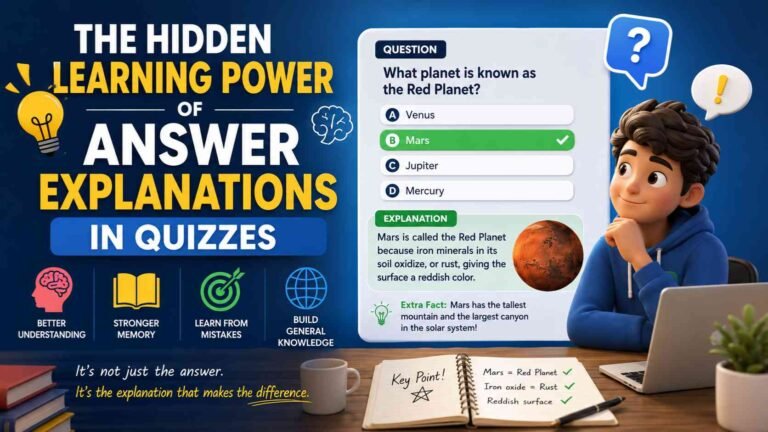
Which planet is known as the Red Planet?
A. Venus
B. Mars
C. Jupiter
D. Mercury
Even if you are not completely sure, your brain starts working. Venus may remind you of Earth’s “sister planet.” Jupiter sounds too large and gaseous. Mercury is closest to the sun. Mars? That feels right.
That process matters. You are not just guessing. You are comparing, sorting, eliminating, and using what you already know to remove what does not fit. That is why multiple-choice quizzes can support quiz learning, memory improvement, and stronger general knowledge.
⚡ Why Multiple-Choice Quizzes Help You Learn Faster
Multiple-choice quizzes work well because they lower the pressure of learning. Instead of asking you to produce an answer from nothing, they give you clues. Those clues make learning feel easier, especially when the topic is new.
A full lesson can feel heavy. A quiz question feels light. That small difference can help people keep learning longer.
🔍 Answer Choices Make Your Brain Compare Ideas
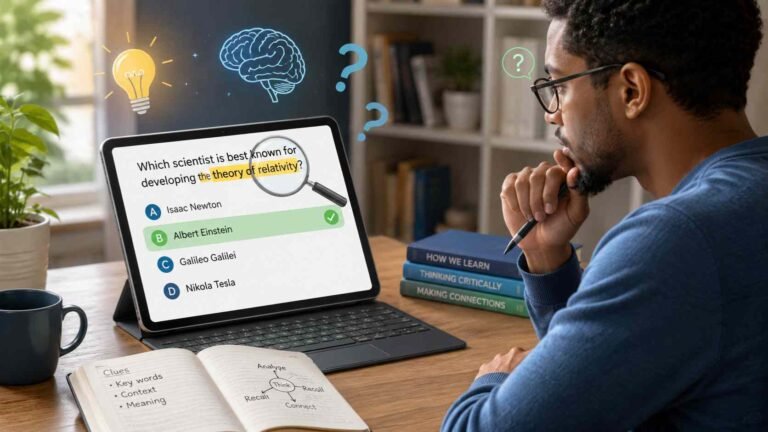
The best multiple-choice quizzes are not just about recognition. They are about comparison. When you read several answer choices, your brain starts asking useful questions:
- Which one sounds most accurate?
- Which answer does not belong?
- Which option is too extreme?
- Which choice matches what I remember?
- Which option is close, but not quite right?
Example:
Which ocean is the largest?
A. Atlantic Ocean
B. Indian Ocean
C. Pacific Ocean
D. Arctic Ocean
You may not instantly know the answer. But you might remember that the Pacific is huge, or that the Arctic is the smallest. So your brain starts eliminating choices. That is where multiple-choice quizzes become more than a simple test. They become a thinking exercise.
🚦 Wrong Answers Can Teach You Too
Here is something people often miss: wrong answer choices can be useful. A good wrong answer is not random. It teaches you what the correct answer is not.
Example:
Who wrote “Romeo and Juliet”?
A. Charles Dickens
B. William Shakespeare
C. Mark Twain
D. Jane Austen
Even if you answer correctly, the other choices remind you of other famous writers. Over time, this helps build a wider mental map.
- Shakespeare is strongly connected with famous plays.
- Dickens wrote classic novels such as Oliver Twist.
- Mark Twain is linked with American literature.
- Jane Austen wrote beloved novels such as Pride and Prejudice.
One question can quietly teach more than one fact. Sneaky little brain snack.
💡 Multiple-Choice Quizzes Support Memory Improvement
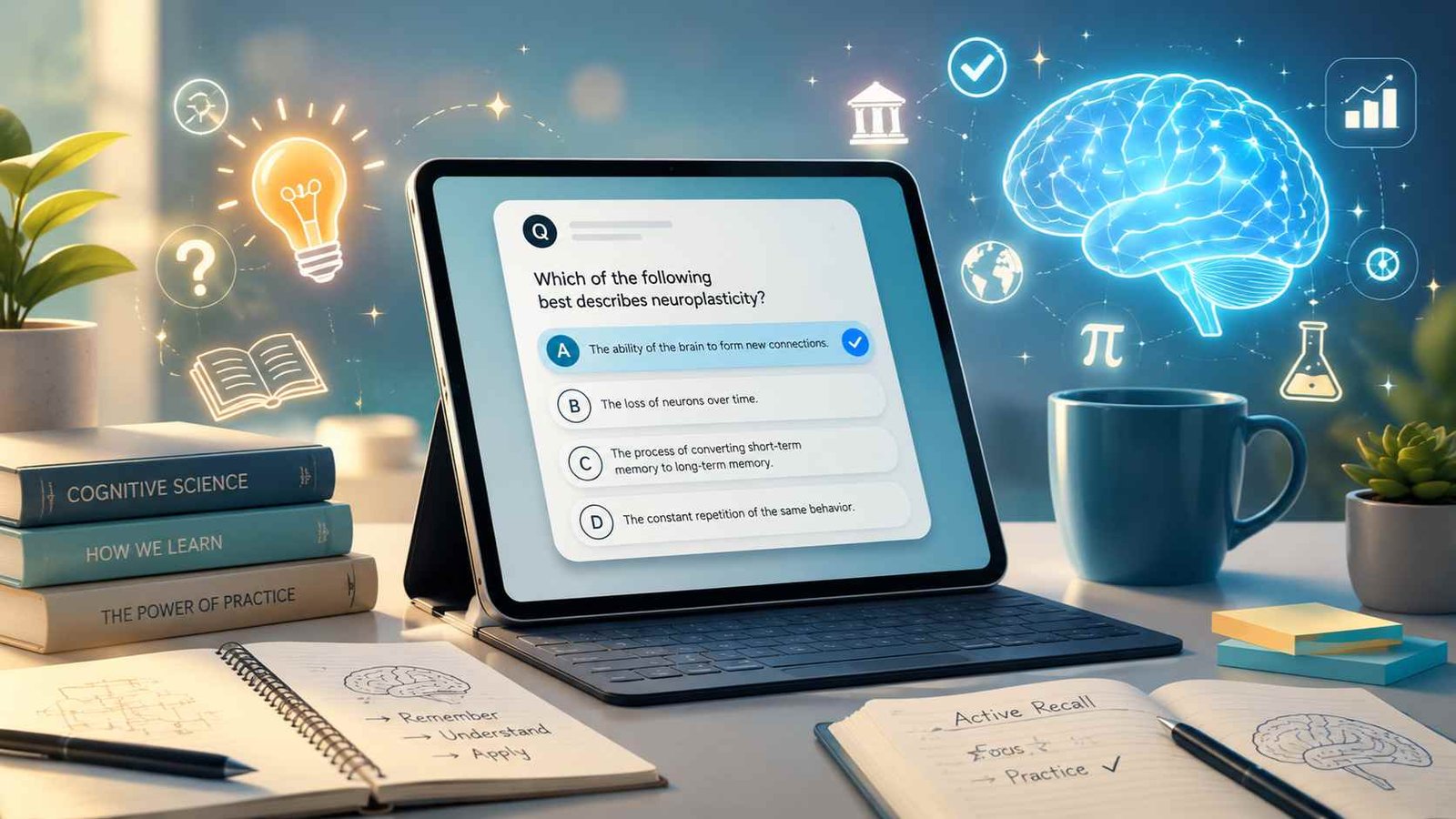
Memory improves when your brain retrieves information. That means you try to pull an answer from your mind instead of only reading it passively.
Multiple-choice quizzes encourage retrieval because they make you pause and choose. Even when the choices help you, your brain still has to search for what feels familiar.
Quick Memory Truth
Reading a fact once is easy to forget. Answering a question about it makes it stick better.
This is why daily quizzes can be effective. A few questions each day can help you remember facts longer because you keep bringing those facts back to mind.
🌎 They Make General Knowledge Less Intimidating
General knowledge can feel endless. History, science, geography, sports, entertainment, Bible facts, world news, nature, inventions — where do you even start?
Multiple-choice quizzes make big topics feel smaller. Instead of saying, “Learn world history,” a quiz asks one clear question.
Example:
Which ancient civilization built the pyramids at Giza?
A. Romans
B. Egyptians
C. Greeks
D. Vikings
That is much easier to handle. One question gives you one small door into a big subject. Over time, those small doors add up.
🏆 Multiple-Choice Quizzes Build Confidence
Confidence matters in learning. When people feel lost, they often stop. Multiple-choice quizzes help because they give learners a starting point.
Even if someone does not know the answer, the choices offer clues. That makes the question feel possible. And when a person gets an answer right, it gives a small reward.
That “I knew it!” moment matters.
Small wins can motivate people to try another question, then another, until learning becomes a habit.
👀 They Improve Attention to Detail
Some multiple-choice questions are easy. Others are tricky. That is not always a bad thing. Tricky questions can train careful reading.
Example:
Which country is both a continent and a country?
A. Canada
B. Australia
C. Brazil
D. India
The answer is Australia. But the phrase “both a continent and a country” makes you slow down. That is a useful skill. Good quizzes teach people not to rush. They encourage careful reading, patience, and attention to small details.
📌 Why Explanations Make Multiple-Choice Quizzes Even Better
A multiple-choice quiz becomes much more powerful when it includes answer explanations. The explanation is where the learning becomes clear.
Correct Answer: B. Australia
Explanation: Australia is commonly described as both a country and a continent. It is the smallest continent and one of the largest countries by land area.
That short explanation does three things: it confirms the correct answer, fixes the fact in memory, and adds extra context. Without an explanation, a quiz is mostly a score. With an explanation, it becomes a mini-lesson.
✨ How Multiple-Choice Quizzes Encourage Curiosity
A good quiz question can make you curious. You might answer one question about volcanoes and suddenly wonder why some volcanoes erupt more violently than others. You might miss a question about the ocean and want to know more about deep-sea creatures.
That spark matters. Curiosity turns learning from a task into a habit.
Small Window, Big Rabbit Hole
Multiple-choice quizzes give just enough information to make you want more. They do not overwhelm you. They open a small window — and sometimes that small window becomes a whole educational rabbit hole.
✅ Practical Tips for Getting More Value From Multiple-Choice Quizzes
1. Answer Before Looking
Read the question first. Pause for a second. See if you can think of the answer before checking the choices.
2. Do Not Rush
Read every option, even if you think you already know the answer. The first answer that looks right may only be partly right.
3. Learn From Mistakes
When you get a question wrong, ask what confused you, what clue you missed, and how you can remember it next time.
4. Read the Explanation
The explanation is often more valuable than the score because it turns a simple quiz into real learning.
5. Use Daily Quizzes
Five to ten questions a day can help build general knowledge without making learning feel heavy.
6. Mix Easy and Hard
Easy questions build confidence. Hard questions stretch your thinking. A strong quiz should have both.
🌐 Why Multiple-Choice Quizzes Work Well Online
Online quizzes are perfect for quick learning. They are easy to access, easy to finish, and easy to share. You can take one during a break, after lunch, before bed, or while waiting in line.
They also work well because they give instant feedback. You know right away if you were correct. That quick response helps the brain connect the question, answer, and explanation.
For quiz websites, this is powerful.
Visitors do not just want to be tested. They want to feel smarter after playing. That is where well-written multiple-choice quizzes shine.
🎯 Multiple-Choice Quizzes Are Not “Just Guessing”
Yes, guessing happens. But good multiple-choice quizzes are not built for blind guessing. They are built to guide thinking.
The answer choices act like clues. Some are clearly wrong. Some are close. One is best. That structure teaches people how to reason through uncertainty.
Honestly, that is a useful life skill. Not every problem gives you a perfect answer right away. Sometimes you have to compare choices, remove bad options, and make the best decision with what you know.
🛠️ How Quiz Websites Can Make Multiple-Choice Quizzes Better
For quiz creators, the quality of the answer choices matters. A strong multiple-choice question should have one clearly correct answer, believable wrong answers, simple wording, helpful explanations, and a balanced mix of easy, medium, and challenging questions.
Weak Example
What is the capital of France?
A. Paris
B. Banana
C. Ocean
D. Chair
That does not make the brain work because the wrong answers are not realistic.
Better Example
What is the capital of France?
A. Paris
B. Lyon
C. Marseille
D. Nice
Now the learner has to think. The wrong answers are still reasonable because they are real French cities.
Bad answer choices make a quiz feel cheap. Good answer choices make a quiz feel smart, fair, and fun.
❓ FAQs About Multiple-Choice Quizzes
Are multiple-choice quizzes good for learning?
Yes. Multiple-choice quizzes can help with learning because they make your brain retrieve information, compare answer choices, and recognize correct facts. They work even better when each question includes a short explanation.
Do multiple-choice quizzes improve memory?
They can support memory improvement, especially when used regularly. Daily quizzes help you review facts in small sessions, which makes information easier to remember over time.
Are wrong answers useful in multiple-choice quizzes?
Yes. Wrong answers can help you understand what the correct answer is not. When the wrong choices are realistic, they train your brain to notice differences and avoid common mistakes.
How many multiple-choice questions should I answer daily?
You can start with 5 to 10 questions a day. That is enough to build a simple learning habit without feeling overwhelmed. The key is consistency, not cramming.
Final Thoughts
Multiple-choice quizzes are more powerful than people think because they do more than test memory. They help you compare ideas, notice details, learn from wrong answers, and build confidence.
They make general knowledge easier to approach and daily learning more enjoyable. Best of all, they do not feel heavy.
One question can teach a fact. One explanation can clear up confusion. One daily quiz can slowly build a smarter, sharper mind.
So the next time you take a multiple-choice quiz, do not treat it like a quick guessing game. Treat it like a mini workout for your brain.