The 10-Minute Quiz Method for Improving Memory and Focus
Most people think quizzes are only for school, exams, or proving who knows the most random facts at family gatherings.
But quizzes can do something much better.
They can train your brain.
The 10-minute quiz method is a simple daily habit that uses short quiz sessions to improve memory, focus, and learning without overwhelming your mind. You do not need a long study plan. You do not need expensive apps. You do not even need to be “good at trivia.”
You only need 10 minutes, a few good questions, and the willingness to notice what your brain remembers — and what it forgets.
That is where the real learning begins.
Memory
Quizzes make your brain retrieve information instead of only receiving it.
Focus
Each question gives your attention one clear target.
Consistency
A short habit is easier to repeat than a heavy study marathon.
What Is the 10-Minute Quiz Method?
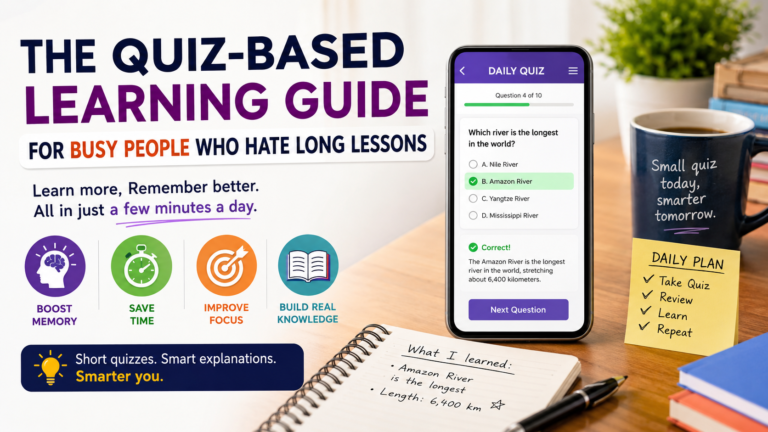
The 10-minute quiz method is a short learning routine where you answer a small set of quiz questions every day, then quickly review your mistakes.
The goal is not to get a perfect score. The goal is to wake up your memory, sharpen your focus, and build knowledge through repetition and curiosity.
Minutes
Answer quiz questions.
Minutes
Review wrong answers.
Minute
Repeat one useful fact.
That is it. No complicated system. No giant notebook. No three-hour study marathon that ends with you staring at the wall like your brain has resigned.
Why 10 Minutes Works So Well
Ten minutes sounds small, but that is exactly why it works.
Long study sessions can feel heavy. Your attention starts strong, then slowly fades. You begin reading the same sentence again and again. Suddenly, your mind is thinking about snacks, bills, or why one sock always disappears in the laundry.
A short quiz session avoids that problem.
It gives your brain a clear task with a clear finish line. When you know the session only lasts 10 minutes, it becomes easier to focus and easier to repeat.
Small habits are easier to repeat. Repeated habits are where memory improvement begins.
How Quizzes Help Improve Memory
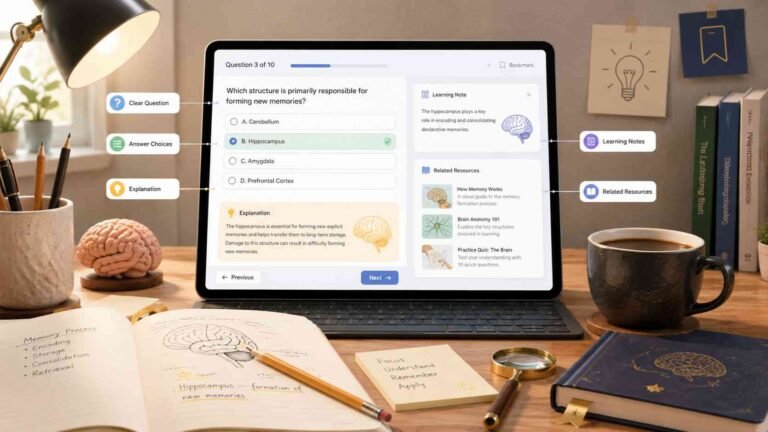
Quizzes improve memory because they force your brain to retrieve information.
Reading
Gives you information.
Quizzing
Asks your brain to find it.
That difference matters. When you answer a question, your brain has to search for the answer. Even if you get it wrong, the act of trying makes the correct answer more memorable afterward.
Example
Suppose you see this question: Which planet is known as the Red Planet? You think for a second. Maybe you know it is Mars. Maybe you almost say Jupiter because your brain enjoys chaos sometimes. Either way, your mind has to work.
That small mental effort strengthens recall. This is why quiz learning can be more powerful than simply rereading facts.
How Quizzes Improve Focus
Focus is not just about sitting still and forcing yourself to concentrate. Focus is about giving your attention a target.
Educational quizzes do this naturally. Each question creates a tiny challenge. Your mind has to pause, think, compare choices, and choose an answer. That process trains attention in small bursts.
A 10-minute quiz session can help you practice:
This is especially useful if you struggle with long articles, videos, or lessons. A short quiz gives your brain structure. It keeps things moving.
The Best Way to Use the 10-Minute Quiz Method
You can use this method with almost any topic: history, science, geography, entertainment, Bible knowledge, money facts, technology, or general knowledge. But the method works better when you follow a simple structure.
Choose One Quiz Topic
Do not try to learn everything at once. Pick one topic for the session so your daily quizzes stay fresh without becoming messy.
Answer Without Looking Up the Answers
Let your brain try first. Guess if you have to. A wrong guess is not useless. It tells you where your memory is weak, and that weak spot becomes your learning spot.
Review Your Wrong Answers Immediately
Do not only check the score and leave. Spend a few minutes with your wrong answers. Ask what you chose, why you chose it, what the correct answer is, and what clue can help you remember it next time.
Repeat One Key Fact Out Loud
At the end of your session, choose one fact worth remembering and say it in your own words. Your brain likes repetition, especially when it is short and clear.
A Sample 10-Minute Quiz Routine
Here is a practical routine you can follow today.
Prepare
Open your daily quiz. Remove distractions if possible. Tell yourself: “Just 10 minutes.” That small phrase makes the task feel light.
Answer Questions
Try 8 to 12 questions. Do not rush too much. Read each question carefully and eliminate obviously wrong choices first.
Review and Remember
Look at your incorrect answers. Pick the most interesting one. Read the explanation if available. Then turn it into a simple memory sentence.
Memory sentence example:
“I missed that the Great Barrier Reef is in Australia. Next time, I’ll connect reef with Australia.”
That tiny connection may help the fact stick.
Why Daily Quizzes Beat Random Cramming
Cramming can help you remember something for a short time. Daily quizzes help you build knowledge slowly. That is the difference.
When you practice a little every day, your brain gets repeated chances to retrieve information. This makes learning feel more natural. You begin to recognize patterns. You remember facts faster. You also become more curious because each quiz gives you small surprises.
A good quiz does not just ask, “Do you know this?”
It quietly asks, “Do you want to know more?”
That curiosity is powerful.
Practical Tips to Make the Method Work
Keep the Quiz Short
Do not turn the 10-minute quiz method into a 45-minute study session wearing a fake mustache. The short time limit is the point.
Mix Easy and Hard Questions
If every question is too easy, your brain gets bored. If every question is too hard, you may quit. A good quiz has both.
Track Only One Thing
Do not track ten different stats. Start with one simple number: how many questions you got right.
Use Wrong Answers as Clues
Wrong answers show you what needs attention. Maybe your brain has secretly declared war on maps. Good. Now you know what to review.
Make It a Daily Habit
Daily quizzes work best when attached to something you already do. A habit becomes easier when it has a regular place in your day.
What Kind of Quizzes Are Best?
The best quizzes for this method are clear, varied, and educational.
Look for quizzes that include:
Educational quizzes are especially useful because they do more than entertain. They give your brain a reason to recall, compare, and learn. Daily quizzes are even better because they create rhythm. You do not have to decide what to study every day. You simply show up and answer.
Common Mistakes to Avoid
Only Caring About the Score
Scores are useful, but they are not the whole point. A 6 out of 10 can teach you more than a 10 out of 10 if you review your mistakes properly.
Skipping the Review
The review is where the learning sticks. Without review, a quiz becomes entertainment only. Fun, yes. But not as useful.
Taking Too Many Quizzes
More is not always better. If you take too many quizzes in one sitting, your attention may drop. Keep the session short and focused.
Choosing Topics You Hate
Do not punish your brain. Start with topics you enjoy. Then slowly add harder subjects. Curiosity makes learning easier.
Who Can Use the 10-Minute Quiz Method?
Almost anyone.
Students can use it to review lessons. Adults can use it to keep their minds active. Quiz lovers can use it to build stronger general knowledge. Busy people can use it because it does not require a huge time commitment.
It is especially helpful for people who say:
“I want to learn, but I do not have much time.”
That is exactly where this method shines.
FAQs About the 10-Minute Quiz Method
1. Can the 10-minute quiz method really improve memory?
Yes, it can help improve memory because quizzes make your brain practice recalling information. The key is to review your wrong answers, not just check your score and leave.
2. How many questions should I answer in 10 minutes?
A good range is 8 to 12 questions. If the questions are harder or include explanations, fewer may be better. The goal is focused learning, not speed-running your brain into smoke.
3. Should I take the same quiz again?
Yes, repeating a quiz after a few days can be very helpful. If you remember answers you missed before, that is a sign your memory is improving.
4. What topics are best for daily quizzes?
General knowledge, science, history, geography, current events, Bible knowledge, and educational quizzes are all good choices. The best topic is one that keeps you curious enough to return tomorrow.
Final Thoughts
The 10-minute quiz method is simple, but that is its strength.
You answer a few questions. You review your mistakes. You remember one useful fact. Then you come back tomorrow and do it again.
Over time, this small habit can help improve memory, strengthen focus, and make learning feel less like a chore.
You do not need to study for hours to become sharper.
Sometimes, 10 honest minutes with a good quiz is enough to wake up your mind.