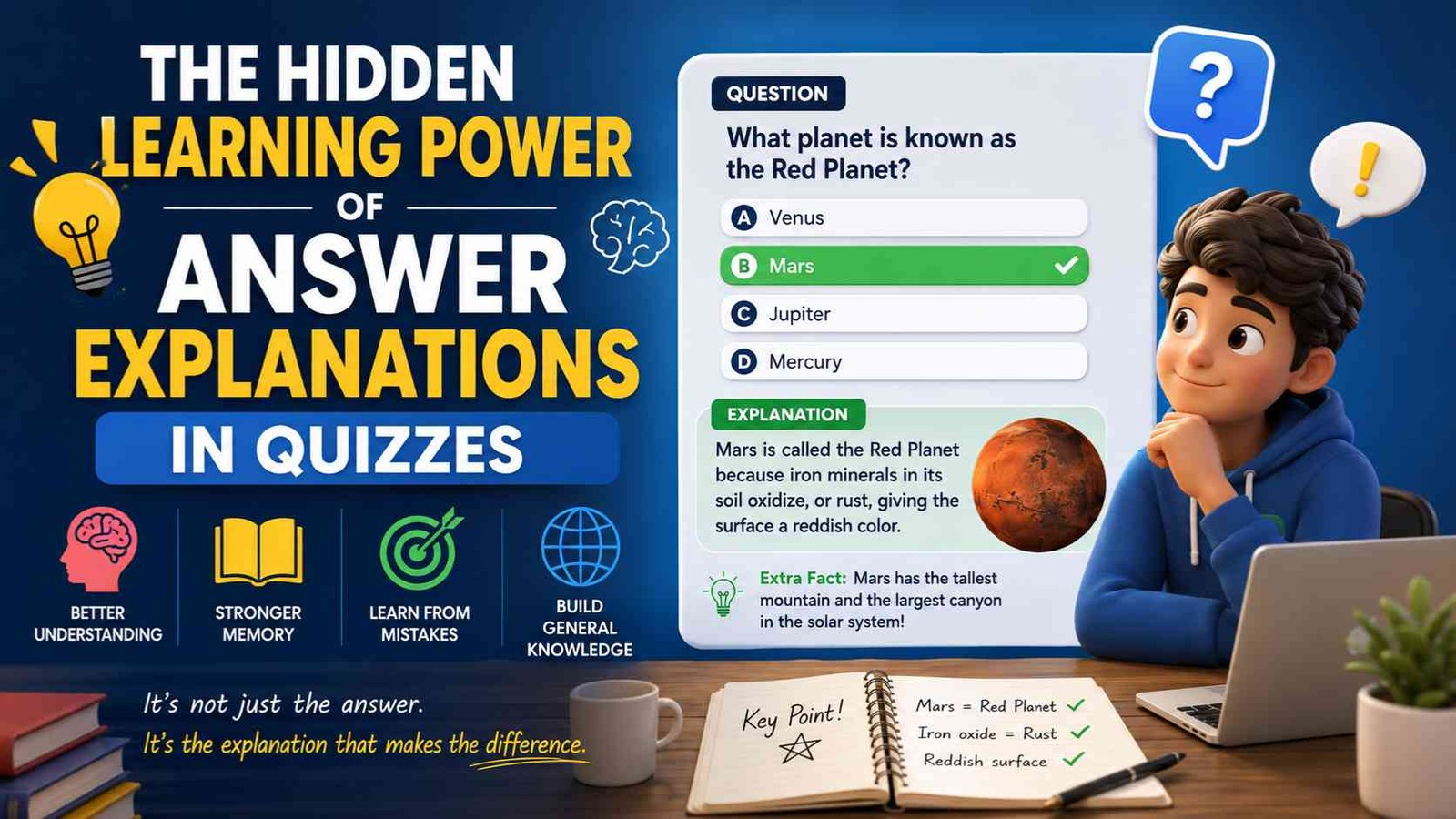
The Hidden Learning Power of Answer Explanations in Quizzes
🧠 Quiz Learning • Memory • General Knowledge
Most people think the quiz ends when they see the score.
But the score is only the scoreboard. The real learning often happens after the answer is revealed.
That small explanation under a quiz question can do something powerful. It can fix a misunderstanding, connect a fact to something you already know, and help your brain remember the answer longer.
That is the hidden learning power of answer explanations in quizzes. A good explanation does not just tell you what was right. It shows you why it was right, why another choice was tempting, and how to remember the lesson next time.
✨ Why Answer Explanations Matter More Than You Think
A quiz without explanations is like a teacher saying, “Wrong,” then walking away. Not very helpful, right?
When you answer a question, your brain is already active. It made a guess, searched your memory, compared the options, and picked an answer. That moment is valuable because your mind is paying attention.
Then the explanation steps in.
It tells your brain: “What you thought was close, but here is the missing piece.”
This is why quiz learning can be so effective. You are not just reading random facts. You are testing what you know, then correcting or strengthening it right away.
🏆 A Score Tells You What Happened. An Explanation Tells You Why.
Scores are useful, but limited. A score can tell you, “You got 7 out of 10.” But it cannot explain what really happened inside the learning process.
That is where explanations shine. In educational quizzes, the explanation is the bridge between guessing and understanding. Without it, you may know that your answer was wrong, but not why it was wrong.
And honestly, “I was wrong but I don’t know why” is one of the most annoying learning moments ever. It is like losing your keys and being told, “They are not there.” Great. Very inspiring.
🧠 How Answer Explanations Help Memory Improvement
Your brain remembers better when information has meaning. A plain answer gives you a fact. An explanation gives you a reason.
Basic answer:
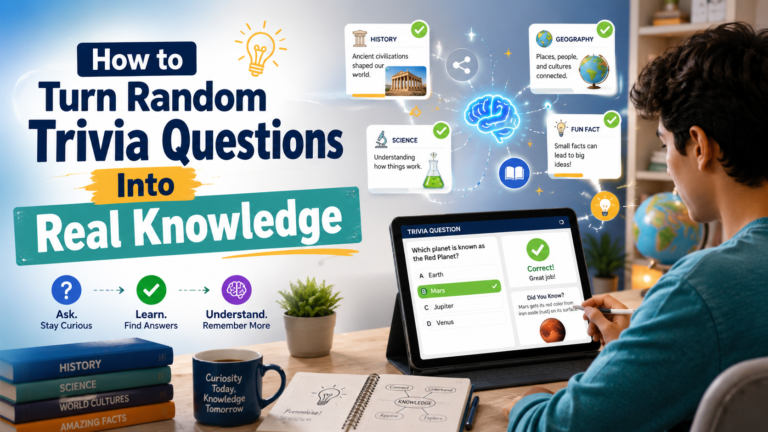
Question: What planet is known as the Red Planet?
Answer: Mars.
Better with explanation:
Mars is called the Red Planet because iron minerals in its soil oxidize, or rust, giving the surface a reddish color.
Now the fact has a story. Your brain can connect Mars with rust, red soil, and iron. That makes the answer easier to remember.
This is one reason answer explanations in quizzes support memory improvement. They give your brain more “hooks” to hold onto the information.
⏱️ The Brain Likes Corrections at the Right Moment
Timing matters. If you get an answer wrong and see the explanation immediately, your brain is still interested. The mistake is fresh. The curiosity is active.
That is a perfect learning window.
Small corrections, repeated often, can become long-term knowledge.
This is especially helpful in daily quizzes, where small learning moments build up over time. You may not remember every question from today, but if you read the explanations, you slowly collect useful facts, patterns, and connections.
🚦 Explanations Turn Wrong Answers Into Useful Clues
Wrong answers are not useless. In fact, wrong answers can be surprisingly valuable if you know what to do with them.
A wrong answer can show you that:
- You confused two similar facts
- You remembered only part of the topic
- You trusted a familiar-sounding option
- You guessed too quickly
- You misunderstood the question
The explanation helps you see the pattern behind the mistake. For example, if you confuse Austria with Australia in a geography quiz, the explanation can help separate them clearly in your mind. One is a landlocked country in Europe. The other is a country and continent in the Southern Hemisphere.
That one explanation can prevent the same mix-up next time.
🌍 Answer Explanations Build Real General Knowledge
General knowledge is not just a pile of facts. It is a web of connected ideas. Answer explanations help build that web.
A good explanation does not only say what the answer is. It gives a little context.
Example:
“The Nile is often listed as the longest river in the world, though some sources debate whether the Amazon may be longer depending on measurement methods.”
That explanation teaches more than a single answer. It shows that knowledge can have details, debates, and context. This makes online quizzes more useful than simple trivia games. They become mini-lessons that fit into a busy day.
📌 What Makes a Good Quiz Explanation?
Not all explanations are equal. Some are too short: “Because it is correct.” Wonderful. Truly life-changing. Some are too long and turn into a mini textbook nobody asked for.
A good quiz explanation should be clear, short, and helpful.
The best explanations feel like a friendly guide saying, “Here’s the trick.”
⚖️ Weak Explanation vs. Helpful Explanation
Weak Explanation
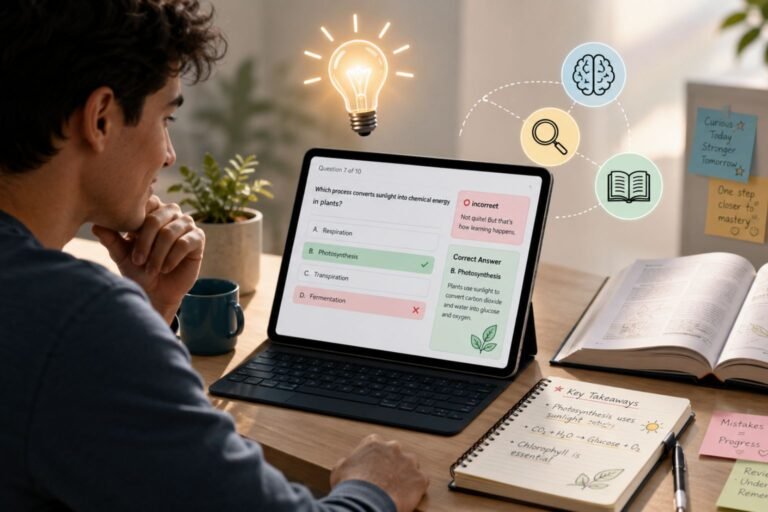
Question: Which gas do plants absorb during photosynthesis?
Answer: Carbon dioxide.
Explanation: Plants use carbon dioxide.
Helpful Explanation
Plants absorb carbon dioxide from the air during photosynthesis. They use it, along with sunlight and water, to make food and release oxygen.
Now the answer has meaning. You understand the process, not just the word. That is the difference between memorizing and learning.
🚀 Why Explanations Make Quizzes Better for Busy People
Many people do not have time to read long lessons every day. That is why quizzes work well. They are quick, active, and easy to fit into small breaks.
But the explanation is what makes the quiz educational. You can answer one question during lunch, read a two-sentence explanation, and walk away knowing something new.
Small learning still counts.
A daily quiz habit can help you build knowledge in science, history, geography, language, entertainment, sports, and current events without feeling like you are studying for an exam. No highlighter. No thick textbook. No dramatic sighing at page 347.
✅ Practical Tips: How to Learn More From Quiz Explanations
1. Read It Even When You Got It Right
Sometimes you get the right answer for the wrong reason. The explanation confirms whether you truly understood it.
2. Pause After a Wrong Answer
Do not rush to the next question. Ask, “What did I think was true?” That small pause helps your brain notice the gap.
3. Look for the Memory Hook
Every good explanation has something you can remember: a date, a cause, a comparison, or a simple clue.
4. Keep a Small Fact List
A phone note titled “Quiz Facts I Keep Missing” can help you review tricky ideas once in a while.
5. Explain It to Someone Else
If you can explain a quiz answer in your own words, you probably understand it.
Quick examples worth remembering:
- Venus is the hottest planet, not Mercury.
- Canberra is the capital of Australia, not Sydney.
- Shakespeare wrote tragedies, comedies, and histories.
🌐 How Quiz Websites Can Use Explanations Better
For a quiz website, answer explanations are not just extra content. They improve the whole experience. They make quizzes feel more useful, not just entertaining.
A visitor may come for fun, but they stay longer when they learn something interesting.
Good quiz explanations can help a website:
- Offer more educational value
- Improve user trust
- Encourage repeat visits
- Support better engagement
- Make quizzes more helpful for students and casual learners
- Create stronger content around general knowledge topics
This is especially important for quiz websites that publish daily quizzes or educational quizzes. A fresh set of questions is good. A fresh set of explanations is better.
🔥 The Best Explanations Make You Curious
A great answer explanation does not only close the question. Sometimes, it opens another one.
Example:
“The Great Wall of China was not built all at once. Different sections were built and rebuilt by different dynasties over centuries.”
Now the reader may wonder: Which dynasty built the most famous sections? How long is the wall really? Was it actually visible from space?
That is a beautiful thing. Curiosity is one of the strongest engines of learning. A good explanation gives just enough information to satisfy the moment, but also enough spark to make the reader want to know more.
💻 Why This Matters for Online Learning
Online learning can feel passive. Scroll. Read. Forget. Repeat. Quizzes change that because they ask you to do something. You have to choose, recall, compare, and decide.
But answer explanations complete the learning loop.
The quiz learning loop:
That loop is simple, but powerful. It turns online quizzes from quick entertainment into useful learning tools.
⚠️ Common Mistake: Treating Explanations Like Fine Print
Many people skip explanations because they want to move fast. That is understandable. Quizzes are fun when they have momentum.
But skipping explanations is like opening a gift, seeing the box, and ignoring what is inside. The answer tells you the result. The explanation gives you the reward.
Even reading one or two explanations carefully can make a quiz more valuable.
❓ FAQs About Answer Explanations in Quizzes
Why are answer explanations in quizzes important?
Answer explanations help you understand why an answer is correct. They turn a simple right-or-wrong result into a learning moment. This makes quizzes more useful for memory, general knowledge, and long-term understanding.
Do explanations help even if I already got the answer right?
Yes. Sometimes you choose the right answer because you guessed well or recognized a familiar word. Reading the explanation confirms your understanding and may teach you an extra detail.
Are quizzes with explanations better for students?
Yes, especially when the explanations are clear and short. They help students learn from mistakes, understand key ideas, and remember facts better than quizzes that only show scores.
How long should a quiz explanation be?
A good explanation is usually short: two to four sentences is often enough. It should explain the answer clearly without overwhelming the reader.
Final Thoughts
Answer explanations in quizzes may look small, but they carry a lot of learning power.
They help you understand mistakes, remember facts, build general knowledge, and make daily quizzes more meaningful. A score can tell you how you performed, but an explanation helps you grow.
So the next time you take an online quiz, do not rush past the explanation. That little paragraph might be the part your brain remembers tomorrow.