Frontline Education: Complete Guide to School Management Solutions
Running a school district is much bigger than lesson plans, classrooms, and textbooks. Behind every smooth school day is a busy network of people, records, schedules, approvals, reports, and student support services working quietly in the background.
Teacher absences need coverage. Substitutes need assignments. HR teams need accurate employee records. Special education departments need compliant documentation. Administrators need reliable reporting. When all of those moving pieces are handled through disconnected spreadsheets, paper forms, phone calls, and email chains, school operations can quickly become stressful.
That is where Frontline Education becomes useful. It is a K–12 school software platform designed to help districts manage daily operations, employee workflows, student services, compliance records, and data reporting in a more organized digital environment.
What Is Frontline Education?
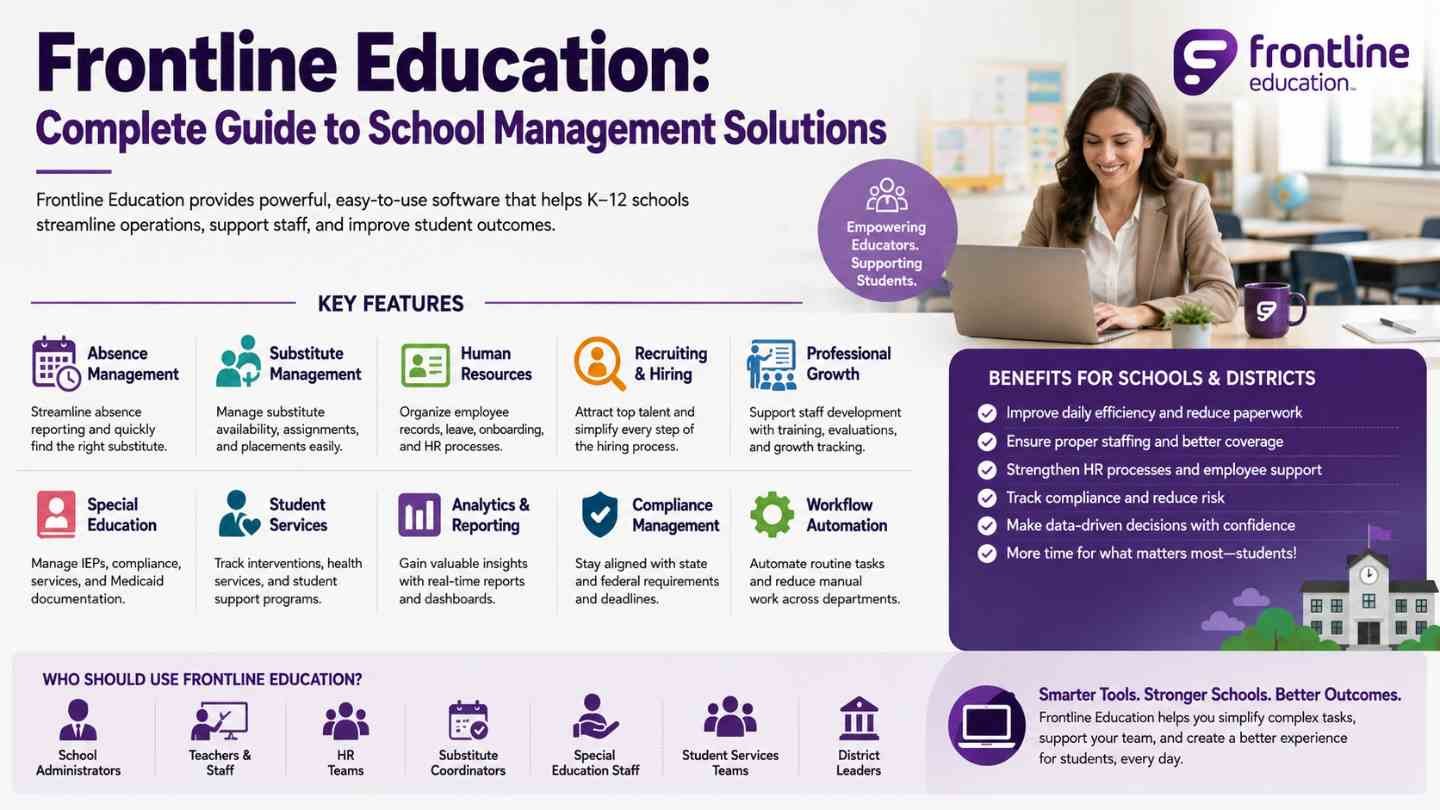
Frontline Education is an education technology company that provides school management solutions for K–12 districts. Its platform supports important areas of school operations, including absence management, substitute placement, human resources, recruiting, employee records, professional learning, special education, student services, analytics, and compliance.
In simple terms, Frontline Education helps schools manage the “business side” of education so teachers, administrators, and support teams can spend more time focusing on students.
✨ Simple Example
Instead of a teacher calling the school office to report an absence, the teacher can submit the absence through Frontline. The system can record it, notify eligible substitutes, help someone accept the assignment, and give administrators visibility into whether the class is covered.
How Frontline Education Works
Frontline Education works by giving schools digital tools for managing specific operational needs. Districts can select solutions based on their priorities, such as HR, absence management, special education, student services, professional growth, or reporting.
A typical absence workflow may look like this:
- A teacher submits an absence through the system.
- The absence is recorded automatically.
- Available substitutes are notified.
- A substitute accepts the assignment.
- The school office sees that the position is covered.
- HR and payroll teams review absence and time data.
- Administrators use reports to identify staffing patterns.
This is only one example. Frontline can also support applicant tracking, employee onboarding, professional development, teacher evaluations, IEP documentation, student support records, Medicaid-related documentation, and district-wide reporting.
Key Features of Frontline Education
📅 Absence Management
Frontline’s absence management system helps schools track employee absences, notify substitutes, monitor coverage, and review absence-related data.
🧑🏫 Substitute Management
Districts can manage substitute pools, job assignments, availability, and placement records, making it easier to fill classroom vacancies quickly.
👥 Human Resources
School HR teams can organize employee records, leave tracking, certifications, onboarding, hiring steps, and compliance documentation.
📝 Recruiting & Hiring
Frontline can support job postings, applicant tracking, candidate communication, interview workflows, and hiring decisions.
🌱 Professional Growth
Districts can track staff development, professional learning plans, training completion, evaluation forms, observations, and growth goals.
♿ Special Education
Frontline can help with IEP management, 504 plans, service tracking, compliance monitoring, intervention records, and reporting.
Frontline Education for HR and Absence Management
For many school districts, HR and absence management are among the biggest reasons to use Frontline Education. School HR teams handle complex staffing needs every day. Teachers need leave. Substitutes need assignments. New employees need onboarding. Certifications must be tracked. Payroll data must be accurate. Administrators need to know whether classrooms are covered.
Important HR and staffing functions may include:
- Employee absence reporting
- Substitute job matching
- Leave tracking
- Time and attendance support
- Applicant tracking
- Hiring workflows
- Employee records
- Certification tracking
- HR reporting
- Compliance documents
For example, if a district notices that substitute shortages are highest on Fridays, administrators can review absence data and plan ahead. They may improve substitute recruitment, adjust staffing strategies, or communicate better with campus leaders.
In that sense, an absence management system becomes more than a scheduling tool. It becomes a planning tool.
Frontline Education for Special Education and Student Support
Special education departments have some of the most documentation-heavy responsibilities in a school district. IEPs, evaluations, service minutes, accommodations, goals, progress notes, Medicaid documentation, and compliance deadlines all require careful management.
Frontline can help special education teams organize these responsibilities in a digital format. Better documentation is not only an administrative benefit. It can also help students receive the services and support they are supposed to receive.
Student support tools may help with:
- IEP creation and management
- 504 plan documentation
- Service tracking
- Progress monitoring
- Compliance alerts
- State reporting support
- Medicaid-related documentation
- Intervention and student support tracking
For general information about special education requirements in the United States, the official Individuals with Disabilities Education Act website is a helpful resource.
Benefits of Frontline Education for Schools
⚙️ More Efficient Operations
Routine processes such as absence reporting, substitute placement, HR workflows, and compliance tracking can become easier to manage.
✅ Better Staff Coverage
Administrators can respond faster when teachers or staff are absent and improve visibility into staffing needs across campuses.
📁 Stronger HR Organization
Employee records, leave data, applicant information, and professional documentation can be stored in a more structured system.
🛡️ Improved Compliance Tracking
Districts can monitor documentation, deadlines, service records, and reporting requirements more consistently.
How Frontline Education Improves School Operations
Frontline Education helps improve school operations by connecting everyday administrative work with better visibility, clearer workflows, and more useful reporting. Instead of relying on scattered manual processes, districts can move important tasks into digital systems that are easier to monitor and update.
Practical ways it can help:
- Reduces manual work: Paper forms, old spreadsheets, and long email chains become easier to replace.
- Improves communication: Teachers, substitutes, HR staff, and administrators can access relevant information faster.
- Supports faster decisions: Leaders can use data to spot trends and respond sooner.
- Creates accountability: Digital records make it easier to track completed tasks and missed deadlines.
- Builds consistency: Districts can standardize workflows across multiple schools and departments.
Possible Challenges and Limitations
Frontline Education can be highly useful, but no software solves every operational issue on its own. Districts should plan implementation carefully and understand the possible challenges before adopting or expanding the platform.
Learning Curve
Teachers, substitutes, HR teams, and administrators may need role-based training.
Setup Planning
Absence rules, substitute lists, calendars, workflows, and employee records must be configured properly.
Data Quality
Reports are only reliable when the information entered into the system is accurate and updated.
Integration Needs
Frontline may need to connect with payroll, finance, student information, or other district systems.
Tips for Using Frontline Education Effectively
Best practices for schools and districts:
- Train users by role. Teachers, substitutes, HR teams, and administrators need different types of training.
- Keep data clean. Update employee records, substitute lists, calendars, and student support information regularly.
- Set clear procedures. Explain when to use Frontline, who approves requests, and how reports should be reviewed.
- Use reports regularly. Review staffing gaps, hiring timelines, absence trends, and compliance reports before problems grow.
- Start with priority areas. Focus first on the biggest pain points, such as absence management or HR workflows.
- Ask for feedback. Teachers, office staff, substitutes, and support teams can identify real-world issues quickly.
- Connect the platform to district goals. Use Frontline to support better staffing, stronger compliance, less paperwork, and improved student services.
Who Should Use Frontline Education?
Frontline Education is designed mainly for K–12 school districts and education organizations that need better systems for managing people, services, documentation, and operations.
- Public school districts
- Charter school networks
- Private K–12 schools
- Regional education agencies
- HR departments
- School administrators
- Substitute coordinators
- Special education departments
- Student services teams
- Professional development coordinators
- District leadership teams
A small school may not need every feature. A large district, however, may benefit from multiple Frontline tools working together across HR, absence management, special education, student services, analytics, and compliance.
Frontline Education FAQ
What is Frontline Education used for?
Frontline Education is used by K–12 schools and districts to manage administrative tasks such as employee absences, substitute placement, HR processes, recruiting, professional growth, special education documentation, student support, analytics, and compliance.
Is Frontline Education only for teachers?
No. Teachers may use Frontline for absence reporting, professional development, or evaluations, but the platform is also used by substitutes, HR teams, administrators, special education staff, student support teams, and district leaders.
Is Frontline an absence management system?
Yes. Absence management is one of Frontline’s best-known uses. Schools can use it to track employee absences, manage substitute coverage, and review absence-related data.
Can Frontline help with special education?
Yes. Frontline offers tools that can support special education management, including IEP documentation, service tracking, compliance monitoring, reporting, and student support workflows.
Why do school districts use Frontline Education?
Districts use Frontline Education to improve efficiency, reduce paperwork, manage staffing, support HR processes, track compliance, organize student services, and make better data-informed decisions.
Final Thoughts
Frontline Education is a practical platform for school districts that want to manage daily operations with more clarity and less manual work. From absence management and substitute placement to HR workflows, professional growth, special education, student services, analytics, and compliance, it helps organize many of the behind-the-scenes tasks that keep education running.
Its biggest value is not only convenience. Frontline gives school leaders better visibility into staffing, services, records, and trends. It can help teachers report absences more easily, HR teams manage employee processes more consistently, and support staff document student services more effectively.
Like any school management solution, Frontline works best when districts train users properly, keep data accurate, review reports regularly, and connect the software to real operational goals. For schools looking to modernize their administrative systems, Frontline Education can be a strong option to consider. And for readers who enjoy learning through quick daily challenges, you can also try this quiz of the day for a fun break after exploring education technology.