Continuing Education Guide for Lifelong Learning and Career Growth
Continuing Education: A Practical Guide to Learning, Growing, and Moving Forward
Continuing education is not only for people chasing promotions or new certificates. Sometimes it is for the parent studying after bedtime, the worker trying to stay useful in a changing field, the career changer starting over with a notebook and a little courage, or the lifelong learner who simply refuses to get stale.
Skill Development
Professional Growth
Learn with a purpose
The best learning path usually starts with one honest question: what do I need this knowledge to help me do?
Grow at a steady pace
Small lessons count. A few focused hours each week can change your confidence faster than you might expect.
Build real momentum
Continuing education works best when it fits your actual life, not an imaginary perfect schedule.
What Continuing Education Really Means
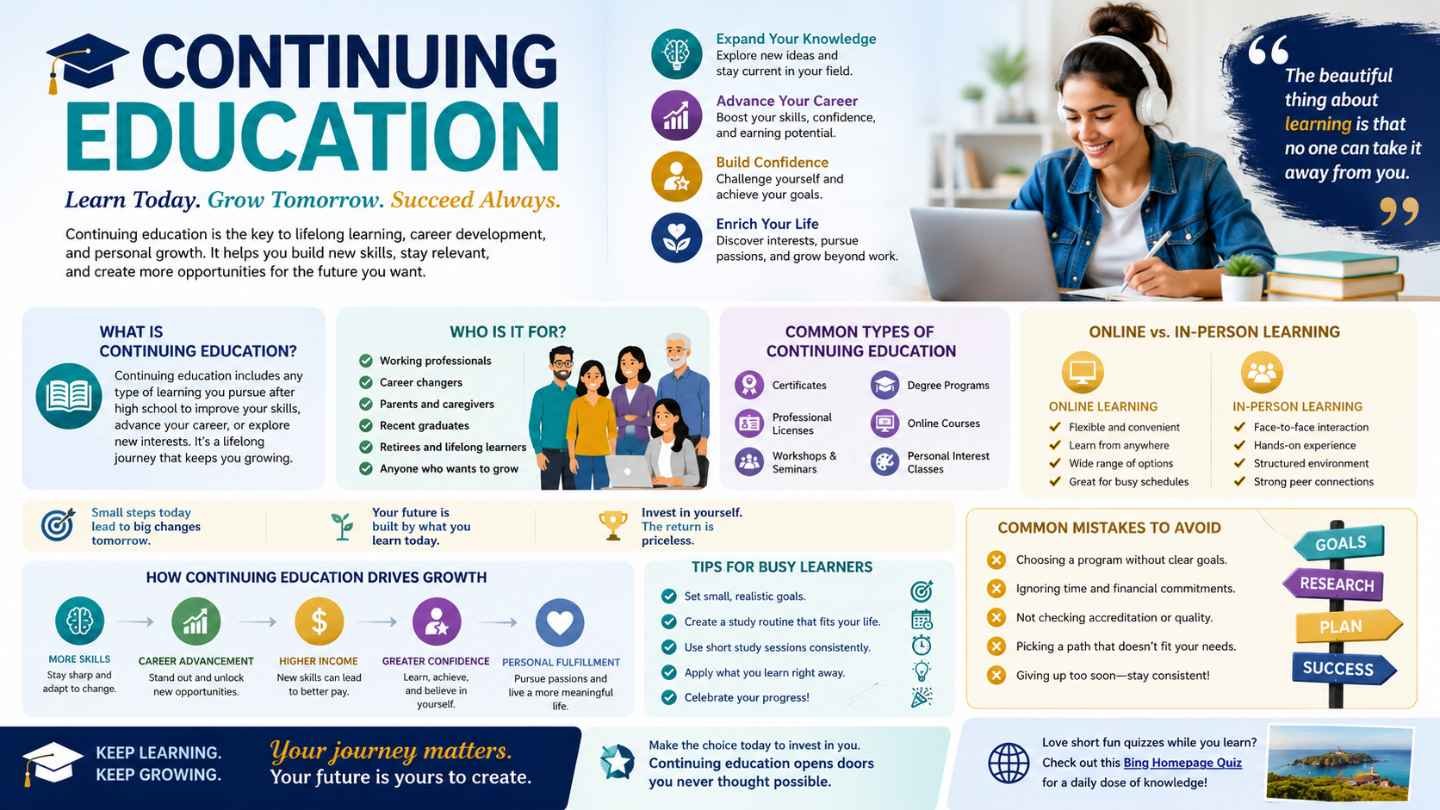
Continuing education refers to learning that happens after someone has completed a formal stage of schooling, or after they have already entered the workforce. It can include short courses, professional certificates, workshops, seminars, online learning programs, adult education classes, industry training, or even structured self-study that builds useful knowledge.
The phrase can sound a little official, almost like something printed on a brochure at a conference table. But at its heart, it is simple. You keep learning because your work, goals, interests, and responsibilities keep changing. Life does not freeze after graduation. Neither should your skills.
Why Continuing Education Matters
A person can be hardworking and still feel left behind when tools, expectations, and industries shift. That is the quiet pressure many adults feel. Continuing education gives people a way to catch up, sharpen up, and sometimes completely redirect their future.
It keeps skills current
Technology changes. Workplace standards change. Even familiar jobs slowly collect new expectations.
It supports confidence
There is a different kind of calm that comes from understanding what you are doing, not just getting through it.
It opens better options
A new skill may lead to career advancement, a raise, a stronger resume, or a door you did not know existed.
Who Is Continuing Education For?
Honestly? More people than admit it. Continuing education is for working professionals who need new tools, adults returning to study after years away, parents looking for flexible learning, career changers preparing for a fresh start, business owners trying to make smarter decisions, and retirees who still love learning because curiosity has no retirement date.
It is also for the person who feels a little nervous. Maybe you have not been in a classroom in years. Maybe you worry you are too busy, too late, or too far behind. Those feelings are common. They are not proof that you cannot learn. They are proof that starting matters.
A useful way to think about it
Continuing education is not about proving you were not good enough before. It is about giving your future self better tools.
Common Types of Continuing Education Programs
There is no single path, which is good news. Some people need a formal credential. Others need one practical skill they can use next Monday.
Professional certificates
Helpful for fields where employers want proof of focused training, such as technology, finance, healthcare, education, management, or project work.
Workshops and seminars
Short, concentrated learning experiences. Great when you need fresh ideas without committing to a long program.
College extension courses
Often designed for adults who want structured study, academic credit, or a bridge toward a degree.
Online learning programs
Flexible, searchable, and usually easier to fit around work and family. Quality varies, so choose carefully.
Licensing and compliance training
Required in many professions to maintain credentials, meet industry rules, or keep practicing legally.
Personal enrichment classes
Language, writing, history, art, financial literacy, communication, or any subject that makes life wider and more interesting.
Online Learning vs. In-Person Learning
Online learning gets a lot of attention because it is convenient. And yes, being able to study from the kitchen table after the house quiets down is a real advantage. Still, in-person learning has its own energy. Some people learn better when they can ask questions on the spot, meet classmates, and physically show up somewhere.
Online learning may fit best if…
Your schedule changes often, you live far from training centers, you prefer self-paced lessons, or you need affordable options. It also works beautifully for learners who like pausing, replaying, and taking notes without feeling rushed.
In-person learning may fit best if…
You need hands-on practice, direct feedback, networking, lab work, coaching, or the discipline of a fixed schedule. Some adults do better when the class becomes an appointment they cannot casually ignore.
How Continuing Education Supports Career Growth
Career development does not always happen through one dramatic move. More often, it happens through quiet upgrades. You learn a new software tool. You improve your writing. You understand data better. You become more comfortable speaking in meetings. Then one day, people start trusting you with bigger work.
Career advancement
New credentials and stronger skills can help you qualify for promotions, lateral moves, or better roles elsewhere.
Income potential
No course can promise a raise, of course. But relevant skill development can make your work more valuable and your options stronger.
Confidence
When you know the language of your field, you participate differently. You ask better questions. You stop shrinking.
Personal development
Learning stretches patience, discipline, curiosity, and resilience. Those qualities travel with you everywhere.
A Simple Career Roadmap for Choosing Your Learning Path
Name the goal
Promotion? Career change? License renewal? Better confidence? A vague goal makes every program look tempting.
Find the skill gap
Look at job posts, performance feedback, industry standards, or daily tasks that still feel uncomfortable.
Match the format
A certificate may be right for career advancement. A short workshop may be enough for one specific skill.
Check the return
Return does not only mean money. Time saved, confidence gained, and new opportunities count too.
Practical Tips for Busy Adults
Busy adults do not need fantasy schedules. They need learning plans that survive laundry, deadlines, traffic, dinner, overtime, and the random Tuesday when everything goes sideways.
Use small study blocks
Twenty-five focused minutes beats a three-hour plan that never happens. Keep the promise small enough to repeat.
Attach learning to a routine
Study after coffee, during lunch, before school pickup, or right after work. A habit needs a home.
Tell your household
Parents and caregivers often need protected learning time. Say it plainly: “This hour is for class.”
Apply lessons immediately
Use one idea at work, in a project, or in a conversation. Knowledge sticks when it touches real life.
Challenges You Might Face
The hardest part of continuing education is not always the material. Sometimes it is the tiredness. Or the cost. Or the strange feeling of being a beginner again.
Time pressure
Choose programs with realistic deadlines. A course that assumes unlimited evenings may not be your course.
Cost
Compare tuition, materials, exam fees, renewal fees, and employer reimbursement options before enrolling.
Motivation dips
They happen. Do not build a plan that depends on feeling inspired every day. Build one that can run on ordinary discipline.
Common Mistakes to Avoid
Choosing only by price
Cheap is not always bad, and expensive is not always better. Look for quality, relevance, support, and outcomes.
Ignoring accreditation or recognition
If you need the program for work, licensing, or career advancement, make sure employers or industry bodies actually respect it.
Overloading your schedule
Ambition is good. Exhaustion is not a strategy. Start with a pace you can maintain.
Skipping the fine print
Check refund rules, completion requirements, exam dates, software needs, and whether support is available when you get stuck.
How to Choose the Right Continuing Education Program
Start with the end. Not the brochure. Not the prettiest website. Not the friend who said a course was “amazing” but works in a completely different field.
Ask what the program will help you do, whether it fits your weekly schedule, who teaches it, how students are supported, what proof of completion you receive, and whether the skills are current. Read reviews carefully, but do not let one dramatic comment make the decision for you. Look for patterns.
A Gentle Note for Lifelong Learners
Not every learning journey needs to end with a certificate. Some learning makes you better at your job. Some makes you more patient. Some helps you understand the world with less noise in your head.
If you enjoy testing your knowledge in a light, low-pressure way, quizzes can be a friendly starting point. You can explore a quick daily challenge like the Bing Homepage Quiz as a simple habit for curiosity, recall, and everyday learning.
Short FAQ About Continuing Education
Is continuing education only for professionals?
No. Professionals use it for career development, but continuing education also serves parents, retirees, career changers, hobby learners, and adults who want stronger everyday skills.
Can online learning be as valuable as in-person learning?
Yes, when the program is well-designed and the learner stays engaged. In-person learning may be better for hands-on practice, while online learning often wins on flexibility.
How do I know if a program is worth it?
Check the provider’s reputation, course content, instructor background, cost, time commitment, student support, and whether the credential matters in your field.
What if I have been away from school for years?
Start small. Many adult education programs are built for learners returning after a long break. You may feel rusty at first, but rusty is not broken.
Keep Learning, But Keep It Yours
Continuing education works best when it is chosen with care, shaped around real life, and connected to something that matters to you. It can support professional growth, career advancement, income potential, and personal development, but it can also do something quieter: remind you that you are still capable of becoming new at something.