The Fact-to-Meaning Method: Turning Information Into Understanding
Facts are easy to collect but surprisingly easy to lose. You can memorize a date, a formula, a vocabulary word, a science term, or a quiz answer and still forget it the next day. Not because your brain is “bad,” but because the fact has nothing to hold on to.
A fact that sits alone is fragile. It may appear useful for a moment, but without context, examples, questions, or real-life use, it can disappear quickly. That is why some information fades while other lessons stay with you for years.
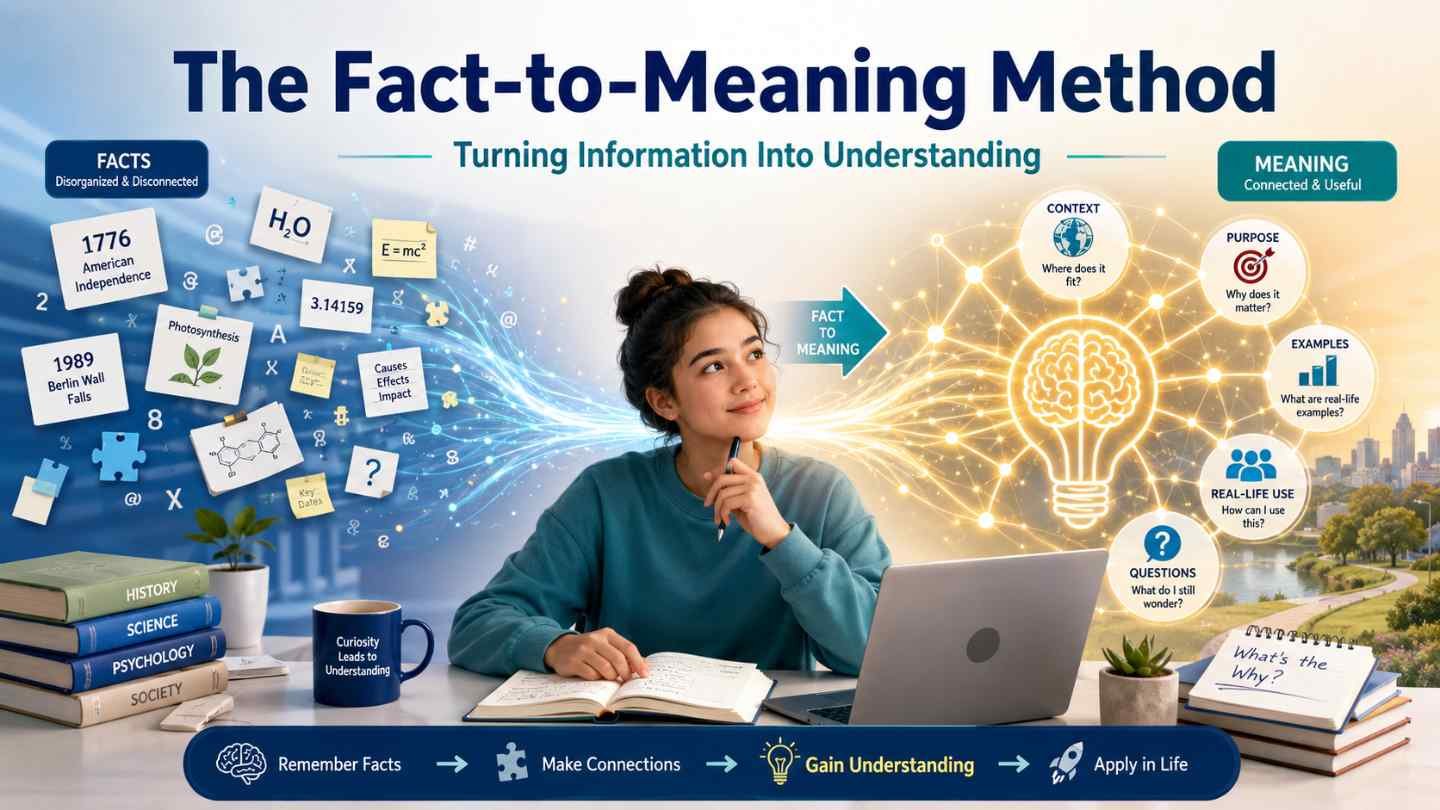
The difference is often meaning. When a fact has purpose, connection, and application, it becomes more than something to remember. It becomes something you understand. That is the heart of the Fact-to-Meaning Method.
What Is the Fact-to-Meaning Method?
The Fact-to-Meaning Method is a simple learning approach that helps you move from “I know this fact” to “I understand why this fact matters.” Instead of stopping at memorization, you take one extra step and connect the fact to meaning.
✨ Instead of only memorizing, ask:
- What does this fact mean?
- Why is it important?
- What bigger idea does it connect to?
- Where can I use it?
- How would I explain it to someone else?
A fact is a piece of information. Meaning is what gives that information value. For example, knowing that water boils at 100°C is a fact. Understanding that boiling point changes with air pressure gives the fact meaning. Suddenly, it connects to cooking, mountains, weather, science experiments, and real-world problem-solving.
That is when learning becomes useful.
Why Facts Alone Are Often Hard to Remember
A disconnected fact is like a loose paper on a windy desk. It can disappear quickly because it is not attached to anything. When learners only memorize isolated information, they may recognize the answer during a quiz but struggle to use it later.
This is why rereading a list of facts often feels productive but does not always lead to strong understanding. You may become familiar with the words, but familiarity is not the same as meaning.
💡 The simple problem
A fact without context is easy to drop. Meaning gives facts a place to belong.
Why Meaning Makes Information Easier to Remember
Meaning helps memory because it creates more connections. When you understand a fact, you are not relying on one mental path. You can reach the idea through examples, stories, comparisons, uses, questions, and personal experiences.
Think of it like saving a file in several folders instead of one. If you forget one route, another route can still lead you back.
🏛️ History
A date becomes easier to remember when you understand what changed because of the event.
➗ Math
A formula becomes easier to use when you know what problem it solves in real life.
🗣️ Vocabulary
A word becomes easier to recall when you connect it to a real sentence, feeling, or situation.
Meaning makes information active. It turns something you recognize into something you can explain, apply, and remember longer.
How to Turn a Simple Fact Into a Deeper Idea
You do not need a complicated system. You only need to slow down for a moment and ask better questions. Here is how the Fact-to-Meaning Method works in practice.
Step 1: Start with the basic fact
First, identify the fact clearly.
Example: “The Earth rotates once every 24 hours.”
Step 2: Add context
Ask where the fact belongs. The Earth’s rotation is connected to day and night, time zones, and how we measure a day. Now the fact has a setting.
Step 3: Ask why it matters
The Earth’s rotation affects sleep schedules, travel, work hours, farming, communication, and daily routines. Now the fact has purpose.
Step 4: Connect it to an example
If it is morning in the Philippines, it may still be evening in another country because different places face the Sun at different times. Now the fact feels real.
Step 5: Apply it
If you are scheduling an online class with someone overseas, you need to consider time zones because of Earth’s rotation. That is the fact becoming useful knowledge.
Practical Examples of the Fact-to-Meaning Method
The method works across quizzes, math, science, history, language learning, reading, online learning, and everyday life because every fact can become more useful when it gains meaning.
🎯 Quizzes: From correct answer to clear understanding
A quiz might ask, “What is the capital of Japan?” The answer is Tokyo. That is the fact.
To add meaning, ask: Why is Tokyo important? What role does it play in Japan? What makes it a political, economic, and cultural center?
Now Tokyo is not just a memorized answer. It becomes connected to geography, government, business, transportation, and culture. This is why quiz learning can be powerful when you review the explanation after answering. A quick trivia question can become a doorway into real understanding. You can practice this habit when you Play Today’s Bing Quiz and pause to ask why each answer matters.
➗ Math: From formula to purpose
A learner may memorize: Area of a rectangle = length × width. That is the fact.
Meaning begins when the learner understands that area measures the amount of space inside a shape. A classroom floor, a garden plot, a phone screen, and a wall for painting all use the same idea.
The formula is not just something to recite. It solves a real measurement problem. When learners understand the purpose, the formula becomes easier to remember and apply.
🔬 Science: From term to real-world use
A student might learn: Photosynthesis is the process plants use to make food. That is the fact.
Meaning comes when the learner connects photosynthesis to sunlight, carbon dioxide, oxygen, plant growth, food chains, and life on Earth.
Now the term is not just a science definition. It explains why plants need light, why forests matter, and how energy moves through living systems.
🏛️ History: From date to consequence
A student may memorize the date of an important revolution, election, war, or independence movement. The date matters, but the meaning matters more.
Ask what problems led to the event, who was affected, what changed afterward, and why people still study it. A historical fact becomes memorable when connected to causes, choices, consequences, and human lives.
🗣️ Language learning: From word to situation
A language learner may memorize a new word. But a word becomes easier to remember when it is placed in a real situation.
Example: Learning the word “urgent” becomes meaningful when you connect it to a sentence: “This message is urgent because the meeting starts in ten minutes.”
Now the word has tone, purpose, and use. It is no longer just a vocabulary item. It is a tool for communication.
📖 Reading: From detail to main idea
When reading an article or book, learners often remember small details but miss the bigger point. The Fact-to-Meaning Method helps by asking what the detail is showing, how it supports the main idea, and why the author included it.
A detail about a character, event, statistic, or example becomes more useful when it helps explain the message of the text.
Online Learning: From Watching to Understanding
Online lessons can feel easy because the information is already organized. But watching a video is not the same as understanding it. Passive watching may make a topic seem familiar, but real learning requires a small pause.
After learning one fact from an online course, ask:
- What problem does this solve?
- Can I explain it without replaying the video?
- Where would I use this outside the lesson?
- What example makes it clearer?
That small pause turns passive watching into active learning.
Everyday Life: From Random Information to Better Decisions
Facts are everywhere in daily life. A food label shows sugar content. A weather report gives a chance of rain. A bank statement lists interest charges. A product review gives ratings. The Fact-to-Meaning Method asks you to go one step deeper.
Useful everyday questions include:
- What does this number mean for me?
- How should it affect my choice?
- What pattern should I notice?
- What action should I take next?
A fact becomes powerful when it helps you make a better decision.
The Five-Minute Fact-to-Meaning Exercise
Use this exercise after a quiz, lesson, article, video, or study session. It is short enough to do daily but strong enough to turn loose information into understanding.
⏱️ Try this five-minute method:
- Minute 1: Choose one fact. Pick one fact you just learned. Example: “Sound travels faster through water than through air.”
- Minute 2: Explain it simply. Write the fact in your own words. Sound moves more quickly through water because particles in water are closer together than particles in air.
- Minute 3: Ask why it matters. This helps explain how whales communicate underwater and why sonar works.
- Minute 4: Add an example. If you are swimming, sound may feel different underwater because it travels through a different medium.
- Minute 5: Use it in a sentence or question. Example: “How does the speed of sound in water help marine animals communicate?”
In five minutes, the fact becomes connected to science, animals, technology, and real experience. That is much stronger than memorizing the sentence alone.
How Self-Study Learners Can Use This Method
Self-study can be powerful, but it is easy to rush through information. Without a teacher checking your understanding, you need a simple way to test whether a fact has become meaningful.
After studying, do not only ask, “Do I remember this?” Ask:
- Can I explain it?
- Can I give an example?
- Can I connect it to something I already know?
- Can I use it in a real situation?
- Can I create a question from it?
If you can do those things, you are not just storing facts. You are building understanding.
Common Mistakes to Avoid When Studying Facts
The Fact-to-Meaning Method works best when you avoid a few common traps that make learning shallow, crowded, or fragile.
Memorizing Without Context
Memorization is not always bad, but it should not be the only step. A fact without context is fragile. Add meaning as soon as possible.
Collecting Too Many Facts
More information does not always mean better learning. It is better to understand five facts clearly than skim twenty and forget them all.
Confusing Familiarity With Understanding
Rereading can make information look familiar. Test yourself by explaining the fact without looking.
Ignoring Examples
Examples are not decorations. They are bridges. A good example helps you see how a fact works.
Never Asking Why It Matters
This question forces your brain to search for purpose, which makes the fact easier to remember and use.
A Simple Template You Can Use
Use this whenever you learn a new fact. It works for quizzes, textbooks, online courses, language learning, math practice, science review, reading notes, and everyday learning.
📌 Fact-to-Meaning Template
- Fact: What did I learn?
- Meaning: What does it mean?
- Context: Where does it belong?
- Connection: What does it relate to?
- Example: What is a real example?
- Use: Where can I apply it?
- Question: What question does it help me answer?
Why This Method Works for Long-Term Learning
The Fact-to-Meaning Method works because it makes learning more connected. Instead of treating knowledge as a pile of separate pieces, it helps you build a map. Each fact becomes part of a bigger pattern. Each example gives the idea a picture. Each question gives it movement. Each application gives it purpose.
🌱 The deeper benefit
A memorized fact may help you answer one question. A meaningful fact can help you answer many.
FAQ About the Fact-to-Meaning Method
What is the Fact-to-Meaning Method?
The Fact-to-Meaning Method is a learning strategy that helps you turn isolated facts into deeper understanding by adding context, purpose, examples, questions, and real-life use.
Is memorization still important?
Yes. Some facts need to be memorized. But memorization becomes stronger when facts are connected to meaning. The goal is not to avoid memorizing. The goal is to make memorized information useful.
Can this method help with quizzes?
Yes. After answering a quiz question, ask why the correct answer matters and how it connects to a bigger idea. This turns quiz practice into real learning instead of simple guessing.
How can I use this method in math?
Do not only memorize formulas. Ask what the formula measures, what problem it solves, and where it appears in real life. Then practice with examples.
How can I use this method when reading?
Choose one detail from the text and ask how it supports the main idea. This helps you move from remembering details to understanding the message.
How long does this method take?
It can take as little as five minutes. Even one extra minute spent asking “why does this matter?” can make a fact easier to remember.
Is this useful for self-study?
Yes. It is especially useful for self-study because it gives you a way to check your own understanding without needing a teacher or tutor.
Final Thoughts
Facts matter, but facts alone are not the finish line. A fact becomes truly useful when you understand what it means, where it belongs, why it matters, and how it can be used.
The Fact-to-Meaning Method helps learners slow down just enough to connect information to context, examples, questions, and real situations. That small pause can make a big difference in memory, comprehension, and confidence.
The next time you learn a fact, do not stop at “I know this.” Ask what it means. Ask why it matters. Ask where it connects. That is how information turns into understanding.