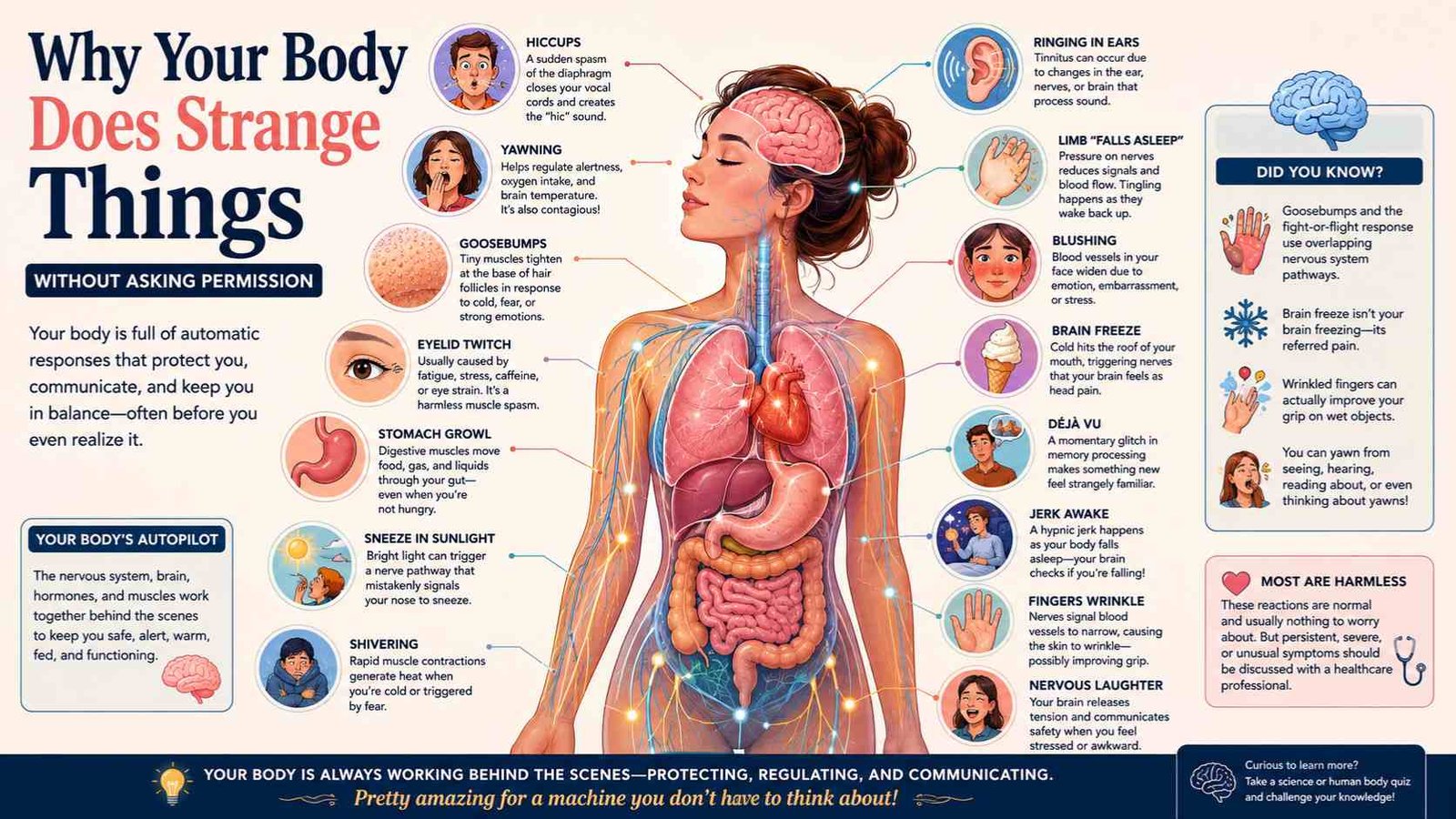
Why Your Body Does Strange Things Automatically
Your body has opinions—and it rarely waits to be invited into the conversation.
It interrupts quiet meetings with a rumbling stomach, launches hiccups halfway through a sentence, raises goosebumps during a favorite song, and occasionally jolts you awake just as you are drifting into sleep. It may even make you sneeze simply because you stepped into bright sunlight.
So, why does your body do strange things without asking permission? Most of these moments are automatic body responses controlled by the nervous system, muscles, hormones, blood vessels, and internal organs. Some protect you from danger. Others help regulate temperature, digestion, circulation, alertness, or sleep. A few may be leftovers from earlier stages of human evolution, while others remain fascinating everyday body mysteries that researchers are still investigating.
These strange body reactions are not usually signs that your body is malfunctioning. More often, they reveal just how much work is happening beneath conscious awareness.
Why Your Body Does Strange Things Automatically
Your brain does not consciously supervise every heartbeat, muscle contraction, or digestive movement. Much of this work is handled by the autonomic nervous system, brainstem, spinal cord, sensory nerves, and networks of reflex circuits.
A reflex is essentially a biological shortcut. Sensory information enters the nervous system, the signal is evaluated, and the body responds—sometimes before your conscious mind fully understands what has happened. That speed is useful when you touch something hot, inhale an irritant, lose your balance, or need to conserve heat.
Not every involuntary body function has one simple explanation. Different biological systems can sometimes produce similar sensations, and scientists are still examining the purpose of several familiar reactions. Nevertheless, occasional and short-lived responses are generally signs that your internal maintenance crew is doing its job.
Why We Hiccup
You eat lunch too quickly, swallow a fizzy drink, and suddenly every sentence comes with its own tiny sound effect.
A hiccup begins when the diaphragm—the broad muscle beneath the lungs—contracts involuntarily. The contraction pulls air inward, and the vocal cords quickly close, producing the familiar “hic” sound.
The hiccup reflex involves a network that includes the phrenic nerve, vagus nerve, spinal cord, and brainstem. Eating rapidly, swallowing air, drinking carbonated beverages, becoming excited, or experiencing a sudden temperature change may stimulate parts of this circuit.
Scientists have not established one essential purpose for hiccups in adults. Some theories connect the reflex to early development or ancient evolutionary mechanisms, but its exact biological role remains uncertain.
A hiccup is not merely trapped air. It is a coordinated nerve-and-muscle event involving the diaphragm and vocal cords. Learn more from the MedlinePlus guide to hiccups.
Hiccups that continue for an unusually long time, repeatedly return, or interfere with sleeping, eating, or breathing deserve medical attention.
Why Yawns Can Be Contagious
Someone yawns across the room. Seconds later, your mouth opens as though it has accepted a silent invitation.
Yawning is a coordinated activity involving the jaw, facial muscles, throat, diaphragm, and respiratory system. It frequently appears when people are tired, bored, waking up, or shifting from one level of alertness to another.
Scientists have proposed several explanations. Yawning may help the brain move between states of alertness, stretch facial and airway muscles, briefly increase arousal, or participate in temperature regulation. No single theory explains every yawn.
Contagious yawning may involve attention, social awareness, and brain networks that respond to the actions of others. Seeing, hearing, reading about, or even imagining a yawn can sometimes trigger one—which means this paragraph may be conducting a very small experiment on you.
Yawning is not simply the body demanding more oxygen. Research has not supported low oxygen as the main explanation.
Why We Get Goosebumps
A cold breeze crosses your arms—or a song reaches its most powerful moment—and your skin suddenly resembles that of a plucked bird.
Goosebumps form when microscopic muscles called arrector pili contract around individual hair follicles. Cold, fear, excitement, and intense emotion can activate these muscles through the sympathetic nervous system.
For furry mammals, raised hair traps insulating air and may make an animal look larger when threatened. Humans have far less body hair, so the reaction is less useful. The wiring remains, however—rather like an antique switch still connected to equipment we no longer possess.
Cold-induced goosebumps are connected to temperature regulation. Goosebumps caused by music or emotion show how closely physical sensations and emotional processing can be linked.
Goosebumps and the fight-or-flight response use parts of the same sympathetic nervous system.
Why an Eyelid Suddenly Twitches
You have slept too little, stared at a screen for too long, and now the corner of your eyelid is performing a private drum solo.
An occasional eyelid twitch, commonly called eyelid myokymia, consists of small involuntary contractions in the muscles around the eye. Frequent triggers include tiredness, stress, eye strain, caffeine, and irritation.
Tiny motor signals coordinate the muscles responsible for blinking. When the muscles or their nerve signals become temporarily overexcitable, a fluttering sensation may appear.
Most ordinary eyelid twitches disappear without treatment. Despite centuries of folklore, they do not reliably predict visitors, unexpected money, good luck, or bad news.
Seek professional advice when twitching continues, forcefully closes the eye, spreads across the face, causes pain, or appears with weakness or changes in vision.
Why the Stomach Growls at the Worst Possible Moment
The room becomes silent. Naturally, this is when your digestive system decides to imitate distant thunder.
Stomach and intestinal sounds are called borborygmi. They occur as muscles move food, gas, and liquid through the digestive tract. These wave-like muscular contractions are known as peristalsis.
Growling may be louder when the stomach is relatively empty. Between meals, the digestive tract performs a clean-up pattern known as the migrating motor complex, moving leftover material through the stomach and small intestine.
The sound does not always mean you are hungry. Digestion continues after eating, and moving gas or liquid can create noticeable noises at almost any time. Imagine squeezing a partly filled water balloon through a flexible tube: movement naturally produces sound.
Why Bright Sunlight Makes Some People Sneeze
You walk outdoors on a bright morning, glance toward the sky, and immediately sneeze.
This reaction is known as the photic sneeze reflex. It appears to involve overlapping activity between the optic nerve, which carries visual information, and pathways associated with the trigeminal nerve, which carries facial sensations and participates in sneezing.
In susceptible people, a sudden burst of bright light strongly activates visual pathways. That activity may spill into nearby nerve circuits, causing the brain to respond as though the nose has encountered an irritant.
The tendency often runs in families. It is generally harmless, although it can be inconvenient when moving abruptly from darkness into intense sunlight—especially while driving.
Sunlight does not need to enter the nose. The reflex begins with intense light entering the eyes.
Why We Shiver When Cold—or Frightened
Your jaw trembles, your shoulders shake, and your muscles begin contracting without waiting for instructions.
Cold-induced shivering generates heat. Temperature receptors send information to the hypothalamus, the brain region that helps regulate body temperature. When the body begins becoming too cold, the hypothalamus can trigger rapid muscular contractions.
Working muscles release heat. Instead of using their contractions to walk, lift, or perform another deliberate movement, the body uses the activity as a temporary heating system.
Fear may also produce trembling. Adrenaline and other stress-related chemicals prepare the muscles for rapid action. The sudden increase in muscle tension and nervous system activity can cause shaking even in a warm room.
Cold shivering is a temperature defense. Fear trembling belongs to the body’s emergency-preparation system. Both demonstrate how automatic body responses can recruit major muscle groups before conscious thought has finished making a plan.
Why the Ears Sometimes Ring in Silence
You are sitting in a quiet room when a thin, high-pitched tone suddenly appears, even though nothing around you is making it.
Tinnitus is the perception of ringing, buzzing, humming, roaring, clicking, or another sound without a matching external source. It can be associated with changes anywhere along the hearing pathway, including the inner ear, auditory nerve, and brain regions that process sound.
A brief tone may occasionally appear and disappear without an obvious explanation. Longer-lasting tinnitus may be related to loud-noise exposure, hearing changes, earwax, certain medicines, jaw problems, circulatory changes, or other conditions.
The sound is not always being physically produced inside the ear. In some cases, the brain may be responding to altered or missing auditory information—rather like a radio increasing its internal static as the broadcast signal weakens.
The National Institute on Deafness and Other Communication Disorders explains common tinnitus symptoms, causes, research, and treatment approaches.
Consult a healthcare professional about persistent or disruptive tinnitus, particularly when it appears with sudden hearing loss, severe dizziness, pain, or other neurological symptoms.
Why a Limb “Falls Asleep”
You stand after sitting with one leg tucked underneath you. The leg feels numb, followed by what seems like a parade of phantom ants.
A limb commonly “falls asleep” when prolonged pressure temporarily interferes with nerve signaling and, in some situations, local blood flow. Sensory nerves normally carry information about touch, pressure, pain, and temperature to the spinal cord and brain.
Compression disrupts those messages. When you change position, the pressure is released and the nerves begin communicating normally again. During recovery, irregular signaling may create prickling, buzzing, warmth, or a pins-and-needles sensation known as transient paresthesia.
The limb has not literally fallen asleep. Its communication cables have temporarily been squeezed.
Read the MedlinePlus overview of numbness and tingling for possible causes and signs that deserve medical evaluation.
Repeated, unexplained, long-lasting, or one-sided numbness—especially when accompanied by weakness, confusion, speech difficulty, or poor coordination—should not be dismissed as ordinary posture-related tingling.
Why We Blush Before We Can Stop It
Someone gives you an unexpected compliment. Every face turns in your direction, and your cheeks answer before you do.
Blushing occurs when small blood vessels in the cheeks, ears, neck, or upper chest widen, increasing blood flow near the skin’s surface. This response is influenced by the sympathetic nervous system and may involve adrenaline.
Embarrassment, social attention, anxiety, praise, and emotional vulnerability can all trigger the reaction. Because facial blood vessels lie close to the skin, changes in blood flow can quickly become visible.
Some researchers suggest that blushing may also carry social information. It can communicate embarrassment, sincerity, vulnerability, or recognition that a social boundary has been crossed—without the person saying a word.
Trying desperately not to blush can make the experience stronger. Once you notice the warmth, anxiety may increase, giving the autonomic nervous system even more excitement to manage.
Why Ice Cream Causes Brain Freeze
You take an ambitious bite of ice cream. Seconds later, a sharp pain appears behind your forehead as though dessert has launched a tiny snowball into your skull.
Brain freeze occurs when something very cold rapidly chills the roof of the mouth or the back of the throat. The sudden temperature change stimulates temperature-sensitive nerves and affects nearby blood vessels.
The trigeminal nerve carries sensation from much of the face and mouth. The brain may interpret the cold-related signal as pain coming from the forehead rather than the mouth. This mistaken location is an example of referred pain.
Your brain itself is not freezing. It remains protected inside the skull at a carefully controlled temperature.
Eating more slowly, taking smaller bites, or pressing the tongue against the roof of the mouth may warm the area and help the discomfort fade.
Why Déjà Vu Feels Like a Memory Without a Source
You enter a place you have never visited, yet the arrangement feels strangely familiar. For a moment, your brain insists: “We have been here before.”
Déjà vu, meaning “already seen,” is often described as a conflict between two mental signals: one says that the current experience feels familiar, while another indicates that it is new.
Brain regions involved in memory and familiarity—including structures in and around the temporal lobe—help distinguish the feeling of knowing something from the ability to retrieve an actual memory. A brief mismatch may produce familiarity without a matching event to recall.
It is less like remembering a previous experience and more like discovering that the brain has attached a “familiar” label without attaching the correct file.
Occasional déjà vu can happen in healthy people and may become more noticeable during stress or tiredness. Researchers continue to debate its exact mechanism, and more than one process may produce the sensation.
Very frequent episodes associated with confusion, lost awareness, unusual smells, repetitive movements, or other neurological symptoms should be discussed with a doctor because déjà vu can sometimes occur with certain seizure disorders.
Why We Jolt Awake While Falling Asleep
You are nearly asleep when you suddenly feel as though you have stepped off a curb. Your body jerks, your heart jumps, and sleep has to begin all over again.
This sudden movement is called a hypnic jerk or sleep start. It is a form of myoclonus—an abrupt, involuntary muscular contraction.
As you fall asleep, muscle tone and nervous system activity change. One theory suggests that the brain occasionally interprets rapidly relaxing muscles as evidence that the body is falling, triggering a corrective movement. It is rather like a security alarm mistaking a moving curtain for an intruder.
Stress, exhaustion, caffeine, and irregular sleeping habits may make hypnic jerks more noticeable. They are common and usually harmless.
A normal sleep start is not automatically a seizure. Medical evaluation becomes more important when jerks are frequent, violent, injurious, occur while fully awake, or appear with other concerning symptoms.
Why Fingers Wrinkle in Water
You leave a long bath or swim and discover that your fingertips now resemble tiny dried fruits.
People once assumed that fingertips wrinkled simply because the skin absorbed water and expanded. Water does affect the skin’s outer layer, but the full response is more active than that explanation suggests.
After prolonged exposure to water, the sympathetic nervous system causes blood vessels beneath the skin of the fingertips to narrow. As tissue volume decreases, the overlying surface forms ridges.
One intriguing theory proposes that the ridges improve grip on wet objects, in much the same way that tire grooves help move water away from a contact surface. Experiments have found benefits in certain damp conditions, although scientists continue to debate how universal or important that advantage is.
Water-induced wrinkling depends partly on functioning nerves. Researchers have therefore studied fingertip wrinkling as a possible indicator of autonomic nerve activity.
Why We Sometimes Laugh When Nothing Is Funny
You are giving a presentation, forget the next line, and laugh—even though nothing about the situation feels amusing.
Nervous laughter can appear when the brain is managing anxiety, embarrassment, tension, fear, or social discomfort. Several brain systems may participate, including networks involved in emotion, movement, breathing, social behavior, and vocal expression.
Laughter changes breathing, facial muscle activity, and physical tension. In an awkward moment, it may help release pressure or communicate friendliness. It can silently suggest, “I understand that this situation is uncomfortable, and I am not a threat.”
This response does not necessarily mean that someone is disrespectful or entertained by another person’s difficulty. Emotional expressions do not always match the feeling that seems most obvious to an observer. People may laugh when frightened, cry when relieved, or smile when embarrassed.
Sometimes the body handles excess emotion like an overcrowded building: it opens whichever exit is available.
Five Fast Facts About Your Inner Autopilot
Myth or Fact?
Myth: Hiccups occur because air becomes stuck in the throat.
Fact: Hiccups begin with an involuntary diaphragm contraction followed by the rapid closing of the vocal cords.
Myth: Fingers wrinkle because they absorb water like sponges.
Fact: Water exposure triggers a nerve-controlled response that narrows blood vessels beneath the fingertip skin.
Myth: A limb that has fallen asleep has completely lost its blood supply.
Fact: Ordinary posture-related numbness is frequently caused by temporary nerve compression. A complete loss of blood supply would be a far more serious situation.
Myth: Brain freeze means the brain has become dangerously cold.
Fact: The reaction begins when cold stimulates nerves and blood vessels around the roof of the mouth and throat.
How Well Do You Know Your Own Autopilot?
These everyday body mysteries show that familiar experiences can hide complicated biology. Continue exploring surprising facts and test what you have learned with an educational quiz.
What Strange Body Reaction Surprises You Most?
Perhaps you assumed that brain freeze meant the brain itself was becoming cold. Maybe you had never connected fingertip wrinkles with the nervous system or considered nervous laughter a form of social communication.
These unusual body sensations remind us that ordinary experiences can conceal complex biology. The next time you hiccup, blush, shiver, yawn, or wake with a sudden jolt, pause for a moment. Somewhere beneath your awareness, nerves are transmitting signals, muscles are contracting, blood vessels are changing shape, and brain networks are comparing current information with stored experience.
Your body may occasionally behave like an uninvited guest, but most of its interruptions are evidence of a system working continuously to protect, regulate, and adapt.
When a Strange Reaction Needs Attention
Most of the involuntary body functions described here are brief, common, and harmless. However, similar symptoms may sometimes have other causes.
Consult a qualified healthcare professional when a reaction is persistent, severe, painful, worsening, unusually frequent, or disruptive to daily life. Prompt medical attention may be necessary when symptoms appear with weakness, confusion, fainting, loss of awareness, difficulty breathing, sudden hearing or vision changes, severe dizziness, or difficulty moving or speaking.
This article is provided for general educational purposes and is not a substitute for professional medical advice, diagnosis, or treatment.
Why Your Body Never Really Clocks Out
Understanding why your body does strange things turns seemingly random annoyances into clues about an extraordinary regulatory system.
A shiver produces warmth. A sneeze attempts to clear an irritant. A blush broadcasts emotion. A tingling limb reveals interrupted nerve communication. Even reactions without a firmly established purpose, such as hiccups, demonstrate how easily nerves, muscles, and brain circuits can launch a coordinated response without conscious permission.
Your body does not wait to be told what to do. Every second, it is protecting, regulating, repairing, adapting, and communicating—usually with remarkable subtlety and occasionally by making your stomach growl during the quietest part of a meeting.
The weird things the human body does are not merely biological oddities. They are glimpses of a tireless system working behind the scenes to keep you functioning.
Author: James Green
James Green is a content writer and quiz maker who enjoys researching interesting subjects and presenting them in a straightforward and amusing way. He is also a website designer who appreciates clear information, engaging learning experiences, and thoughtful digital design.