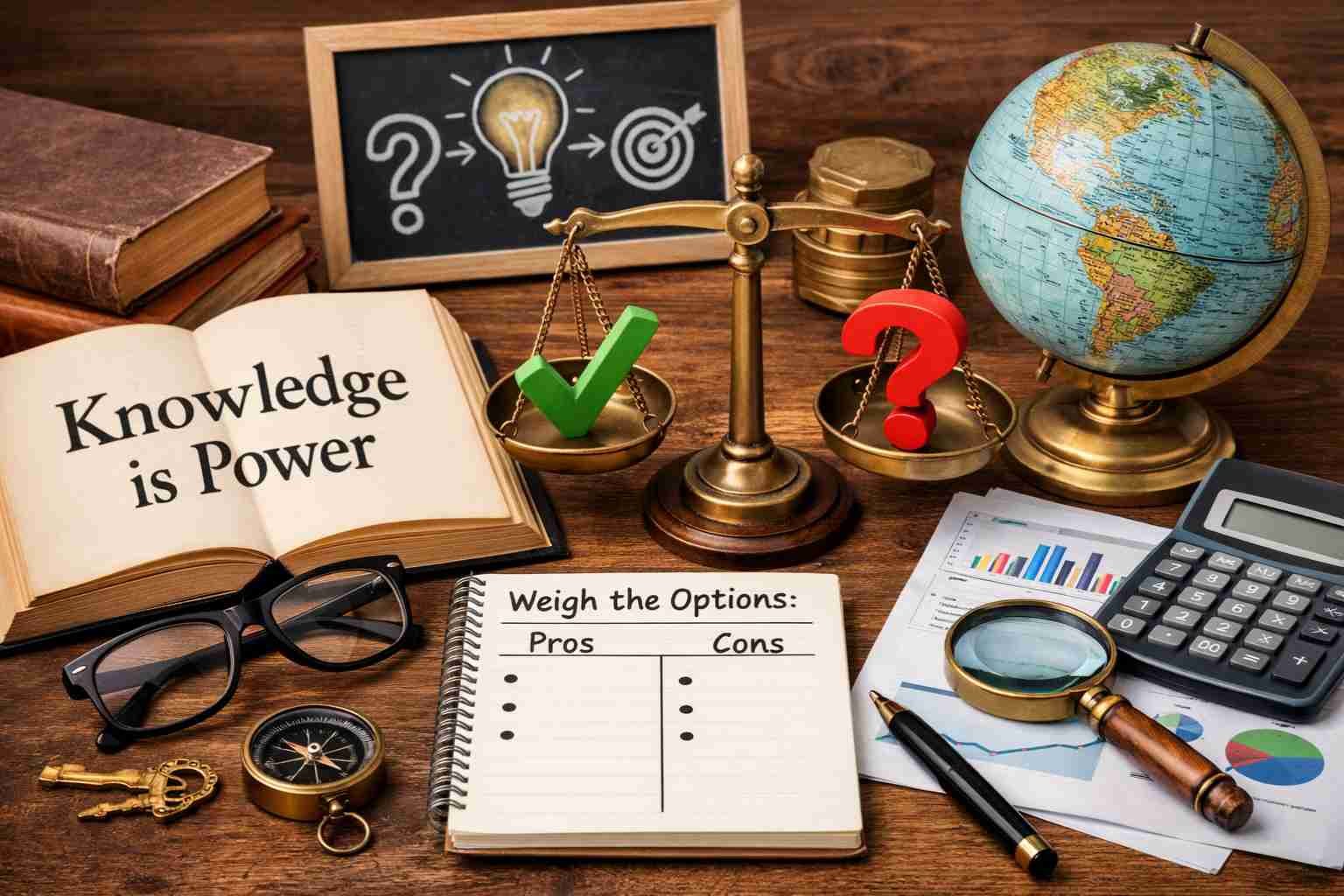
How Knowledge Helps You Make Better Decisions
Every ordinary day is built from choices. You decide what deserves your attention, which information to trust, how to spend limited resources, and whether a promising opportunity is worth the risk. Some decisions barely affect the next hour; others can reshape a career, a relationship, a business, or a financial future.
Knowledge does not make anyone infallible. What it can do is replace part of the guesswork with context. It gives you a clearer view of the options, the trade-offs, the warning signs, and the consequences that may not be obvious at first glance. Better decisions begin not with knowing everything, but with understanding enough to ask better questions.
Knowledge Is More Than a Collection of Facts
A head full of information is not automatically a well-prepared mind. Useful knowledge includes facts, but it also includes concepts, relationships, patterns, practical skills, and an awareness of when a familiar rule may not fit a new situation.
Learning researchers describe knowledge as something people organize and use, not simply store. As understanding grows, new information can be connected to an existing framework, making it easier to interpret unfamiliar problems and retrieve relevant ideas when they are needed.1 This is one reason an experienced nurse, mechanic, teacher, accountant, or manager may notice meaningful details that a beginner overlooks.
There is an important caution, though: prior knowledge can also create blind spots. A person may force a new problem into an old pattern, ignore contradictory evidence, or become too confident in a familiar explanation.2 The most reliable form of knowledge is therefore both well developed and open to correction.
Relevant
It addresses the actual decision rather than filling your mind with interesting but unrelated details.
Reliable
It comes from evidence, credible expertise, direct observation, or sources that can be checked.
Usable
It helps you compare options, predict consequences, or identify the next sensible action.
Understanding Reduces Unnecessary Uncertainty
Decisions become difficult when too many parts of a situation are unknown. You may not understand the terms of a contract, the true cost of a loan, the reliability of a product, or the likelihood that a plan will succeed. In that information gap, people often lean more heavily on habit, social pressure, persuasive marketing, or whatever feeling is strongest in the moment.
Research on decision-making distinguishes between risk, where possible outcomes and their probabilities are at least partly known, and ambiguity, where the probabilities themselves are unclear. Ambiguity can feel especially uncomfortable and can influence how people evaluate choices.3 Gathering good information does not eliminate uncertainty, but it can convert a vague fear into specific questions that can be examined.
A knowledgeable decision is not a risk-free decision. It is a choice made with a more accurate picture of what is known, what is uncertain, and what could happen next.
Consider a home appliance advertised at a surprisingly low price. The sticker price alone may look attractive. A better-informed buyer also checks energy use, repair history, warranty terms, expected lifespan, delivery fees, and the seller’s return policy. Knowledge expands the decision from “Is this cheap?” to “What will this choice really cost and deliver over time?”
Knowledge Helps You Compare Trade-Offs
Most meaningful choices do not have one option that is perfect in every way. A new job may offer higher pay but a longer commute. A safer investment may offer lower potential returns. A faster solution may be more expensive. A healthy routine may require convenience to be sacrificed today for benefits that arrive later.
Knowledge makes these trade-offs visible. It helps you identify which criteria matter, estimate their importance, and recognize costs that are easy to hide. This is especially useful when decisions involve money. The OECD defines financial literacy as a combination of knowledge, skills, attitudes, and behaviors that supports informed financial choices, rather than knowledge alone.4
| Decision | Surface Question | Knowledge-Based Questions |
|---|---|---|
| Borrowing money | Can I afford the monthly payment? | What is the effective interest rate, total repayment, fee structure, penalty, and effect on cash flow? |
| Changing jobs | Is the salary higher? | How do benefits, stability, commute, workload, growth, culture, and long-term prospects compare? |
| Sharing a claim | Does this sound believable? | Who produced it, what evidence supports it, is the context complete, and can independent sources confirm it? |
| Choosing a health product | Do the testimonials sound convincing? | What do qualified medical sources say, what evidence exists, what are the risks, and does it conflict with current care? |
Emotion and Reasoning Work Together
It is tempting to divide decisions into two camps: rational choices and emotional choices. Human judgment is more complicated. Emotions can distort attention, encourage impulsive action, or make a possible loss feel larger than it is. Yet emotions also communicate value. Concern can draw attention to danger, empathy can highlight the human cost of a choice, and enthusiasm can provide the energy to act.
Modern research treats emotion as an integral part of decision-making, particularly when people face uncertainty, risk, and competing goals.5 The goal is not to become emotionless. It is to prevent a temporary emotional state from becoming the only evidence considered.
Knowledge creates a useful pause. When a headline triggers outrage, a sales pitch creates urgency, or fear makes an option seem impossible, factual understanding gives the mind something stable to test those reactions against. You can ask: What exactly do I know? What am I assuming? What evidence would change my mind?
- You feel pressured to decide immediately.
- The offer depends on fear, hype, or secrecy.
- You cannot explain the main risk in plain language.
- Only one source supports the claim.
- The potential loss would be difficult to reverse.
- You are unusually angry, excited, tired, or anxious.
Experience Turns Information Into Pattern Recognition
Formal learning and practical experience contribute different strengths. Reading can introduce principles, vocabulary, evidence, and examples beyond your own life. Experience reveals how those ideas behave under real constraints: deadlines, incomplete information, human behavior, limited budgets, and unexpected consequences.
With repeated practice, people often become faster at recognizing patterns in familiar domains. They do not necessarily examine fewer details; they become better at identifying which details deserve attention. This is part of what distinguishes expertise from simple familiarity.1
Experience, however, is not automatically wisdom. A person can repeat the same mistake for years. Experience becomes educational when it is paired with reflection: What happened? Which assumption was wrong? Which signal did I overlook? What should I repeat or change next time?
Knowledge Makes Manipulation Harder
Modern information environments reward speed, novelty, outrage, and certainty. Advertisements simplify complicated trade-offs. Social posts strip claims from their context. Confident speakers may appear credible even when their evidence is weak. Artificially urgent messages can push people to click, buy, invest, or share before they think.
Media-literacy guidance emphasizes checking sources, evidence, intent, and corroboration rather than judging a claim only by how professional or emotionally compelling it appears.6 Knowledge provides a reference point: it helps you notice when a statistic lacks context, when an argument confuses correlation with cause, or when a promise conflicts with established facts.
Being informed does not require distrusting everything. Healthy skepticism is selective. It asks for stronger proof when the claim is consequential, extraordinary, irreversible, or designed to provoke an immediate reaction.
A Practical Framework for Better Decisions
You do not need a complicated formula for every choice. A simple repeatable process can improve the quality of decisions that carry meaningful cost or risk.
- Define the real decision. State the choice in one clear sentence. Separate the central question from the surrounding noise.
- Identify the objective. Decide what a good outcome must accomplish. Without a goal, comparing options becomes arbitrary.
- Gather decision-relevant facts. Focus on information that could realistically change the choice, not every fact that can be found.
- Check source quality. Prefer primary evidence, qualified expertise, transparent methods, and independent confirmation.
- List assumptions and uncertainties. Mark what is known, estimated, believed, or still missing. This helps prevent confidence from outrunning evidence.
- Compare benefits, costs, and reversibility. A reversible experiment can justify faster action; an irreversible commitment deserves more care.
- Consider the second-order effects. Ask what the choice may trigger next week, next year, or for other people affected by it.
- Review the result. After acting, compare the outcome with your expectations. This turns one decision into knowledge for the next.
This process reflects metacognition and self-regulation: monitoring how you understand a problem, noticing gaps, and adjusting your approach instead of moving automatically.7
How to Build Decision-Ready Knowledge
You do not need expertise in every subject. You need dependable habits for learning what matters before a decision becomes urgent.
Read beyond a single source
One article can provide an introduction, but comparison reveals disagreement, missing context, and differences in evidence. For important matters, include primary documents, official guidance, or qualified professional sources whenever possible.
Learn the basic language of important domains
A small working vocabulary can dramatically improve your questions. Understanding terms such as compound interest, opportunity cost, probability, conflict of interest, side effect, warranty exclusion, or data privacy makes it harder for important details to remain hidden behind jargon.
Seek people with relevant experience
A mentor or professional can help you notice practical issues that general reading may miss. Choose advisers whose expertise matches the decision, and pay attention to incentives that could influence their recommendations.
Keep a decision journal
For major choices, record what you expected, which evidence mattered, what remained uncertain, and why you chose one option. Reviewing those notes later helps distinguish good reasoning from a lucky result—and poor reasoning from an unlucky one.
Practice intellectual humility
The sentence “I may be wrong” is not weakness. It is a quality-control tool. It keeps the door open for better evidence and reduces the risk that identity, pride, or sunk costs will trap you in a failing choice.
Knowledge is most valuable when it does more than make you certain—it helps you become more accurate, more careful, and more willing to revise.
The Real Advantage of Knowing More
Knowledge cannot promise a perfect outcome. Chance, incomplete data, changing conditions, and other people’s actions will always matter. Two well-informed people can examine the same evidence and reasonably choose different paths because their priorities, resources, and tolerance for risk are different.
The advantage is not certainty. It is preparedness. Knowledge helps you recognize the structure of a problem, compare alternatives, resist manipulation, regulate impulsive reactions, and explain the reasoning behind your choice. It gives you a stronger basis for acting—and a better basis for learning when the result is not what you expected.
In that sense, knowledge is not merely power. It is a navigational tool: a way to move through uncertainty with clearer eyes, better questions, and fewer avoidable mistakes.
Learning also becomes stronger when you retrieve and apply what you know. Test your recall, explore unfamiliar subjects, and discover new questions through the daily Bing knowledge quiz.
Challenge Your KnowledgeResearch and further reading
- National Academies of Sciences, Engineering, and Medicine, “Knowledge and Reasoning,” How People Learn II.
- National Academies of Sciences, Engineering, and Medicine, How People Learn II, discussion of prior knowledge and bias.
- FeldmanHall and Shenhav, “Emotion and Decision-Making Under Uncertainty”, Current Opinion in Behavioral Sciences.
- Organisation for Economic Co-operation and Development, Financial Education.
- Crivelli and Balconi, “Emotional and Cognitive Route in the Decision-Making Process”.
- American Psychological Association, “How to Teach Students Critical Thinking Skills to Combat Misinformation Online”.
- National Academies of Sciences, Engineering, and Medicine, “Processes That Support Learning,” How People Learn II.